A European trip may begin as a line on a map: Algiers to Rome, Oran to Madrid, Constantine to Paris. A successful visa application begins with a carefully assembled file in which every date, destination and dinar tells the same story.
That principle matters when applying for a Schengen visa from Algeria. The application form may be standardised, but the route to the consulate is not. France uses Capago, Spain uses BLS International, several countries use VFS Global, Belgium and Portugal use TLScontact, and a number of smaller Schengen states are represented by another embassy. Choosing the wrong channel can waste an appointment before the document review even starts.
This guide explains the Schengen visa types from Algeria, the current application requirements, fees, timing, biometrics and submission process. It also maps all 29 Schengen destinations to the practical application route used in Algeria. The result is a country-specific plan, not a generic checklist copied from another market.
Quick answer: Algerian citizens holding ordinary passports need a visa for short visits to the Schengen Area. A short-stay Type C visa generally permits up to 90 days in any rolling 180-day period. Apply through the country that is genuinely responsible for the trip, normally no earlier than six months and no later than 15 days before departure. The standard adult fee is €90, excluding any authorised service-centre charge.
Schengen Visa from Algeria at a Glance
| Question | Current general rule |
| Do Algerian ordinary-passport holders need a visa? | Yes, for short visits to the Schengen Area |
| How many Schengen countries are there? | 29 |
| Maximum Type C stay | 90 days in any rolling 180-day period |
| Earliest application date | Six months before the intended journey |
| Latest legal filing point | At least 15 days before travel; earlier is strongly advised |
| Standard processing time | 15 calendar days after an admissible application reaches the competent authority |
| Possible extended processing | Up to 45 calendar days where further examination is required |
| Standard visa fee | €90 for adults; €45 for children aged 6 to under 12; children under 6 are generally exempt |
| Travel insurance | At least €30,000 coverage, valid throughout the Schengen Area for the full trip |
| Passport validity | Issued within the previous 10 years and normally valid for at least three months after leaving Schengen |
| Where to apply | The competent destination country, through its embassy, consulate or authorised centre in Algeria |
The European Commission’s current application guide confirms the six-month filing window, the 15-day minimum, core documents, fees and the normal 15-day processing period. Individual consulates may require extra documents or a longer practical lead time.
Do Algerian Citizens Need a Schengen Visa?
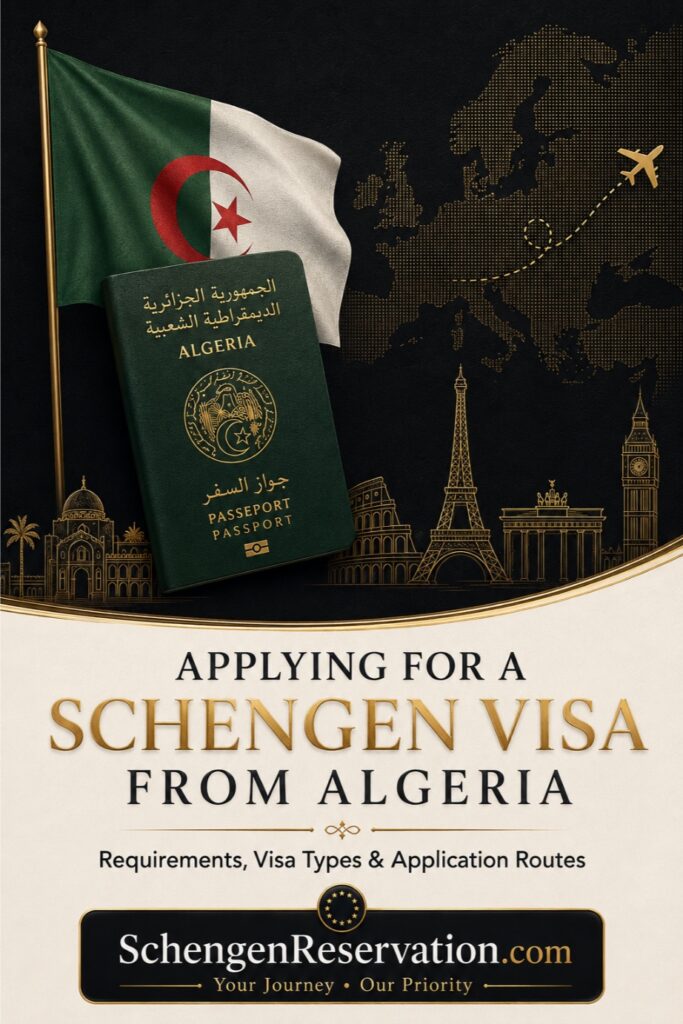
Yes. Holders of ordinary Algerian passports are visa-required for short stays in the Schengen Area. The common short-stay rules now cover 29 countries: Austria, Belgium, Bulgaria, Croatia, Czechia, Denmark, Estonia, Finland, France, Germany, Greece, Hungary, Iceland, Italy, Latvia, Liechtenstein, Lithuania, Luxembourg, Malta, the Netherlands, Norway, Poland, Portugal, Romania, Slovakia, Slovenia, Spain, Sweden and Switzerland.
Bulgaria and Romania became full Schengen members on 1 January 2025. Cyprus and Ireland are not part of the border-free Schengen Area, so their national entry rules should not be confused with the Schengen visa process. The European Commission’s Schengen overview maintains the current membership list.
A Type C visa is usually valid across the Schengen Area, but it is not a promise of entry. Border officers may still ask for the purpose of the visit, accommodation, return or onward journey, insurance and sufficient funds. Keep an accessible copy of the same evidence used in the application.
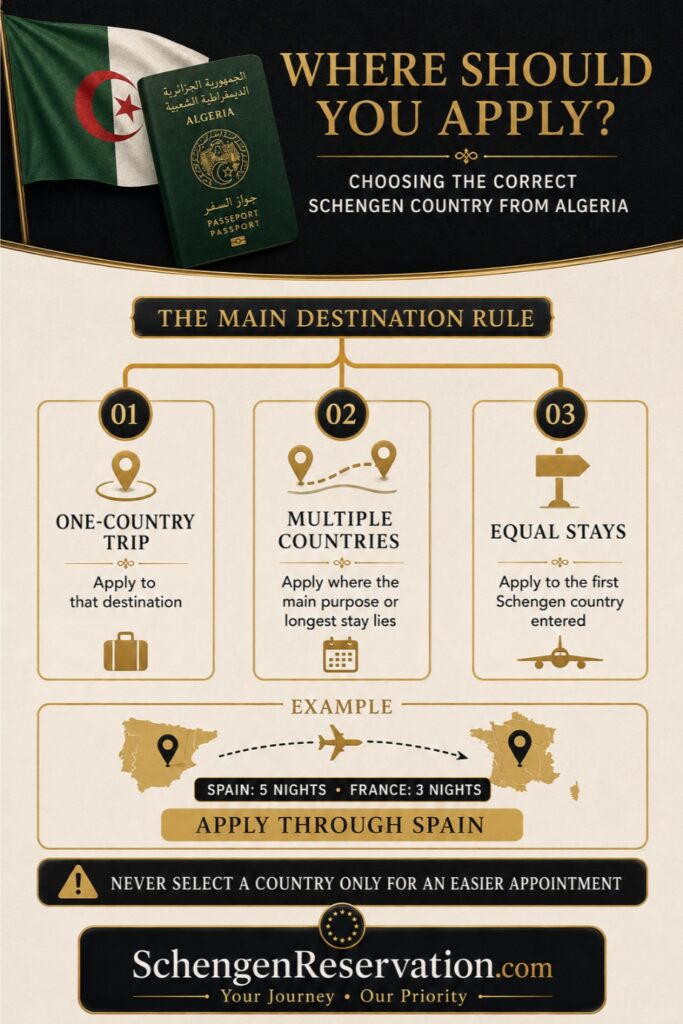
How to Choose the Correct Schengen Country
The easiest appointment is not necessarily the correct appointment. Jurisdiction follows the real trip.
Use this decision order:
- One-country trip: apply to that country.
- Several countries with one clear main destination: apply to the country that is central to the journey because of its purpose or the longest stay.
- Several countries with equal stays and no distinct main purpose: apply to the country where the traveller first enters Schengen.
- Residence rule: apply from Algeria only if Algeria is the applicant’s place of legal residence, unless the competent consulate accepts a justified exception.
For example, an itinerary with four nights in Spain, four in France and four in Italy normally belongs to the first Schengen country entered. A route with two business days in Germany followed by a longer holiday elsewhere may still make Germany the main destination when the business purpose is the defining reason for travel. If the case is not obvious, ask the competent mission before booking.
The EU’s “where to apply” guidance uses the longest-stay country and, for equal stays, the first country visited. Do not alter hotel nights merely to obtain a faster slot. The reservations, transport, cover letter and form should reflect the journey the applicant genuinely intends to take.
Schengen Visa Types from Algeria
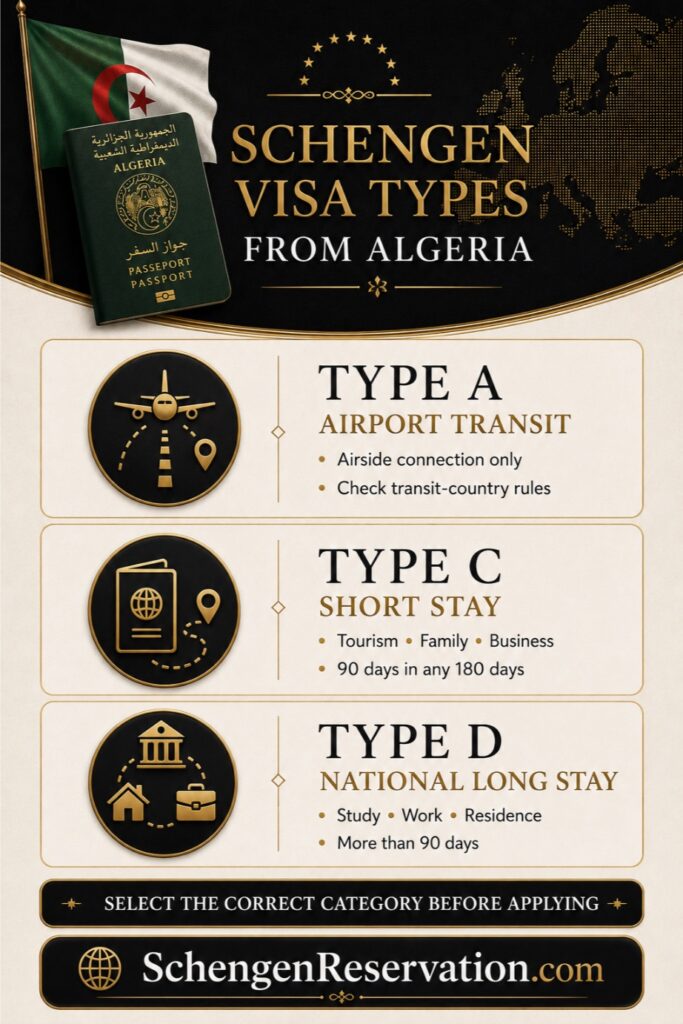
Selecting the correct visa category determines the form, checklist, fee and submission route. The three principal categories are Type A, Type C and Type D.
Type A – Airport Transit Visa
A Type A visa permits a traveller to remain in the international transit zone of a designated airport while connecting to a destination outside Schengen. It does not allow the holder to pass border control, collect baggage landside, change to an airport without an airside connection or visit the country during the stopover.
Algerian nationals are not subject to a blanket Type A requirement at every Schengen airport. Individual states can impose national airport-transit requirements. Czechia, for example, currently lists Algerian citizens among those who may need an airport transit visa, subject to exemptions. The European Commission’s current airport-transit table and the transit country’s own rules must be checked for the exact travel date.
Even when a Type A visa is not required, a Type C visa may be necessary if the connection requires entering Schengen – for example, to recheck baggage, change airports or continue on a domestic Schengen flight.
Type C – Short-Stay Schengen Visa
Type C is the category used for most trips from Algeria. It covers visits of no more than 90 days in any rolling 180-day period for purposes such as:
- tourism and holidays;
- visiting family or friends;
- business meetings, trade fairs and conferences;
- short training or educational activities;
- cultural, scientific or sporting events;
- medical treatment;
- official visits; and
- airport or land transit that involves entering the Schengen Area.
A Type C visa may permit one entry, two entries or multiple entries. A multi-entry sticker with a long validity period does not create an unlimited stay: the holder must still respect the 90-days-in-180 rule and the “duration of stay” printed on the visa.
Type D – National Long-Stay Visa
Type D is for an intended stay exceeding 90 days in one country, commonly for university study, employment, family reunification, research or long-term residence. It is issued under the national law of the destination state, so its form, fees, authorisations and appointment system can differ substantially from the Type C process.
A national visa or residence permit may allow limited short visits to other Schengen countries under the applicable rules, but permission to live, study or work belongs to the issuing country. A French student visa, for example, is not permission to take up employment or residence in another Schengen state.
This article focuses mainly on Type C applications. Anyone planning a stay over 90 days should use the destination country’s official long-stay portal instead of adapting a tourism checklist.
Schengen Visa Requirements from Algeria
The European Commission adopted a harmonised list of supporting documents for applications lodged in Algeria. That common framework is the foundation, but the live checklist issued by the competent consulate or authorised centre remains decisive. Requirements can change with the destination, purpose and applicant profile.
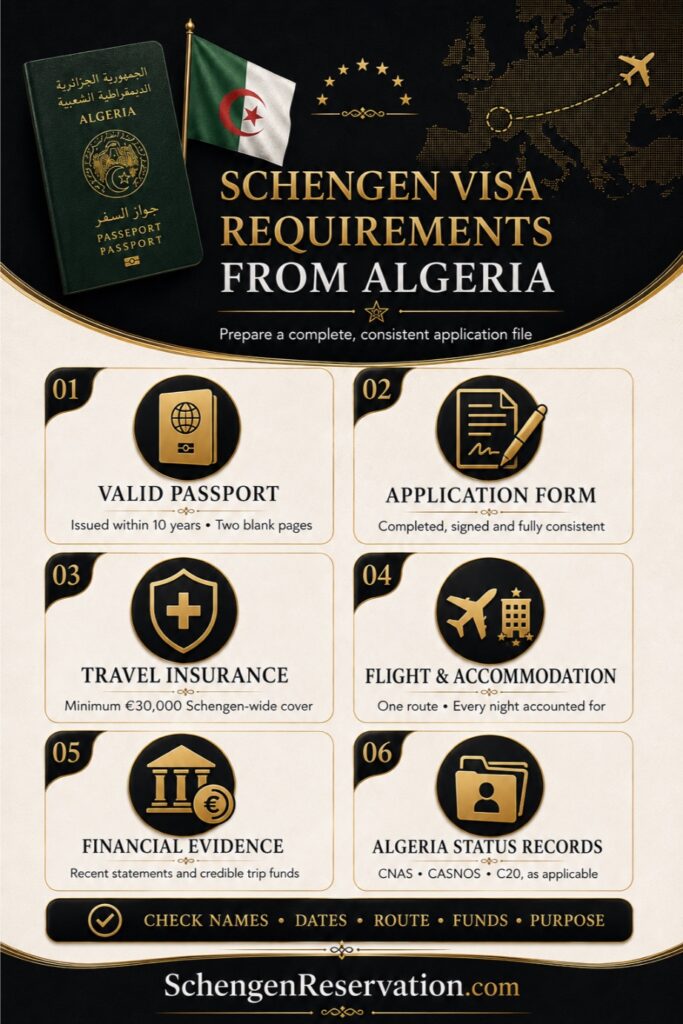
- Completed Visa Application Form
Complete the official short-stay form through the destination’s prescribed portal or application system. Names, passport number, dates, host details, destination and number of entries must match the evidence in the file. Sign every required field. For minors, the signatures required from parents or legal guardians depend on the mission’s instructions.
- Passport and Identity Evidence
The passport should:
- have been issued within the previous 10 years;
- remain valid for at least three months after the intended departure from Schengen;
- contain at least two blank visa pages; and
- be undamaged and signed where applicable.
Include copies of the identity page, previous Schengen visas and any pages requested by the checklist. Non-Algerian applicants should also provide proof of lawful residence in Algeria valid for the period required by the consulate.
- Recent Biometric Photographs
Provide the number of photographs specified by the destination checklist, usually in 35 × 45 mm format and compliant with current ICAO standards. The image should be recent, clear, front-facing and taken against the required plain background. Do not assume every mission asks for the same number of printed photographs.
- Travel Medical Insurance
Insurance must normally cover at least €30,000 and be valid throughout all Schengen states for the complete travel period. The certificate should expressly include emergency medical treatment, hospitalisation and repatriation, including repatriation in the event of death.
Check names and dates carefully. A policy beginning after the flight departs or ending before the final exit creates an avoidable gap.
- Flight Itinerary or Transport Evidence
Provide the round-trip or onward itinerary requested by the consulate. It should show a logical arrival point, departure point and internal route where more than one country is visited. If travel includes ferries, trains, domestic flights or car journeys, add evidence that explains those segments.
A reservation is not the same as a fully paid, non-refundable ticket. Unless the competent authority expressly demands ticket purchase, avoid exposing the trip budget before a decision. A structured flight reservation for a visa application can document the proposed route while the application is under review.
- Proof of Accommodation
Account for every night from arrival through departure. Acceptable evidence may include:
- hotel reservations;
- a lease or proof of owned accommodation;
- a formal host certificate or invitation in the destination country’s required format; or
- a combination of hotels and host accommodation that follows the itinerary.
Names, city sequence and dates must agree with the form and transport plan. A multi-city applicant can use a properly aligned hotel booking document rather than presenting unexplained gaps.
- Proof of Financial Means
Consulates need evidence that the applicant can pay for transport, accommodation and daily expenses without unauthorised work. The exact daily amount varies by destination. Common evidence includes:
- personal bank statements, often for the latest three months or the period stated on the checklist;
- payslips, pension records or business income evidence;
- proof of prepaid major expenses;
- a sponsor’s undertaking and financial records; or
- a combination of personal and sponsor funds.
Avoid unexplained last-minute deposits. If a legitimate exceptional credit appears for example, a property sale, bonus or family transfer, document its source. The bank balance should be credible in relation to the applicant’s regular income and proposed trip cost.
- Proof of Work, Study or Economic Activity in Algeria
This is where an Algeria-specific file differs most from a generic checklist. The document set commonly uses local employment, social-security, tax and commercial records. The official Polish consular checklist for applications in Algeria illustrates the categories found in the harmonised local framework.
| Applicant profile | Evidence commonly requested in Algeria |
| Salaried employee | Recent employment certificate or contract, last three payslips, authorised leave, CNAS affiliation and bank statements |
| Civil servant | Function or appointment certificate, leave or mission authorisation, payslips, bank statements and applicable social-security evidence |
| Trader or company owner | Commercial register, C20 tax certificate, CASNOS affiliation, tax records and business/personal bank evidence |
| Independent professional | Professional authorisation or order registration, CASNOS evidence, income/tax records and bank statements |
| Farmer | Farmer card or proof of agricultural activity/property, income evidence and CASNOS documentation where applicable |
| Retired applicant | Pension certificate and recent bank or postal-account statements |
| Student | Current enrolment certificate, academic evidence where requested, and the parent’s or sponsor’s financial and professional documents |
| Unemployed applicant | Evidence of family and economic circumstances, sponsor documents where relevant, and any legitimate income, pension or property evidence |
| Minor | School certificate, birth record, parental documents, funding evidence and travel consent as required |
The table is a preparation aid, not a substitute for the selected mission’s checklist. CNAS, CASNOS or C20 is not automatically relevant to every applicant; the correct record follows the applicant’s genuine status.
- Civil-Status and Family Documents
Depending on the case, the mission may request a birth certificate, family record, marriage certificate, proof of relationship to a host, or documents concerning a spouse or children. Submit recent originals or legalised/certified copies when the checklist requires them. Follow the destination’s translation rules; Arabic documents may need an authorised French, English or destination-language translation.
- Evidence of the Purpose of Travel
The purpose controls the supporting layer of the file.
| Purpose | Typical additional evidence |
| Tourism | Day-by-day or city-by-city itinerary, accommodation and transport plan |
| Family or friend visit | Host invitation in the prescribed format, host ID/residence evidence, address and proof of relationship where relevant |
| Business | Company invitation, meeting or fair details, commercial relationship evidence and employer mission letter |
| Conference, culture or sport | Registration, invitation, programme, organiser details and evidence of who pays |
| Short study or training | Admission or course confirmation, dates, programme, funding and accommodation |
| Medical treatment | Algerian medical report, confirmation from the receiving institution, estimated cost and proof of payment or funding |
| Official mission | Note verbale or mission order, institutional invitation and funding arrangements |
- Documents for Minors
A minor’s file may require:
- full birth certificate;
- signed application form as instructed;
- copies of both parents’ passports or identity documents;
- notarised authorisation from the non-travelling parent or both parents;
- custody or death documents where relevant;
- school certificate; and
- proof of who finances the trip.
Rules differ when one parent has sole custody or the child travels with a school group. Resolve parental-consent evidence before the appointment.
- Cover Letter
A cover letter is not universally mandatory, but it can make a complex file easier to understand. Keep it factual. State the purpose, dates, destinations, funding, companions and reason for returning to Algeria. Explain genuine irregularities such as a new job, a sponsored trip or an unusual transaction instead of hoping the reviewer will infer the answer.
The File Consistency Audit: A New Five-Line Test
Before submission, place these five lines side by side:
- Identity: the same spelling and passport details appear everywhere.
- Calendar: form, insurance, flights, hotels, invitation and leave approval use compatible dates.
- Geography: transport and accommodation produce a possible route with no missing nights.
- Money: declared trip costs make sense beside income, account activity and sponsorship.
- Purpose: the invitation, daily plan, professional evidence and selected visa category describe one genuine reason for travel.
Most weak files are not missing a dramatic document; they contain small contradictions. A hotel beginning one day late, a leave letter ending before the return flight or a sponsor who is never mentioned on the form can undermine an otherwise credible application.
Step-by-Step Process to Apply for a Schengen Visa from Algeria
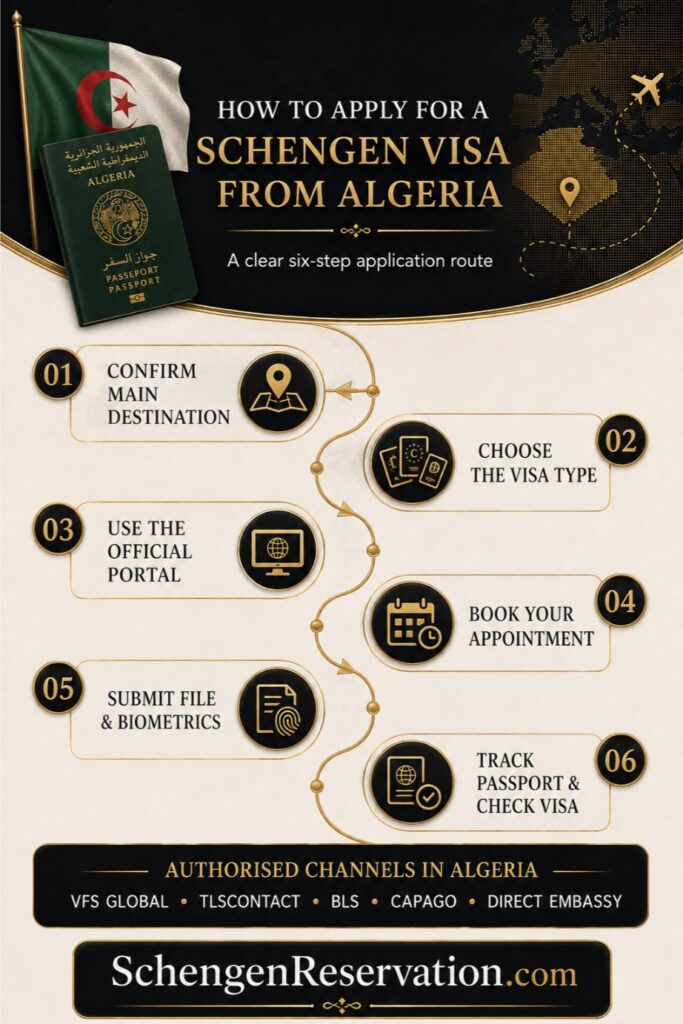
Step 1 – Draw the Trip Before Building the File
List each travel date, city, country and overnight stay. Mark the main purpose and first Schengen entry. This simple calendar identifies the competent state and prevents accommodation gaps.
Step 2 – Open the Official Destination Portal
Use the embassy, foreign ministry or authorised provider page linked later in this guide. Avoid unofficial appointment sellers. An external service centre collects documents and biometrics; the embassy or consulate remains the decision-maker.
Step 3 – Select the Correct Category and Purpose
Choose Type C for a short visit and then select tourism, family visit, business or the exact purpose offered by the portal. A mismatched category can produce the wrong checklist or appointment.
Step 4 – Complete the Form Before Booking Where Required
Some systems require an online form or registration number before the appointment platform opens. France begins with France-Visas, Belgium uses its prescribed online system, Poland uses e-Konsulat, and Romania begins through the eVisa portal. Follow the sequence shown by the competent authority.
Step 5 – Reserve the Appointment Through the Authorised Channel
Appointment supply in Algeria can tighten during summer, year-end holidays and major events. France advises Algerian applicants to allow substantial lead time, and some local channels have published extended appointment waits in peak periods. Start near the beginning of the six-month window when travel dates are fixed.
Never pay a social-media account for a “guaranteed” slot. Use only the official embassy or provider site and keep the confirmation letter.
Step 6 – Assemble the Destination-Specific Checklist
Download the latest checklist for the exact purpose. Arrange documents in its order. Add translations, copies and originals as instructed. If the checklist conflicts with a general blog—including this guide—the official checklist wins.
Step 7 – Run the Consistency Audit
Check identity, calendar, geography, money and purpose. Correct discrepancies before printing the final set.
Step 8 – Attend the Appointment
Bring the complete file, passport, appointment confirmation and accepted payment method. The centre or consulate may collect fingerprints and a live photograph. Applicants should plan to appear in person unless the official channel confirms otherwise.
Fingerprints are generally reusable in the Visa Information System for 59 months, although the mission can require a fresh collection. Children under 12 are exempt from fingerprinting, not necessarily from appearing or supplying a photograph. Finland’s official Algeria visa guidance explains the 59-month rule in the local process.
Step 9 – Pay the Required Charges
Pay the visa fee and, where applicable, the authorised service-centre fee. Optional courier, SMS, photocopying, photo or premium-lounge charges are separate and do not improve the likelihood of approval.
Step 10 – Track the Application and Check the Visa Sticker
Use the official tracking system. On return of the passport, verify the name, passport number, validity dates, entry count and permitted duration immediately. Report a printing error to the issuing authority before travelling.
Schengen Visa Fees in Algeria
The standard Type C application fee is:
- €90 for applicants aged 12 and over;
- €45 for children aged 6 to under 12; and
- no visa fee for children under 6, subject to the applicable rules.
Other exemptions or reduced procedures may apply for example, to qualifying family members of EU/EEA citizens and specified categories under the Visa Code. The European Commission fee table is the best general reference.
In Algeria, the fee is normally collected in dinars using the exchange rate set by the mission or provider. The DZD total can therefore change. VFS Global, TLScontact, BLS International and Capago may charge a separate service fee, and optional services cost extra. Visa and service fees are normally non-refundable after an admissible application has been processed, including after refusal.
Processing Time and the Best Application Window
The legal baseline is straightforward:
- applications may generally be lodged up to six months before travel;
- they should be lodged at least 15 calendar days before departure;
- normal processing is 15 calendar days; and
- examination may extend to 45 calendar days when additional review or documents are needed.
The practical timeline also includes the wait for an appointment and the provider-to-consulate transfer. That is why “15 days” should never be treated as a safe end-to-end plan. For an ordinary trip, begin preparing two to three months ahead and book as soon as the official calendar permits. France’s Algeria-specific page recommends lodging a short-stay file at least one month before travel and warns that appointment demand can be heavier from June to November.
Do not make a non-refundable commitment based on an estimated decision date.
Application Centres in Algeria at a Glance
Provider arrangements and addresses can change. Treat this directory as a routing map, then confirm the address printed on the live appointment confirmation.
VFS Global Joint Visa Application Centre
Many VFS-backed Schengen routes use the joint centre at:
01 Rue Tripoli, Hussein Dey, Algiers 16000
Country portals can have different hours, service fees and jurisdiction rules even at the same building. Italy and Malta also use additional centres or regional arrangements, so applicants should select a location only within the relevant official portal.
TLScontact Algeria
Belgium, Luxembourg and Portugal use TLScontact at the current Algiers location:
71 Rue Mohamed Belkacemi, El Madania, Algiers
Each destination has its own registration path. A Portugal account is not a Belgium appointment.
BLS International for Spain
Spain has two centres with residence-based jurisdiction:
- Algiers: Cooperative Mohamed Boudiaf No. 13, Hydra, Algiers
- Oran: 104 Rue Salah Eddine El Ayoubi, Point du Jour, Oran
The official BLS contact page lists the wilayas assigned to each centre.
Capago for France
France-Visas currently directs Algeria-based applicants to Capago centres in:
- Algiers: Route Nationale 24, Pins Maritimes, Mohammadia, Wilaya d’Alger
- Annaba: Section 21, Îlot de propriété 16, Lots 129 and 130, Annaba
- Constantine: Zone Boussouf, Lot 46, Building 1, Lotissement Cirta
- Oran: Les Pyramides, Résidence Les Aurès, Tour d’Affaires USTO, Bir El Djir 31000
Use the France-Visas Algeria instructions to identify the centre serving the applicant’s consular district.
Direct Embassy Channels
Bulgaria, Czechia, Poland, Romania and Slovenia use direct embassy or government-portal procedures for at least the short-stay routes described below. Appointments are not interchangeable and walk-ins should not be assumed.
All 29 Schengen States: Where to Apply from Algeria
The following directory concerns short-stay Type C applications by legal residents of Algeria. National Type D routes may differ.
Austria
Austria receives short-stay applications through VFS Global Algeria. Complete the required registration, use the Austria checklist and book only through the official portal. The usual filing point is the VFS joint centre in Hussein Dey.
Austria Visa Application Centre in Algeria:
Algiers: VFS Global Austria Visa Application Centre, 01 Rue Tripoli, Hussein Dey, 16000 Algiers, Algeria.
Belgium
Belgian applications are lodged through TLScontact Algeria after completing Belgium’s required online steps. TLScontact collects the file and biometrics; the Belgian authority decides it. The current centre is in El Madania.
Belgium Visa Application Centre in Algeria:
Algiers: TLScontact Belgium Visa Application Centre, 71 Rue Mohamed Belkacemi, El Madania, Algiers, Algeria.
Bulgaria
Bulgaria accepts applicants through its Consular Section in Algiers by prior arrangement. The Bulgarian Ministry of Foreign Affairs instructs applicants to secure a confirmed day and time by phone or email. Bulgaria is a full Schengen member, so Type C competence follows the same main-destination rule.
Bulgaria Visa Application Centre in Algeria:
Algiers: Consular Section, Embassy of the Republic of Bulgaria, 13/15 Colonel Bougara, El-Biar, Algiers, Algeria.
Croatia
Croatia uses VFS Global Algeria for short-stay submissions. Select Croatia, download its live checklist and attend the authorised centre shown on the appointment letter.
Croatia Visa Application Centre in Algeria:
Algiers: VFS Global Croatia Visa Application Centre, 01 Rue Tripoli, Hussein Dey, 16000 Algiers, Algeria.
Czechia
Czech short-stay applications are filed directly with the Czech Embassy’s Consular Section. Appointment registration rules are published on the Czech Embassy in Algiers visa page. Czechia also represents Slovakia for short-stay visas in Algeria.
Czech Republic Visa Application Centre in Algeria:
Algiers: Consular Section, Embassy of the Czech Republic, 3 Chemin du Ziryab, Telemly, Algiers, Algeria.
Denmark
Denmark’s official “where to apply” directory sends Algeria residents to VFS Global. Use the Denmark portal for the form, checklist and appointment at the Algiers centre.
Denmark Visa Application Centre in Algeria:
Algiers: VFS Global Denmark Visa Application Centre, 01 Rue Tripoli, Hussein Dey, 16000 Algiers, Algeria.
Estonia
Estonia’s official representation list states that Spain represents Estonia in Algeria. Begin with that representation notice and confirm the active Estonia intake option with the Spanish/BLS channel before booking, because centre jurisdiction between Algiers and Oran follows residence.
Spain Visa Application Centres in Algeria:
Algiers: BLS International Spain Visa Application Centre, Cooperative Mohamed Boudiaf No. 13, Hydra, Algiers, Algeria.
Oran: BLS International Spain Visa Application Centre, 104 Rue Salah Eddine El Ayoubi, Point du Jour, Oran, Algeria.
Finland
Finland directs applications to VFS Global in Algiers. Start with the official Finland Abroad Algeria page, complete the form through the prescribed system and then book the authorised VFS appointment.
Finland Visa Application Centre in Algeria:
Algiers: VFS Global Finland Visa Application Centre, 01 Rue Tripoli, Hussein Dey, 16000 Algiers, Algeria.
France
Begin on France-Visas Algeria, complete the online application, and then submit through the Capago centre assigned to Algiers, Annaba, Constantine or Oran. The French Consulates General in those districts examine the applications. Capago is the intake provider; it cannot influence the decision.
France Visa Application Centres in Algeria:
Algiers: Capago France Visa Application Centre, Route Nationale 24, Pins Maritimes, Commune of Mohammadia, Wilaya of Algiers, Algeria.
Annaba: Capago France Visa Application Centre, Section 21, Property Block No. 16, Lots No. 129 and 130, Commune of Annaba, Wilaya of Annaba, Algeria.
Constantine: Capago France Visa Application Centre, Zone Boussouf, Lot 46, Lotissement Cirta, Building 1, Commune of Constantine, Wilaya of Constantine, Algeria.
Oran: Capago France Visa Application Centre, Les Pyramides, Résidence Les Aurès, USTO Business Tower, Bir El Djir 31000, Oran, Algeria.
Germany
The German Embassy in Algiers states that Schengen applications are submitted through VFS Global. Use the official Germany VFS portal and the destination-specific checklist for the appointment in Algiers.
Germany Visa Application Centre in Algeria:
Algiers: VFS Global Germany Visa Application Centre, 01 Rue Tripoli, Hussein Dey, 16000 Algiers, Algeria
Greece
Greece accepts short-stay applications through VFS Global Algeria. The Greek mission’s visa page remains the official reference for categories and any exceptional direct-embassy procedure.
Greece Visa Application Centre in Algeria:
Algiers: VFS Global Greece Visa Application Centre, 01 Rue Tripoli, Hussein Dey, 16000 Algiers, Algeria
Hungary
Hungary uses VFS Global Algeria for Schengen submissions. Hungary also represents Latvia in Algeria, but applicants for Latvia should follow the representation instructions rather than selecting Hungary as if it were their destination.
Hungary Visa Application Centre in Algeria:
Algiers: VFS Global Hungary Visa Application Centre, Joint VAC, 01 Rue Tripoli, Hussein Dey, 16000 Algiers, Algeria.
Iceland
Norway handles Iceland short-stay applications in Algeria. Use the Norway VFS Algeria route and select the Iceland option shown by the official process. Do not look for a separate Icelandic embassy appointment.
Norway Visa Application Centre in Algeria:
Algiers: VFS Global Norway Visa Application Centre, 01 Rue Tripoli, Hussein Dey, 16000 Algiers, Algeria.
Italy
Italy uses VFS Global Algeria and may offer more than one regional centre. Select the correct centre inside the official Italy portal; do not rely on an old address copied from a forum or cached search result. Italy’s tourism, family, business and study checklists are category-specific.
Italy Visa Application Centres in Algeria:
Algiers: VFS Global Italy Visa Application Centre, No. 1 Rue Bouteldja Houidef, Ben Aknoun, Algiers, Algeria.
Annaba: VFS Global Italy Visa Application Centre, 17 Avenue Rizzi Amor, Annaba, Algeria.
Constantine: VFS Global Italy Visa Application Centre, Rue Docteur Calmette No. 18B, Cité des Combattants, Constantine, Algeria.
Ghardaïa: VFS Global Italy Visa Application Centre, Oasis Résidence, Zone d’Activité, El Atteuf, RN 1, Ghardaïa, Algeria.
Oran: VFS Global Italy Visa Application Centre, Hai El Othmania, Angle C, Maraval, Oran, Algeria.
Tindouf: VFS Global Italy Visa Application Centre, Hotel El Khaima 2, 37000 Tindouf, Algeria.
Latvia
The Latvian Ministry of Foreign Affairs representation list names the Embassy of Hungary in Algiers as Latvia’s representative. In practice, start through the Hungary/VFS route and confirm the Latvia category before paying or booking.
Hungary Visa Application Centre in Algeria:
Algiers: VFS Global Hungary Visa Application Centre, Joint VAC, 01 Rue Tripoli, Hussein Dey, 16000 Algiers, Algeria.
Liechtenstein
Switzerland provides Liechtenstein’s consular services in Algeria. The Swiss representation page for Liechtenstein is the official starting point; short-stay intake follows the Swiss VFS route where offered.
Switzerland Visa Application Centre in Algeria:
Algiers: VFS Global Switzerland Visa Application Centre, 01 Rue Tripoli, Hussein Dey, 16000 Algiers, Algeria.
Lithuania
Lithuania’s official guidance states that residents of Algeria should apply through Germany for short-stay representation. Follow the German Embassy/VFS Global Germany process and confirm that the booking is for Lithuania as represented destination, not a fictional German itinerary.
Germany Visa Application Centre in Algeria:
Algiers: VFS Global Germany Visa Application Centre, 01 Rue Tripoli, Hussein Dey, 16000 Algiers, Algeria.
Luxembourg
Luxembourg applications are handled through the Belgium representation route at TLScontact Algeria. Select Luxembourg where the system instructs and use Luxembourg-purpose documents even though Belgium is the representing authority.
Belgium Visa Application Centre in Algeria:
Algiers: TLScontact Belgium Visa Application Centre, 71 Rue Mohamed Belkacemi, El Madania, Algiers, Algeria.
Malta
Malta uses VFS Global and the Maltese consular page for Algeria identifies visa centres in Algiers and Oran. Use the official Malta VFS portal to check the current location, jurisdiction and appointment inventory.
Malta Visa Application Centres in Algeria:
Algiers: VFS Global Malta Visa Application Centre, Joint VAC, 01 Rue Tripoli, Hussein Dey, 16000 Algiers, Algeria.
Oran: VFS Global Malta Visa Application Centre, Cité El Othmania (formerly Maraval), Angle C, Oran, Algeria.
Netherlands
The Netherlands directs Algeria-based applicants to VFS Global in Algiers. The official Netherlands Worldwide guide links the process, checklist and appointment route and recommends applying in good time.
Netherlands Visa Application Centre in Algeria:
Algiers: VFS Global Netherlands Visa Application Centre, 01 Rue Tripoli, Hussein Dey, 16000 Algiers, Algeria.
Norway
Norway uses VFS Global Algeria for short-stay applications. Register through the official Norwegian process before attending VFS. The same route also handles Iceland under representation.
Norway Visa Application Centre in Algeria:
Algiers: VFS Global Norway Visa Application Centre, 01 Rue Tripoli, Hussein Dey, 16000 Algiers, Algeria.
Poland
Poland receives short-stay applications directly at its Consular Section. Complete the application and appointment process through e-Konsulat as described on the official Poland in Algeria Type C page. Poland states that it does not use an intermediary for this route.
Poland Visa Application Office in Algeria:
Algiers: Consular Section, Embassy of the Republic of Poland, Rue Olof Palme, Nouveau-Paradou, Hydra, Algiers, Algeria.
Portugal
Portugal uses TLScontact Algeria as its authorised collection partner. Complete the prescribed registration, then attend the El Madania centre. A TLS service or optional upgrade does not affect the consulate’s decision.
Portugal Visa Application Centre in Algeria:
Algiers: TLScontact Portugal Visa Application Centre, 71 Rue Mohamed Belkacemi, El Madania, Algiers, Algeria.
Romania
Begin on Romania’s official eVisa portal, upload or enter the preliminary information requested and follow the instructions for an in-person appointment. The Romanian Ministry of Foreign Affairs lists the embassy at 24 Rue Abri Arezki, Hydra, Algiers 16035. Some purposes and nationalities may involve an approved invitation or additional preliminary checks, so use the generated checklist.
Romania Visa Application Office in Algeria:
Algiers: Consular Section, Embassy of Romania, 24 Rue Abri Arezki, Hydra, 16035 Algiers, Algeria.
Slovakia
The Czech Republic accepts Schengen applications for Slovakia in Algeria under a representation agreement. This is confirmed by the Slovak Ministry of Foreign Affairs. Follow the Czech Embassy’s appointment procedure at 3 Chemin du Ziryab and present a truthful Slovakia-centred itinerary.
Czech Republic Visa Application Centre in Algeria:
Algiers: Consular Section, Embassy of the Czech Republic, 3 Chemin du Ziryab, Telemly, Algiers, Algeria.
Slovenia
Slovenia has an embassy in Algiers. Its official contact page lists 25 Chemin Youcef Tayebi, El Biar, Algiers 16000. Contact the embassy for the current visa appointment and intake procedure before appearing; do not assume another country’s external provider receives Slovenian files.
Slovenia Visa Application Office in Algeria:
Algiers: Consular Section, Embassy of the Republic of Slovenia, 25 Chemin Youcef Tayebi, 16000 El Biar, Algiers, Algeria.
Spain
Spain uses BLS International Algeria with centres in Algiers and Oran. The applicant’s wilaya of residence determines the correct centre. Complete the correct form, choose the genuine purpose and book only through the official BLS system.
Spain Visa Application Centres in Algeria:
Algiers: BLS International Spain Visa Application Centre, Cooperative Mohamed Boudiaf No. 13, Hydra, Algiers, Algeria.
Oran: BLS International Spain Visa Application Centre, 104 Rue Salah Eddine El Ayoubi, Point du Jour, Oran, Algeria.
Sweden
Since 1 June 2026, Denmark represents Sweden for Schengen visa applications in Algeria. Sweden’s official Algeria visa notice directs applicants to the Denmark/VFS route. Older articles that send applicants to Poland are now outdated.
Denmark Visa Application Centre in Algeria:
Algiers: VFS Global Denmark Visa Application Centre, 01 Rue Tripoli, Hussein Dey, 16000 Algiers, Algeria.
Switzerland
Switzerland outsources short-stay intake to VFS Global while the Swiss Embassy makes the decision. Use the official Swiss Schengen page for Algeria and the linked VFS appointment system. Switzerland also handles Liechtenstein consular matters.
Switzerland Visa Application Centre in Algeria:
Algiers: VFS Global Switzerland Visa Application Centre, 01 Rue Tripoli, Hussein Dey, 16000 Algiers, Algeria.
How Schengen Reservation Can Support the Travel-Evidence Layer
The embassy decides the visa. No reservation service, application centre or private adviser can guarantee approval. The useful role of Schengen Reservation is narrower and practical: helping the applicant create travel evidence that matches the declared plan without committing to unsuitable non-refundable bookings too early.
Schengen Reservation can support:
- a structured flight itinerary showing passenger details, dates and routing;
- proof of accommodation aligned with the planned cities and nights; or
- a combined flight and hotel booking package for a coordinated file.
Before ordering, finish the day-by-day trip map. The reservation should follow the application—not force the application to follow an arbitrary reservation. Recheck spellings, date order, airport codes and hotel nights when the documents arrive.
Practical Ways to Strengthen an Algeria-Based Application
Make the Trip Proportionate
A first-time applicant with ordinary income does not need to imitate a luxury itinerary. A shorter, well-funded and clearly explained trip can be more coherent than an ambitious route with implausible costs.
Show Financial History, Not Only a Closing Balance
Reviewers can see account movement. Regular salary, pension or business activity is more informative than money deposited just before the appointment. Explain legitimate large transactions with evidence.
Use Local Status Documents Correctly
An employee file should not contain trader documents merely because someone online called them “mandatory.” Match CNAS, CASNOS, C20, commercial register, pension or student evidence to the applicant’s real status and the live checklist.
Keep the Main Destination Visible
The most important country should be obvious from the nights, purpose and supporting evidence. If Spain is the main destination, the file should not look like a France trip with a token Spanish hotel added for jurisdiction.
Leave a Paper Trail for Sponsorship
If another person funds the trip, identify that person on the relevant form fields and include a sponsorship statement, proof of relationship, identity evidence, bank records and professional documents as required. A sponsor does not replace proof of the applicant’s own situation and reason to return.
Treat Translation as a Checklist Item
Do not translate every document automatically or assume French is accepted everywhere. Follow the mission’s language, certification and legalisation instructions. Keep names and dates consistent across Arabic, French and Latin-script records.
Preserve the File for the Border
Carry digital or printed copies of the itinerary, accommodation, insurance, invitation and funds. A visa permits travel to the border; the border authority makes the entry decision.
Common Reasons a Schengen Visa File Becomes Weaker
- applying to a convenient country that is not the genuine main destination;
- booking through an unauthorised intermediary or outdated centre;
- missing nights or impossible transfers in the itinerary;
- different travel dates across the form, insurance, flight and leave letter;
- unexplained large bank deposits;
- insufficient evidence of employment, business, study or family situation in Algeria;
- a vague invitation with no relationship or event evidence;
- reservations cancelled before the mission can examine the file;
- incomplete parental consent for a minor;
- false, altered or unverifiable documents; and
- asking for a long tourism stay with a budget or work-leave period that does not support it.
A refusal is not repaired by concealing it in a later application. Read the reason, address the evidence gap and follow the appeal or reapplication rules supplied with the decision.
Frequently Asked Questions About Applying for a Schengen Visa from Algeria
- Do Algerian passport holders need a Schengen visa?
Holders of ordinary Algerian passports generally need a visa for short visits to the Schengen Area. Diplomatic or service-passport rules may differ by destination and purpose.
- Which embassy should I apply to from Algeria?
Apply to the sole or main destination. If several countries have equal stays and there is no different main purpose, apply to the first Schengen country entered. Use the representation route listed by that destination when it has no direct visa service in Algeria.
- Can I apply through France or Spain because appointments seem easier?
Only if France or Spain is genuinely competent for the trip. Appointment availability is not a legal basis for choosing a consulate. A manufactured itinerary can lead to refusal, visa revocation or difficulty at the border.
- How early can I apply for a Schengen visa from Algeria?
Normally up to six months before departure. Because the appointment wait is separate from processing, starting two to three months ahead is sensible and peak-season applicants should begin even earlier within the legal window.
- How long does a Schengen visa take in Algeria?
The normal examination period is 15 calendar days after an admissible application reaches the competent authority. It can extend to 45 days. Appointment waits and passport transfers add time outside that standard processing period.
- How much is the Schengen visa fee in Algeria?
The general fee is €90 for adults and €45 for children aged 6 to under 12. Children under 6 are generally exempt. Payment is usually taken in DZD at the current consular rate, and an authorised service-centre fee may be added.
- Is a flight reservation enough, or must I buy the ticket?
Many short-stay checklists request a reservation or itinerary rather than a fully paid non-refundable ticket. Follow the exact wording of the competent authority’s checklist. Buying a ticket does not increase approval chances.
- Are CNAS, CASNOS and C20 all mandatory?
No. They correspond to different professional situations. CNAS commonly supports salaried status; CASNOS is relevant to many self-employed profiles; C20 is commonly requested from traders or business owners. Submit the documents that fit the applicant’s real status and the selected checklist.
- How much money must be in my bank account?
There is no single Schengen-wide balance for every trip. Each destination sets reference amounts, and the required total depends on trip length, accommodation, prepaid costs and sponsorship. A credible transaction history and proportionate budget matter as much as the final balance.
- Can someone sponsor my trip?
Yes, where the destination’s rules permit it. The sponsor normally needs to show identity, relationship, undertaking, lawful funds and professional status. The applicant must still explain the purpose and personal circumstances.
- Do I need to give fingerprints again?
Not always. Schengen fingerprints can generally be reused for 59 months, but poor-quality records, identity concerns or mission policy may require a new collection. Children under 12 are exempt from fingerprinting.
- Can a non-Algerian resident apply in Algeria?
Usually yes if the person is legally resident in Algeria and the competent consulate has territorial responsibility. Include the residence permit and check how long it must remain valid after the proposed trip.
- Is a Type D visa the same as a multiple-entry Type C visa?
No. Type C is a short-stay Schengen visa governed by the 90-in-180 limit. Type D is a national long-stay visa for residence-related purposes such as work, study or family reunification.
- Does a Schengen visa guarantee entry?
No. It allows the holder to travel to a Schengen border and request entry. Border officers can verify purpose, funds, accommodation, insurance and return plans.
- What should I do if my Schengen visa is refused?
Read the refusal form and its appeal instructions. Decide whether an appeal or a better-documented new application is appropriate. Correct the stated issue; resubmitting the same file usually reproduces the same weakness.
Final Checklist Before the Appointment
- Correct country and authorised submission route
- Correct Type C purpose category
- Completed and signed form
- Passport and requested copies
- Required photographs
- Insurance covering all travel dates and Schengen states
- Flight or transport itinerary
- Accommodation for every night
- Recent financial records and trip budget
- Employment, CNAS, CASNOS, C20, pension or study evidence applicable to the real status
- Purpose-specific invitation or programme
- Civil-status, sponsor or minor documents where relevant
- Required translations, originals and copies
- Matching dates, names, route and funding throughout the file
- Appointment confirmation and accepted payment method
Conclusion
Applying for a Schengen visa from Algeria becomes manageable when the file is built in the correct order: identify the genuine destination, choose the right visa type, enter through the authorised Algerian channel, then make every document support the same journey.
The strongest application is not the thickest one. It is the one a reviewer can follow without solving a puzzle. The passport establishes identity, local professional records explain the applicant’s life in Algeria, finances support the budget, and the flight and accommodation plan account for the trip from first landing to final departure.
Use this guide to plan, but check the competent embassy or provider again before booking. Submission channels, fees, appointment systems and representation agreements can change. A final official-source check is the last document in a well-prepared file—even though it never appears in the folder.