

How to Apply for a Schengen Visa from the UAE: Types, Requirements and All 29 States
A trip from the UAE to Europe can look effortless on a boarding screen: Dubai to Vienna, Abu Dhabi to Paris or Sharjah to Milan. The visa file behind that journey needs more precision. The applicant’s passport nationality, UAE residence status, main destination, employment evidence, bank activity and travel reservations must all point to the same credible plan.
That is why applying for a Schengen visa from the UAE is not simply a matter of finding the nearest appointment. Many destinations accept applications at VFS Global in both Abu Dhabi and Dubai, but important exceptions apply. France currently uses only the dedicated VFS centre in Abu Dhabi. Croatia uses VFS in Dubai. Italy divides applicants by the emirate that issued their UAE residence. Poland and Slovenia use direct embassy channels, while Romania begins with its own eVisa portal.
This original guide explains who needs a visa, the correct destination rule, Schengen visa types, UAE-specific supporting documents, fees, biometrics, processing times and the submission route for every Schengen state. It is designed for non-Emirati residents applying from the UAE, while also explaining the different position of UAE citizens.
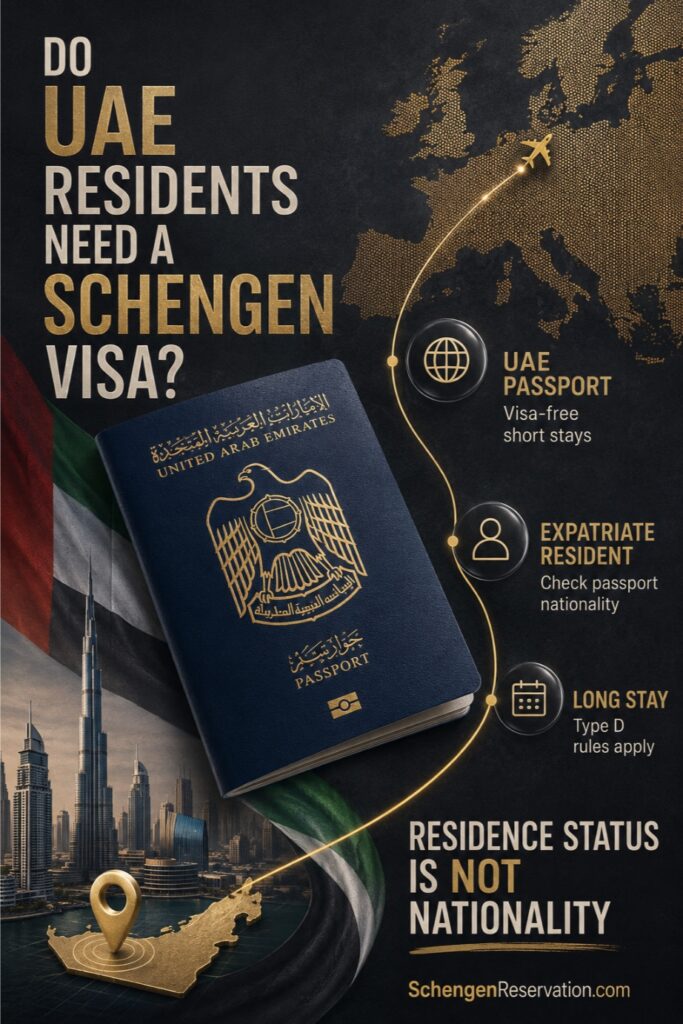
Quick answer: UAE citizens holding ordinary Emirati passports do not need a visa for short Schengen visits of up to 90 days in any rolling 180-day period. A UAE residence visa or Emirates ID does not create the same exemption for expatriate residents; their need for a visa depends primarily on the passport they use. Visa-required UAE residents should apply to the country responsible for their real itinerary, normally no earlier than six months and at least 15 days before travel.
Schengen Visa from the UAE at a Glance
| Question | General rule |
| Do UAE citizens need a short-stay Schengen visa? | No, not when travelling on an ordinary Emirati passport for a visa-free short visit |
| Do all UAE residents receive that exemption? | No. Visa need depends mainly on passport nationality, not UAE residence alone |
| Number of Schengen states | 29 |
| Maximum ordinary Type C stay | 90 days in any rolling 180-day period |
| Earliest normal filing date | Six months before the trip; nine months for seafarers in the relevant category |
| Latest legal filing point | At least 15 days before departure, although waiting this long is risky |
| Standard decision period | Normally 15 calendar days after an admissible file reaches the competent authority |
| Possible extended period | Up to 45 calendar days when further examination is needed |
| Standard visa fee | €90 for adults; €45 for children aged 6 to under 12; generally free for children under 6 |
| Travel insurance | Minimum €30,000 coverage throughout Schengen for the full intended stay |
| Usual UAE submission cities | Abu Dhabi and Dubai, depending on the destination and applicant’s jurisdiction |
| Who makes the decision? | The competent embassy or consulate – not VFS Global, BLS or another service provider |
The European Commission’s application guidance sets out the common filing window, fees, core documents and decision periods. Each destination can still publish a purpose-specific checklist and local procedural requirements, so the official country link should be checked again before every application.
First Check: Do You Need a Schengen Visa as a UAE Resident?
The words “UAE resident” describe where a person lives; they do not identify the passport presented at the border. This distinction should be settled before an appointment is booked.
UAE citizens
Citizens travelling on an ordinary United Arab Emirates passport are visa-exempt for short visits to the Schengen Area. The exemption generally covers tourism, private visits and permitted business activity for no more than 90 days in any 180-day period. It does not authorise employment, residence or a stay longer than 90 days.
An Emirati citizen may therefore still need a national Type D visa or residence authorisation for university study, employment, family reunification or another long-term purpose. Border officials can also request evidence of accommodation, funds, return travel and the purpose of a visa-free visit.
Expatriate residents of the UAE
An Indian, Pakistani, Filipino, Egyptian, South African or other foreign resident does not become visa-exempt merely by holding an Emirates ID. The applicant must check whether the nationality shown in the passport is on the EU visa-required list. If it is, a short-stay Schengen visa is normally required.
The UAE residence permit remains important for a different reason: it shows that the applicant is legally resident in the country where the application is being submitted. Missions may specify how long the UAE residence must remain valid after the planned return. Because the required buffer is not identical on every checklist, do not rely on a single one-month or three-month rule for all 29 destinations.
Visitors and people whose UAE residence is ending
The general rule is to apply in the country of legal residence. A person visiting the UAE on a tourist or visit visa should not assume that a Schengen mission in Abu Dhabi or Dubai will accept the file. A mission may accept a non-resident only when the applicant is legally present and can justify why the application could not be submitted in the country of residence.
Applicants changing jobs, cancelling a UAE visa or approaching residence expiry should resolve jurisdiction before paying for appointments. A consulate needs to see a lawful and credible return position, not merely a valid Emirates ID on the appointment date.
Which Schengen State Should Receive the Application?
The competent country follows the real journey not the fastest calendar, lowest service fee or reputation for easier approvals for Schengen visa application from UAE.
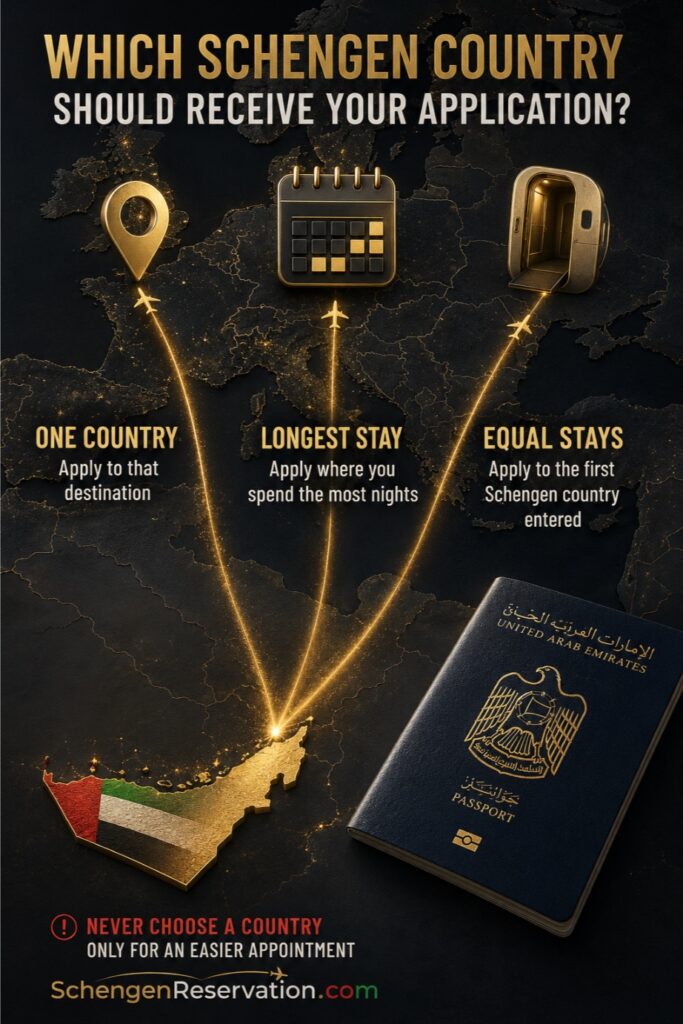
Use this order:
- One Schengen destination: apply to that country.
- Several destinations with different trip purposes: apply to the country connected to the principal purpose. A four-day trade exhibition may define the trip more strongly than a longer but incidental holiday segment.
- Same purpose across several countries: apply to the country where the traveller will spend the most time.
- Equal stays with no distinct main purpose: apply to the country of first Schengen entry.
- UAE residence: use a submission channel authorised for residents in the applicant’s emirate or for all UAE residents, as stated by the destination.
Main-destination examples
| Proposed itinerary | Normally competent state | Why |
| Seven nights in Spain | Spain | Spain is the only destination |
| Three nights in Germany and eight in Austria, all tourism | Austria | Austria has the longest stay |
| Four nights in France and four in Belgium, entering through France | France | Equal stays; France is first entry |
| Two business days in the Netherlands followed by five holiday nights in Belgium | Possibly the Netherlands | The business purpose may be the trip’s defining purpose; confirm if uncertain |
| Airport connection in Germany followed by ten nights in Sweden | Sweden | An airside connection does not make Germany the main destination |
“Visa shopping” creates avoidable risk. A file submitted to one state while the bookings show another as the true destination can be refused. If the itinerary changes genuinely after issuance, keep evidence explaining the change. If it was never genuine, an altered hotel plan will not repair the original inconsistency.
Schengen Visa Types from the UAE
This is the mandatory category decision. The visa type determines what the traveller may do, which checklist applies and whether common Schengen rules or the destination’s national immigration law controls the application.
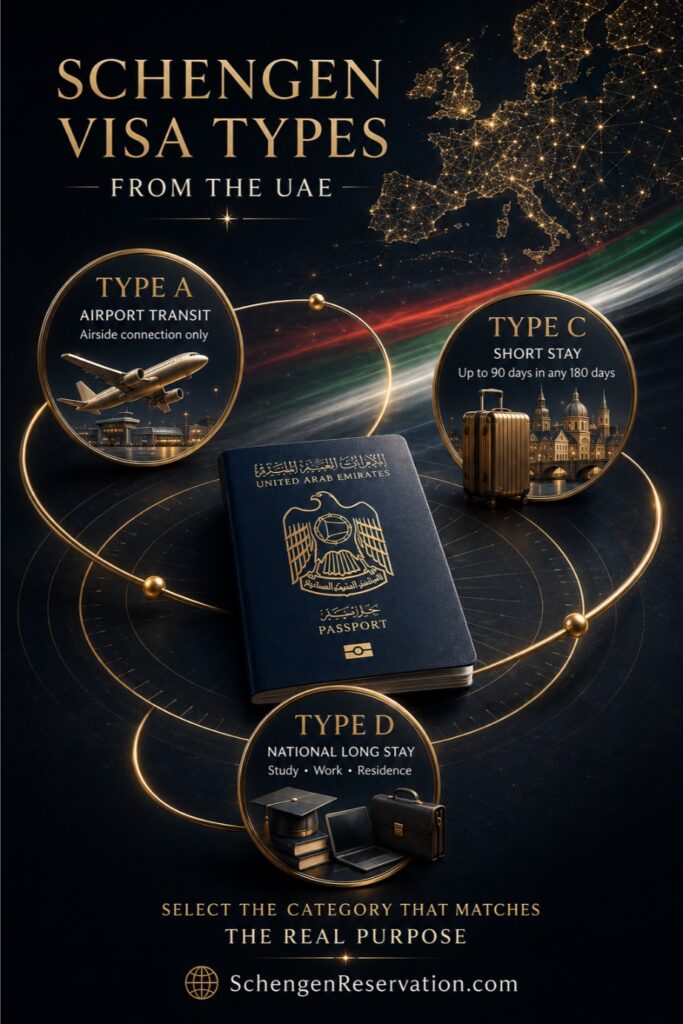
Type A – Airport Transit Visa
A Type A visa permits a traveller to wait in the international transit area of a Schengen airport while continuing to a non-Schengen destination. It does not permit entry through border control.
Whether it is needed depends on the traveller’s nationality, the transit country, airport layout and available exemptions. A Type C visa may be required instead when the route involves collecting baggage, changing airports, staying overnight landside or taking a second flight within the Schengen Area. Always check the transit state’s official tool before ticketing a complex connection.
Type C – Short-Stay Schengen Visa
Type C is the category used for most applications from the UAE. It permits a short visit of up to 90 days in any rolling 180-day period, subject to the dates and permitted duration printed on the sticker.
Common purposes include:
- tourism and holidays;
- visiting relatives or friends;
- business meetings, exhibitions and conferences;
- short courses and training;
- cultural, scientific or sporting events;
- medical treatment;
- official travel; and
- transit that requires entry into the Schengen Area.
A Type C visa can be issued for one entry, two entries or multiple entries. Entry count and visa validity are separate from the allowed length of stay. A one-year multiple-entry visa does not permit a continuous one-year stay; the 90-in-180 calculation still applies.
Type D – National Long-Stay Visa
Type D is a national visa for a stay longer than 90 days, usually for work, university study, research, family reunification or residence. The destination’s national rules govern the procedure. Documents such as a work permit, university admission, accommodation contract or family-reunification approval may be required before the visa appointment.
Do not use a tourist Type C checklist for a long-term plan. A national visa issued by one state may permit limited travel elsewhere in Schengen, but it does not grant a right to live or work in every member country.
Single-entry, double-entry and multiple-entry visas
These labels describe how many times the traveller may cross an external Schengen border during the visa’s validity:
- Single entry: one entry into the Schengen Area. Movement between Schengen states during the same continuous stay does not consume another entry.
- Double entry: two entries, useful when the itinerary leaves Schengen and returns.
- Multiple entry: repeated entries while the sticker is valid, always within the allowed stay calculation.
Applicants can explain a genuine need for multiple entry, but the issuing authority decides the validity and entry count. Previous lawful travel, a recurring business need or close family links may be relevant; paying for a longer insurance policy does not guarantee a longer visa.
Schengen Visa Application Requirements for UAE Residents
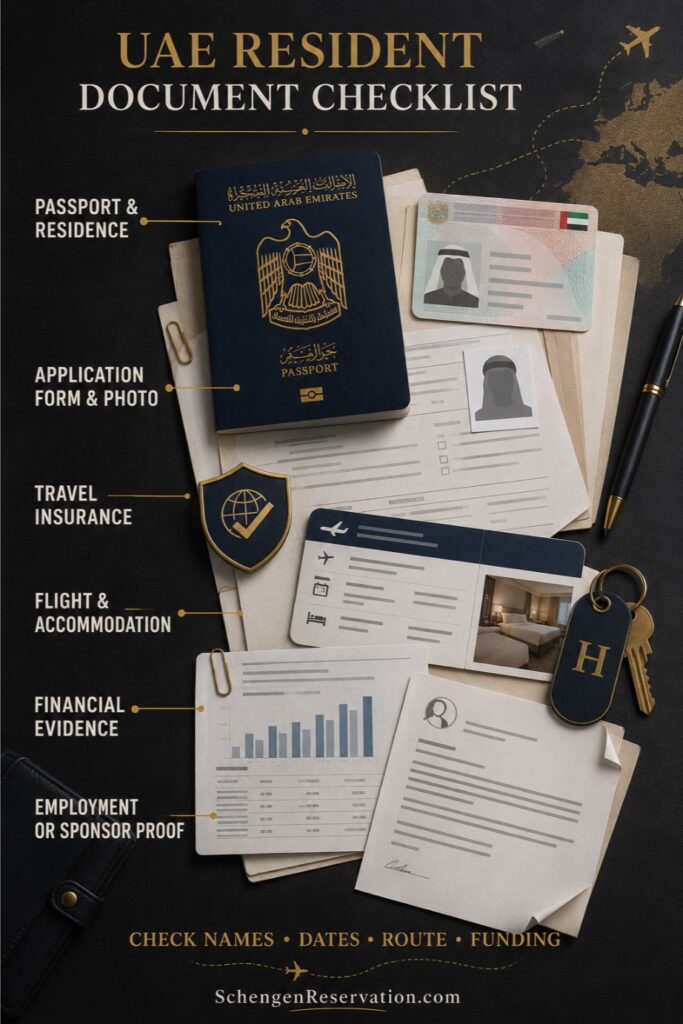
The exact checklist depends on nationality, destination, purpose and personal profile. The following elements form the common architecture of a UAE-based Type C file. The mission’s current checklist takes priority if it asks for extra documents, translations, originals or a particular format.
- Completed and signed application form
Use the form or online portal designated by the competent state. Names, passport numbers, travel dates, host details and first-entry information must match the supporting documents. Each traveller including every child needs a separate application.
Parents or legal guardians sign for minors according to the destination’s rules. Do not recycle an old form if a country-specific portal produces a barcode or unique application code.
- Valid passport and copies
For a typical short-stay application, the passport should:
- have been issued within the previous 10 years;
- remain valid for at least three months after the intended departure from Schengen;
- contain at least two blank visa pages;
- be signed where the passport format requires it; and
- be free from damage that makes identity or security features unclear.
Include the biographical page and any pages requested by the checklist, such as previous Schengen, UK, US or other visas and entry stamps. If the applicant holds an old passport with useful travel history, include it when requested or relevant.
- Emirates ID and proof of lawful UAE residence
Non-Emirati applicants normally provide a valid Emirates ID and evidence of UAE residence. Depending on the applicant’s status and the mission’s checklist, this can include a residence-visa page, electronic residence record or other official proof.
Check the destination’s required validity beyond the return date. If a residence renewal is in progress, do not assume a receipt will be accepted. Ask the provider or mission before booking.
- Recent compliant photograph
Provide the number, size and format shown on the country checklist. A common Schengen format is a recent 35 mm × 45 mm colour image on a light background, with a neutral expression and an unobstructed view of the face. Some application centres capture a digital image at the appointment, but that does not automatically remove every printed-photo requirement.
- Travel medical insurance
The policy should normally:
- name the applicant;
- be valid in every Schengen state;
- cover the entire intended stay;
- provide at least €30,000 in medical coverage; and
- cover urgent treatment, hospital care and repatriation, including in the event of death.
Read the destination checklist for any required extra days or wording. A credit-card benefit is useful only if the certificate proves that the named traveller and trip receive the required cover.
- Flight itinerary and internal transport plan
Provide a reservation or itinerary showing the intended journey from the UAE to Schengen and back, plus trains, flights, ferries or car arrangements needed to explain movement between states. The names and dates must match the form.
Many official checklists accept a travel reservation and do not require a fully paid ticket before a decision. A non-refundable purchase does not strengthen weak finances or an inconsistent itinerary. Follow the selected state’s exact wording.
- Accommodation for every night
Show where the applicant will stay throughout the trip:
- hotel or serviced-apartment reservations;
- a rental agreement;
- an invitation and destination-specific private-accommodation form; or
- proof of an owned property, where applicable.
Multi-country travellers should account for every night, including overnight transport. Host-based trips may require the host’s passport or residence permit, address evidence, relationship proof and a formal sponsorship or accommodation declaration.
- Financial evidence
There is no universal “Schengen bank balance” for every applicant. Each state may publish a reference amount, and the realistic budget depends on duration, accommodation, dependants, prepaid costs and sponsorship.
A strong financial section usually contains:
- recent personal bank statements, commonly covering the previous three months;
- recent salary slips where the applicant is employed;
- evidence of regular income or business drawings;
- a card statement or limit confirmation if requested; and
- a clear sponsorship package if another person pays.
The account should tell a believable story. A large unexplained transfer just before the appointment can create more questions than a modest but stable history. If a one-off credit is legitimate such as a bonus, asset sale or maturity payment, document its source.
- Employment, business, study or retirement evidence
The file should explain the applicant’s life in the UAE and reason to return.
An employed applicant commonly provides a recent employer letter or NOC stating job title, start date or contract status, salary, approved leave and expected return to work. Self-employed applicants may need a trade licence, company registration, proof of ownership, corporate bank activity or a letter explaining their role. Students should provide enrolment and authorised absence. Retirees can use pension, savings and residence evidence relevant to their circumstances.
An NOC is not a magic approval document; it is useful because it links lawful employment, income and leave dates. If the destination does not call it an NOC, an employer certificate containing the required facts may serve the same purpose.
- Purpose-specific evidence
Tourism files normally use an itinerary and reservations. Other purposes need evidence tailored to the reason for travel:
- Family or friend visit: invitation, host identity and residence, relationship evidence and any formal local guarantee.
- Business: invitation from the European company, UAE employer letter, meeting agenda, commercial relationship and explanation of who pays.
- Conference or trade fair: registration, programme, invitation and employer support.
- Medical treatment: medical reports, appointment or acceptance letter, estimated cost and funding evidence.
- Training or short study: enrolment or invitation, programme, duration and funding.
- Sport or culture: organiser invitation, accreditation, event programme and team or association letter.
- Civil-status, sponsor and minor documents
Marriage certificates, birth certificates and legal guardianship records become important when family members travel together, one person sponsors another or a child travels without both parents. A minor may also need notarised parental consent, copies of the non-travelling parent’s passport and proof of school enrolment.
Foreign-language civil documents may need an official translation or legalisation. Requirements vary, so use the destination’s checklist rather than translating every document indiscriminately.
- A concise cover letter
A cover letter is helpful when it resolves questions the form cannot explain: a multi-city itinerary, recent job change, family sponsorship, an unusual bank credit, a passport renewal or the reason for requesting multiple entry.
Keep it factual. State the purpose, route, dates, funding, UAE status and intended return. Avoid emotional appeals, copied embassy language and claims that are not supported elsewhere in the file.
UAE Applicant Profiles: What to Add
Salaried employee
Combine the employer certificate or NOC with recent payslips and bank statements showing the salary credits. If the legal employer, payroll company and work location have different names, explain the relationship briefly rather than leaving a reviewer to guess.
Business owner, partner or freelancer
Include the appropriate UAE trade or professional licence, incorporation or partnership evidence, and records connecting the applicant to the business income. Free-zone, mainland and freelance structures look different; the file should make ownership, role and funding clear.
Sponsored spouse or other dependent
Provide the sponsor’s passport, Emirates ID, UAE residence, employment and financial documents, plus proof of relationship and a signed sponsorship explanation. If the applicant also has personal funds, show them. Sponsorship does not eliminate the need to prove the applicant’s lawful residence and purpose.
Student
Add a current enrolment letter, programme dates, approved absence where relevant, and the funding evidence of the student or sponsor. For school pupils, include parental documents and school confirmation.
Domestic worker or private staff member
Use the exact destination checklist. The file may need the sponsor or employer’s documents, employment contract, salary history, approved leave, relationship to the accompanying household and evidence that the applicant will return to lawful employment in the UAE. Never describe a private employee as a tourist companion if the real purpose is work-related.
Family travelling together
Each person needs an individual application, passport and supporting set even when the itinerary and funding are shared. Use a family cover note and consistent reservations, but do not submit one bank statement without explaining how it supports every traveller.
Family member of an EU, EEA or Swiss citizen
Qualifying family members travelling with or joining an EU, EEA or Swiss citizen may be entitled to a free and accelerated procedure with a reduced document set. The exact entitlement depends on nationality, relationship, destination and whether free-movement rules apply. Select the family-member category at the start rather than paying for a standard tourist route and trying to correct it later.
The UAE File Alignment Check
Before submission, read the application as if no document could explain another document’s mistake. Use this eight-point check:
- Identity: spelling, passport number, date of birth and nationality match everywhere.
- Residency: Emirates ID and UAE residence cover the destination’s required period.
- Travel dates: form, insurance, flight plan, leave letter and accommodation use compatible dates.
- Night count: every night has a location, including transfers and private stays.
- Jurisdiction: the selected country is visibly the main destination, and the chosen UAE centre accepts the applicant’s emirate.
- Funding: the stated sponsor and bank evidence agree; the budget is proportionate to income and trip length.
- Purpose: invitations, programmes and cover letter describe the same activity.
- Return story: work, business, study, family or residence evidence supports a credible return to the UAE.
This alignment check is more useful than simply increasing the page count. A compact, indexed file with one coherent narrative is easier to assess than a thick folder containing contradictions.
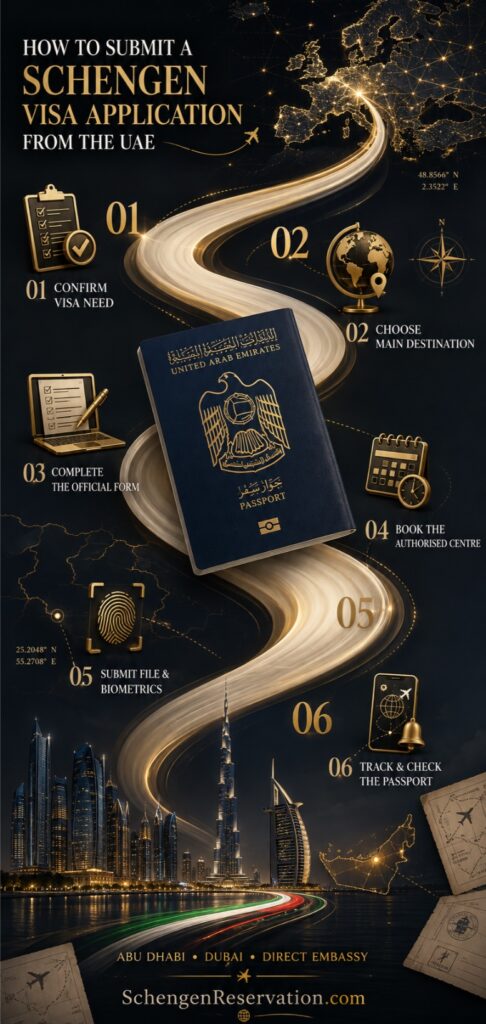
Step-by-Step: How to Submit a Schengen Visa Application from the UAE
Step 1 – Confirm visa need by passport nationality
Use the destination’s official visa tool. Do not infer the answer from UAE residence, profession or previous travel.
Step 2 – Map the genuine itinerary
List each Schengen state, purpose, arrival date, departure date and number of nights. Identify the principal purpose, longest stay and first entry. This determines the competent state.
Step 3 – Open the official government or authorised-provider page
Begin with the embassy, foreign ministry or official visa portal. Follow its link to VFS Global, BLS International or another authorised provider. Check the web domain carefully; appointment imitation sites and paid slot sellers are not consular partners.
Step 4 – Select Type C and the correct purpose
Tourism, family visit and business categories can request different documents even when the trip length is identical. Select the real primary purpose. If the stay exceeds 90 days, move to the destination’s national Type D process.
Step 5 – Complete any online form before booking
Some countries require an online application or preliminary registration before the appointment. France uses France-Visas, Romania starts through eVisa, and Poland uses e-Konsulat for appointments. Print and sign any generated form where instructed.
Step 6 – Book through the authorised UAE channel
Choose only a city and centre that the destination accepts. Italy is the clearest jurisdiction example: Abu Dhabi-issued residents use the authorised Abu Dhabi channel, while Dubai and Northern Emirates residents use the Dubai channel.
Step 7 – Build the file from the current checklist
Download the checklist after selecting nationality and purpose. Prepare originals, copies and translations in its order. Recheck validity dates immediately before the appointment.
Step 8 – Attend the appointment
Applicants usually submit the passport and documents, answer basic questions, provide biometrics when required and pay the applicable charges. Arrive early and follow centre restrictions on bags, electronics and accompanying persons.
Step 9 – Track the passport, not rumours
Use the provider or mission’s official tracking tool. A status such as “under process at embassy” does not reveal whether the application will be approved. Additional-document requests should be answered through the channel and deadline specified.
Step 10 – Inspect the visa sticker before travel
Check the name, passport number, valid-from and valid-until dates, number of entries and duration of stay. If something appears wrong, contact the issuing mission immediately. At the border, carry accessible copies of accommodation, return travel, insurance, invitations and financial evidence.
Schengen Visa Fees in the UAE
| Applicant category | Common Type C visa fee |
| Adult | €90 |
| Child aged 6 to under 12 | €45 |
| Child under 6 | Generally exempt |
| Qualifying EU/EEA/Swiss family member | Often exempt under applicable free-movement rules |
The fee is usually collected in AED at the consular exchange rate in force on the payment date. An authorised external centre can charge a separate service fee. Courier delivery, form filling, SMS, photocopying and premium lounges are optional extras; they do not influence the embassy’s decision.
Some nationalities or purposes benefit from reduced or waived fees under EU agreements or the Visa Code. Always use the fee table connected to the applicant’s nationality and travel category.
Processing Time and Best Time to Apply
The normal legal decision period is 15 calendar days after an admissible application reaches the competent consulate. It may extend to 45 calendar days when further review, additional documents or consultation is required.
That period does not necessarily include:
- waiting for an appointment;
- transport of the passport between the centre and mission;
- incomplete-file delays; or
- courier return after the decision.
Applications can normally be lodged up to six months before departure. Starting eight to twelve weeks ahead is a practical target for ordinary travel, with more time for Eid, summer, Christmas, school holidays, exhibitions and major sporting events. Filing exactly 15 days before departure leaves almost no margin for an extended review.
Spain’s authorised UAE channel currently advises applicants to allow at least three weeks, illustrating why destination-specific guidance matters even when the common rule says 15 calendar days.
Main Schengen Visa Submission Locations in the UAE
Many countries use the two shared VFS locations below. A country-specific page can restrict applicants to one city, so a familiar VFS address is not proof that the selected destination accepts applications there.
VFS Global Visa Application Centre in Abu Dhabi:
Abu Dhabi: Level B2 (Lower Ground), The Mall, World Trade Centre, Khalifa Bin Zayed The 1st Street (Airport Road), Abu Dhabi, United Arab Emirates.
VFS Global Visa Application Centre in Dubai:
Dubai: Wafi Mall, First Floor, Phase 5 – Horus, Umm Hurair 2, Dubai, United Arab Emirates.
Other important UAE routes include the BLS centres for Spain, BLS for Abu Dhabi-jurisdiction Italy applicants, BLS and VFS options for Slovakia, and direct embassy submission for Poland and Slovenia.
All 29 Schengen States: Where to Apply from the UAE
The following routing map focuses on ordinary short-stay Type C applications by legal UAE residents. National Type D visas, diplomatic passports and special categories may use a different process. Centre arrangements change, so follow the official link immediately before paying or attending.
| Schengen state | Main UAE submission route | City or jurisdiction |
| Austria | VFS Global | Abu Dhabi or Dubai |
| Belgium | VFS Global | Abu Dhabi or Dubai |
| Bulgaria | VFS Global | Abu Dhabi or Dubai |
| Croatia | VFS Global | Dubai |
| Czechia | VFS Global | Abu Dhabi or Dubai |
| Denmark | VFS Global | Abu Dhabi or Dubai |
| Estonia | VFS Global | Abu Dhabi or Dubai |
| Finland | VFS Global | Abu Dhabi or Dubai |
| France | France-Visas, then VFS Global | Abu Dhabi only |
| Germany | VFS Global | Abu Dhabi or Dubai |
| Greece | VFS Global | Abu Dhabi or Dubai |
| Hungary | VFS Global | Abu Dhabi or Dubai |
| Iceland | VFS Global | Abu Dhabi or Dubai |
| Italy | BLS or VFS Global | BLS for Abu Dhabi-issued residence; VFS Dubai for Dubai and Northern Emirates |
| Latvia | VFS Global | Abu Dhabi or Dubai |
| Liechtenstein | Swiss VFS Global route | Abu Dhabi or Dubai |
| Lithuania | VFS Global | Abu Dhabi or Dubai |
| Luxembourg | VFS Global | Abu Dhabi or Dubai |
| Malta | VFS Global | Abu Dhabi or Dubai |
| Netherlands | VFS Global | Abu Dhabi or Dubai |
| Norway | VFS Global | Abu Dhabi or Dubai |
| Poland | e-Konsulat, then Polish Embassy | Abu Dhabi |
| Portugal | VFS Global | Abu Dhabi or Dubai |
| Romania | Romanian eVisa, then assigned mission stage | UAE mission specified by the process |
| Slovakia | BLS International or VFS Global | Abu Dhabi or Dubai; check live notices |
| Slovenia | Embassy of Slovenia | Abu Dhabi by advance appointment |
| Spain | BLS International | Abu Dhabi or Dubai |
| Sweden | VFS Global | Abu Dhabi or Dubai |
| Switzerland | VFS Global | Abu Dhabi or Dubai |
Austria Schengen Visa from UAE
Austria uses VFS Global in Abu Dhabi and Dubai. Select the travel purpose, download the Austrian checklist and book only through the official UAE portal. Austrian authorities, not VFS, assess the application.
Austria Visa Application Centres in the UAE:
Abu Dhabi: VFS Global, Level B2 (Lower Ground), The Mall, World Trade Centre, Khalifa Bin Zayed The 1st Street, Abu Dhabi.
Dubai: VFS Global, Wafi Mall, First Floor, Phase 5 – Horus, Umm Hurair 2, Dubai.
Belgium Schengen Visa from UAE
Belgian Type C applications are lodged through VFS Global in Abu Dhabi or Dubai. Choose the correct Belgian purpose checklist; private visits can require formal host or sponsorship evidence that differs from hotel-based tourism.
Belgium Visa Application Centres in the UAE:
Abu Dhabi: VFS Global, World Trade Centre Mall, Level B2, Abu Dhabi.
Dubai: VFS Global, Wafi Mall, First Floor, Phase 5 – Horus, Dubai.
Bulgaria Schengen Visa from UAE
Bulgaria is a full Schengen member. Its foreign ministry directs UAE short-stay applicants through VFS Global, with centres in Abu Dhabi and Dubai. Do not use old pre-Schengen advice that treats Bulgarian short-stay visas as a separate travel system.
Bulgaria Visa Application Centres in the UAE:
Abu Dhabi: VFS Global, World Trade Centre Mall, Level B2, Abu Dhabi.
Dubai: VFS Global, Wafi Mall, First Floor, Phase 5 – Horus, Dubai.
Croatia Schengen Visa from UAE
Croatia currently uses VFS Global in Dubai for UAE applications. Do not assume the shared Abu Dhabi VFS centre can accept a Croatian file merely because it handles many other Schengen states.
Croatia Visa Application Centre in the UAE:
Dubai: VFS Global, Wafi Mall, First Floor, Phase 5 – Horus, Umm Hurair 2, Dubai.
Czechia Schengen Visa from UAE
Czech short-stay applications are accepted at VFS Global in Abu Dhabi and Dubai. Airport-transit travellers should separately check whether their nationality and connection require a Type A visa.
Czechia Visa Application Centres in the UAE:
Abu Dhabi: VFS Global, World Trade Centre Mall, Level B2, Abu Dhabi.
Dubai: VFS Global, Wafi Mall, First Floor, Phase 5 – Horus, Dubai.
Denmark Schengen Visa from UAE
Denmark accepts short-stay applications through VFS Global in Abu Dhabi and Dubai. Use Denmark’s official application guidance for the correct online steps and purpose checklist before booking.
Denmark Visa Application Centres in the UAE:
Abu Dhabi: VFS Global, World Trade Centre Mall, Level B2, Abu Dhabi.
Dubai: VFS Global, Wafi Mall, First Floor, Phase 5 – Horus, Dubai.
Estonia Schengen Visa from UAE
Estonia uses VFS Global in Abu Dhabi and Dubai, with the Estonian Embassy responsible for examination. Applicants should use Estonia’s UAE document guidance, particularly for employment, residence and purpose evidence.
Estonia Visa Application Centres in the UAE:
Abu Dhabi: VFS Global, World Trade Centre Mall, Level B2, Abu Dhabi.
Dubai: VFS Global, Wafi Mall, First Floor, Phase 5 – Horus, Dubai.
Finland Schengen Visa from UAE
Finland receives UAE short-stay applications through VFS Global in Abu Dhabi and Dubai. Complete any required electronic application steps and bring the printed or generated material stated by the Finnish process.
Finland Visa Application Centres in the UAE:
Abu Dhabi: VFS Global, World Trade Centre Mall, Level B2, Abu Dhabi.
Dubai: VFS Global, Wafi Mall, First Floor, Phase 5 – Horus, Dubai.
France Schengen Visa from UAE
France requires applicants to begin through France-Visas, print the generated application and then submit physically. All UAE-resident applications are currently lodged at the dedicated VFS centre in Abu Dhabi; there is no France VFS submission centre in Dubai.
France Visa Application Centre in the UAE:
Abu Dhabi: VFS Global Dedicated Centre for France, Level B2 (Lower Ground), The Mall, World Trade Centre, Khalifa Bin Zayed The 1st Street, Abu Dhabi.
Germany Schengen Visa from UAE
Germany uses VFS Global in Abu Dhabi and Dubai for short-stay applications. Its UAE mission publishes category guidance and retains decision-making authority.
Germany Visa Application Centres in the UAE:
Abu Dhabi: VFS Global, World Trade Centre Mall, Level B2, Abu Dhabi.
Dubai: VFS Global, Wafi Mall, First Floor, Phase 5 – Horus, Dubai.
Greece Schengen Visa from UAE
Greece accepts applications through VFS Global in Abu Dhabi and Dubai. Match the checklist to tourism, business or visit purposes, and account for island or domestic transport where it forms part of the itinerary.
Greece Visa Application Centres in the UAE:
Abu Dhabi: VFS Global, World Trade Centre Mall, Level B2, Abu Dhabi.
Dubai: VFS Global, Wafi Mall, First Floor, Phase 5 – Horus, Dubai.
Hungary Schengen Visa from UAE
Hungary uses VFS Global in both UAE cities. Applicants should distinguish an ordinary tourist visit from family visit, business, conference or medical categories because supporting evidence differs.
Hungary Visa Application Centres in the UAE:
Abu Dhabi: VFS Global, World Trade Centre Mall, Level B2, Abu Dhabi.
Dubai: VFS Global, Wafi Mall, First Floor, Phase 5 – Horus, Dubai.
Iceland Schengen Visa from UAE
Iceland uses VFS Global in Abu Dhabi and Dubai. Applications are still assessed by the competent Icelandic authorities, and transport time between the UAE centre and processing authority should be allowed in the travel schedule.
Iceland Visa Application Centres in the UAE:
Abu Dhabi: VFS Global, World Trade Centre Mall, Level B2, Abu Dhabi.
Dubai: VFS Global, Wafi Mall, First Floor, Phase 5 – Horus, Dubai.
Italy Schengen Visa from UAE
Italy has a UAE jurisdiction split based on the authority that issued the applicant’s residence. Residents of Abu Dhabi Emirate, including Abu Dhabi, Al Ain and Al Dhafra, use the BLS centre authorised by the Italian Embassy. Residents of Dubai and the Northern Emirates use the VFS Global route in Dubai under the Italian Consulate General’s jurisdiction.
Italy Visa Application Centres in the UAE:
Abu Dhabi jurisdiction: BLS International Italy Visa Application Centre, Nation Towers Mall, 1st Floor, Unit F24, 1st Street, Al Bateen, Abu Dhabi.
Dubai and Northern Emirates jurisdiction: VFS Global, Wafi Mall, First Floor, Phase 5 – Horus, Umm Hurair 2, Dubai.
Latvia Schengen Visa from UAE
Latvia accepts short-stay applications through VFS Global in Abu Dhabi and Dubai. Use Latvia’s purpose-specific checklist and submit UAE residence and employment evidence that covers the full local requirement.
Latvia Visa Application Centres in the UAE:
Abu Dhabi: VFS Global, World Trade Centre Mall, Level B2, Abu Dhabi.
Dubai: VFS Global, Wafi Mall, First Floor, Phase 5 – Horus, Dubai.
Liechtenstein Schengen Visa from UAE
Switzerland represents Liechtenstein for Schengen visa matters in the UAE. Apply through the Swiss VFS channel in Abu Dhabi or Dubai and identify Liechtenstein honestly as the destination where applicable.
Liechtenstein Visa Application Centres in the UAE:
Abu Dhabi: VFS Global Switzerland channel, World Trade Centre Mall, Level B2, Abu Dhabi.
Dubai: VFS Global Switzerland channel, Wafi Mall, First Floor, Phase 5 – Horus, Dubai.
Lithuania Schengen Visa from UAE
Lithuania has its own VFS Global route in the UAE, with centres in Abu Dhabi and Dubai. Use the Lithuanian portal rather than assuming representation by another Schengen embassy based on an older arrangement.
Lithuania Visa Application Centres in the UAE:
Abu Dhabi: VFS Global, World Trade Centre Mall, Level B2, Abu Dhabi.
Dubai: VFS Global, Wafi Mall, First Floor, Phase 5 – Horus, Dubai.
Luxembourg Schengen Visa from UAE
Luxembourg applications can be lodged through its VFS Global UAE route in Abu Dhabi or Dubai. Select Luxembourg only when it is genuinely responsible under the principal-purpose or longest-stay rule.
Luxembourg Visa Application Centres in the UAE:
Abu Dhabi: VFS Global, World Trade Centre Mall, Level B2, Abu Dhabi.
Dubai: VFS Global, Wafi Mall, First Floor, Phase 5 – Horus, Dubai.
Malta Schengen Visa from UAE
Malta uses VFS Global in Abu Dhabi and Dubai. Applicants should follow the category guidance issued for Malta and allow time for transfer and examination of the physical file.
Malta Visa Application Centres in the UAE:
Abu Dhabi: VFS Global, World Trade Centre Mall, Level B2, Abu Dhabi.
Dubai: VFS Global, Wafi Mall, First Floor, Phase 5 – Horus, Dubai.
Netherlands Schengen Visa from UAE
The Netherlands receives applications through VFS Global in Abu Dhabi and Dubai. Complete the Dutch online form as instructed and use the checklist for the primary purpose. Dutch official guidance explicitly distinguishes tourism from family/friend visits and explains that a reservation can be used for travel evidence without a paid ticket.
Netherlands Visa Application Centres in the UAE:
Abu Dhabi: VFS Global, World Trade Centre Mall, Level B2, Abu Dhabi.
Dubai: VFS Global, Wafi Mall, First Floor, Phase 5 – Horus, Dubai.
Norway Schengen Visa from UAE
Norway accepts Schengen applications through VFS Global in Abu Dhabi and Dubai. Register or complete the application steps required by the Norwegian portal before attending the centre.
Norway Visa Application Centres in the UAE:
Abu Dhabi: VFS Global, World Trade Centre Mall, Level B2, Abu Dhabi.
Dubai: VFS Global, Wafi Mall, First Floor, Phase 5 – Horus, Dubai.
Poland Schengen Visa from UAE
Poland does not use the shared VFS route for ordinary UAE-resident Type C applications. Applications are submitted in person to the Consular Section of the Polish Embassy in Abu Dhabi after an appointment is registered through e-Konsulat.
Poland Visa Application Office in the UAE:
Abu Dhabi: Consular Section, Embassy of the Republic of Poland, CI Tower, Office 1502, Al Bateen Street, Khalidiyah, Abu Dhabi.
Portugal Schengen Visa from UAE
Portugal uses VFS Global in Abu Dhabi and Dubai for short-stay applications. Check the Portuguese Embassy guidance and the provider’s current category page before booking.
Portugal Visa Application Centres in the UAE:
Abu Dhabi: VFS Global, World Trade Centre Mall, Level B2, Abu Dhabi.
Dubai: VFS Global, Wafi Mall, First Floor, Phase 5 – Horus, Dubai.
Romania Schengen Visa from UAE
Romania is a full Schengen member. Applicants first register and upload the requested information through Romania’s eVisa portal. After online validation, follow the instructions received for the in-person stage at the competent Romanian mission in the UAE. Do not book an unrelated VFS centre.
Romania Visa Application Route in the UAE:
Online first: Register through eVisa, then attend the Romanian mission specified by the process.
Abu Dhabi: Embassy of Romania, 15 Abu Al Abyad Street, Al Bateen, Abu Dhabi.
Slovakia Schengen Visa from UAE
Slovakia currently authorises both BLS International and VFS Global in the UAE for short-stay applications. The Slovak Embassy accepts direct applications only in justified cases and warns that direct appointment waits may be several weeks. Check live notices before attending because temporary centre changes or appointment postponements can occur.
Slovakia Visa Application Centres in the UAE:
Abu Dhabi, BLS: 1311 Tamouh Tower, 13th Floor, Marina Square, Al Reem Island, Abu Dhabi.
Dubai, BLS: Habib Bank AG Zurich Al Jawarah Building, Office 505, Bank Street, next to ADCB Bank, Bur Dubai.
VFS option: Use Slovakia’s official UAE VFS portal for the current Abu Dhabi or Dubai centre shown during booking.
Slovenia Schengen Visa from UAE
Slovenian short-stay applications are submitted directly to the Embassy of Slovenia in Abu Dhabi. An advance appointment is required through the consular section. The embassy’s visa page also publishes the core document, fee and processing framework.
Slovenia Visa Application Office in the UAE:
Abu Dhabi: Consular Section, Embassy of the Republic of Slovenia, 12-01 Office Tower, Capital Plaza, Khalifa Street, Corniche, Abu Dhabi.
Spain Schengen Visa from UAE
Spain uses BLS International in Abu Dhabi and Dubai. The UAE portal currently asks applicants to allow at least three weeks for processing. Use only the official booking system and remember that optional premium services do not improve approval prospects.
Spain Visa Application Centres in the UAE:
Abu Dhabi: BLS International, 1311 Tamouh Tower, 13th Floor, Marina Square, Al Reem Island, Abu Dhabi.
Dubai: BLS International, iRise Tower, 27th Floor, Office C-13, Barsha Heights (Tecom), Dubai.
Sweden Schengen Visa from UAE
Sweden accepts UAE-resident applications through VFS Global in Abu Dhabi and Dubai. The Swedish Embassy states that it does not cooperate with paid agents who claim they can influence processing or outcomes.
Sweden Visa Application Centres in the UAE:
Abu Dhabi: VFS Global, World Trade Centre Mall, Level B2, Abu Dhabi.
Dubai: VFS Global, Wafi Mall, First Floor, Phase 5 – Horus, Dubai.
Switzerland Schengen Visa from UAE
Switzerland uses VFS Global in Abu Dhabi and Dubai. Its official UAE guidance explains legal-residence evidence and directs applicants to the relevant VFS centre. Use the Swiss channel for Liechtenstein as well when Switzerland represents that destination.
Switzerland Visa Application Centres in the UAE:
Abu Dhabi: VFS Global, World Trade Centre Mall, Level B2, Abu Dhabi.
Dubai: VFS Global, Wafi Mall, First Floor, Phase 5 – Horus, Dubai.
How Schengen Reservation Can Support the Travel-Evidence Layer
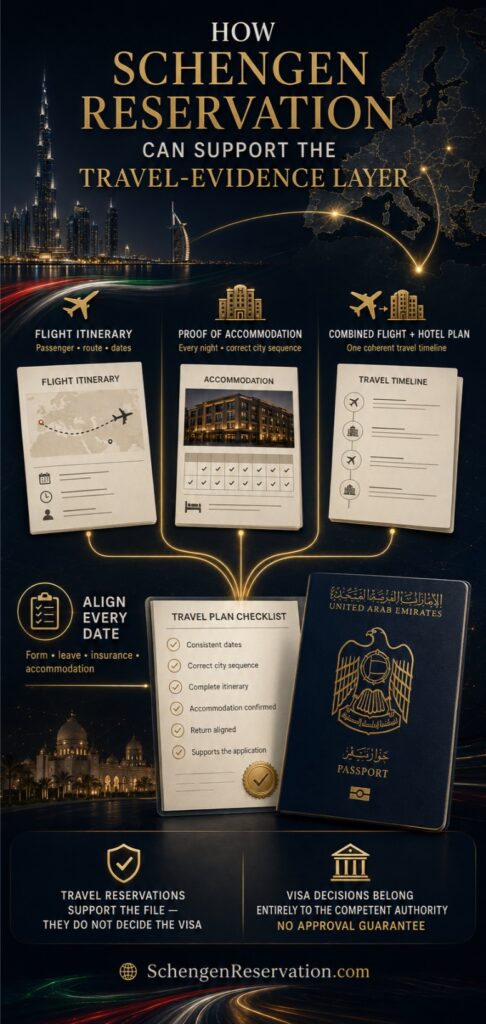
A visa decision belongs entirely to the competent diplomatic authority. Schengen Reservation cannot guarantee approval, influence a consulate or replace mandatory personal, financial and employment evidence. Its practical role is narrower: helping applicants prepare coherent travel reservations for the file without committing prematurely to every non-refundable element of the trip.
Flight itinerary for a visa application
A properly prepared flight reservation for a visa application can show the intended outbound and return journey, passenger name, route and dates. It should reflect the actual plan and remain consistent with the form, leave approval, insurance and accommodation.
Proof of accommodation
A hotel booking for visa purposes can account for the intended stay when the applicant is not staying with a private host. Multi-country trips should cover every night and identify the correct city sequence.
Combined flight and hotel plan
Applicants who need both elements can use a flight and hotel reservation package to align dates before submission. The applicant remains responsible for confirming that every document is genuine, current and accepted by the selected mission.
Creative Planning Feature: Build the File Backwards from the Return Date
UAE applicants often start with a flight search. A stronger method starts with the intended return to the UAE and works backwards:
- Confirm that UAE residence remains valid for the destination’s required period after return.
- Secure employer or school leave that ends on the correct date.
- Set the Schengen exit date and calculate insurance through that date.
- Allocate every overnight stay to a city and country.
- Identify the longest stay or principal purpose.
- Choose the authorised UAE centre for that state and jurisdiction.
- Add transport and accommodation reservations only after the route is settled.
This reverse-planning method exposes problems early: an expiring residence, a leave letter ending too soon, the wrong Italian jurisdiction or a “main destination” that changes when nights are counted accurately.
Common Mistakes in UAE Schengen Applications
Treating Emirates ID as a visa exemption
UAE residence supports local jurisdiction; it does not replace the passport nationality rule.
Booking the wrong city because the provider brand looks familiar
VFS Global is not one universal counter. France accepts UAE-resident submissions in Abu Dhabi, Croatia uses Dubai, and Italy divides applicants by UAE residence jurisdiction.
Using a fixed bank-balance myth
A copied amount ignores trip length, family size and destination reference levels. Show a proportionate budget and genuine financial history.
Submitting a generic NOC
A letter that merely says “no objection” may omit the facts a reviewer needs. Include position, salary, employment status, approved leave and return date when the checklist requests them.
Leaving a sponsorship relationship undocumented
If a spouse, parent, employer or host pays, connect that person to the applicant with identity, relationship, undertaking and lawful funds.
Creating hotel gaps
Every night needs an explanation. An overnight train, hosted stay or early-morning connection should appear clearly rather than leaving an unexplained date.
Buying non-refundable travel too soon
A paid ticket does not compensate for the wrong consulate, missing residence validity or weak purpose evidence. Use the evidence format requested by the mission.
Adding unexplained last-minute deposits
Sudden funds can look borrowed. Document the source or wait until the financial history accurately reflects the applicant’s means.
Trusting appointment sellers
Use official provider and government domains. No intermediary can lawfully guarantee a slot, decision or faster embassy assessment unless the official channel itself offers that service.
Frequently Asked Questions About a Schengen Visa from the UAE
- Do UAE citizens need a Schengen visa?
Not for an ordinary short visit when travelling on a regular Emirati passport. They remain subject to the 90-days-in-180 rule and may need a national visa for work, residence, study or another long stay.
- Do UAE residents automatically receive visa-free entry?
No. An expatriate resident’s visa requirement depends primarily on passport nationality. Emirates ID proves residence; it does not change nationality.
- Can I apply for a Schengen visa from Dubai?
Yes, when the competent state accepts UAE applications in Dubai and the applicant meets any jurisdiction rule. Many countries use VFS at Wafi Mall, Spain uses BLS in Barsha Heights, Croatia uses VFS Dubai, and Italy routes Dubai and Northern Emirates residents through Dubai.
- Can an Abu Dhabi resident submit in Dubai?
Sometimes, but not always. Many VFS destination portals offer both cities to all UAE residents. Italy specifically divides jurisdiction by residence-issuing emirate. Follow the destination’s local page rather than choosing solely for convenience.
- Can a UAE visitor apply in Abu Dhabi or Dubai?
Usually the application should be made in the country of legal residence. A consulate may accept a legally present non-resident who can justify the exception, but acceptance should be confirmed before booking.
- Which country should I apply to for a multi-country trip?
Apply to the state connected to the principal purpose or longest stay. If stays are equal and there is no other main purpose, apply to the first Schengen state entered.
- How early can I apply from the UAE?
Normally up to six months before departure. Apply at least 15 days before travel, but two to three months ahead is safer because appointment waits are separate from examination time.
- How long does processing take?
The normal legal period is 15 calendar days after an admissible application reaches the competent authority. It can extend to 45 days. Provider transfers and appointment queues can add time.
- How much does a Schengen visa cost in the UAE?
The standard Type C fee is €90 for adults and €45 for children aged 6 to under 12; children under 6 are generally exempt. Payment is commonly collected in AED, and an external service fee may be added.
- Is there a minimum UAE bank balance?
There is no single balance that works for every Schengen state and trip. The required means depend on destination reference amounts, trip length, accommodation, dependants and sponsorship. Stable income and understandable transactions strengthen credibility.
- Is an employer NOC mandatory?
Many UAE checklists request an employer letter or NOC, but wording and required details vary. Use the competent state’s list. A useful letter normally confirms employment, position, salary, leave and return.
- Must I purchase the airline ticket before applying?
Many official tourism checklists ask for a reservation or travel plan and do not require a paid ticket. Follow the exact destination checklist. A purchase does not guarantee a visa.
- Do I need biometrics again if I had a previous Schengen visa?
Fingerprints can generally be reused for 59 months, but an applicant may still be asked to appear or provide new biometrics if the stored record is unavailable, inadequate or verification is required. Children under 12 are exempt from fingerprint collection.
- Can family members use one application?
No. Every traveller needs an individual form and supporting set. Shared itineraries, accommodation and sponsorship can be cross-referenced, but fees and biometric requirements apply per person.
- Can I ask for a multiple-entry visa on my first application?
Yes, if the form permits and there is a genuine reason, but the consulate decides. Explain future trips and provide evidence. A request does not create an entitlement.
- Is a Type D visa the same as a multiple-entry Schengen visa?
No. Type D is a national long-stay visa for residence-related purposes. A multiple-entry Type C remains a short-stay visa governed by the 90-in-180 limit.
- Does a Schengen visa guarantee entry?
No. It permits travel to a Schengen border to request entry. Carry evidence of purpose, accommodation, funds, insurance and return travel in case border officials ask.
- What should I do after a refusal?
Read the refusal form and appeal instructions carefully. An appeal or a new application may be appropriate depending on the reason. Correct the identified problem; filing the same evidence again rarely changes the assessment.
Final UAE Appointment Checklist
- Passport nationality checked for visa requirement
- Correct Type A, Type C or Type D route selected
- Genuine main destination identified
- Authorised Abu Dhabi, Dubai or direct-embassy channel confirmed
- Completed and signed form for each applicant
- Passport and requested copies
- Emirates ID and UAE residence evidence with sufficient validity
- Compliant photograph where required
- Travel insurance covering all Schengen states and dates
- Flight or transport itinerary
- Accommodation for every night
- Recent bank statements and salary or business evidence
- Employer letter, NOC, trade licence, study or retirement evidence as applicable
- Purpose-specific invitation, agenda or medical documentation
- Sponsor and relationship evidence where another person pays
- Minor consent and civil-status records where relevant
- Required translations, originals and photocopies
- Matching names, dates, route and funding across the file
- Appointment confirmation and accepted payment method
Conclusion
A successful Schengen visa application from the UAE begins with two distinctions: nationality is not residence, and appointment convenience is not consular jurisdiction. Once those are clear, the rest of the process becomes a sequence, choose the right visa type, identify the responsible state, use its authorised UAE route and assemble evidence around one truthful trip.
The best file behaves like a well-planned itinerary. Nothing is missing, nothing doubles back without explanation and every document arrives at the same conclusion. The passport proves identity, UAE records establish residence and return ties, finances support the budget, and travel reservations make the route visible from departure to homecoming.
Use this guide as a planning framework, then make one final official-source check before submission. Centre locations, service providers, appointment systems, fees and local document formats can change. Accuracy on the day of filing matters more than any checklist saved months earlier.