
How to Apply for a Schengen Visa from Indonesia: Explore Types, Requirements and Approval Essentials
For an Indonesian traveller planning Europe, the most important stage of the journey often happens long before reaching the airport. It begins with deciding which Schengen country is legally responsible for the visa application and constructing a file in which the itinerary, finances, employment circumstances, accommodation and purpose of travel support the same genuine journey.
Indonesian ordinary-passport holders generally require a Schengen visa for short visits to the Schengen area. The visa can allow travel across 29 participating European states for a temporary stay, generally subject to the 90 days in any 180-day period rule.
Indonesia also has a comparatively broad Schengen application network. Depending on the main destination, applicants may submit through VFS Global, TLScontact, BLS International, a representing Schengen state or, for some countries, directly through an embassy or consular procedure.
That flexibility is useful, but it introduces an important requirement: the applicant cannot simply select whichever embassy has the earliest appointment.
A credible Schengen application from Indonesia should answer five fundamental questions without contradiction:
- Why is the applicant travelling?
- Why is this particular Schengen country responsible for the application?
- Where will the applicant stay throughout the journey?
- How will the applicant finance the trip?
- What credible circumstances support the applicant’s return to Indonesia?
No travel reservation company, visa centre or intermediary can guarantee visa approval. The final decision belongs to the competent diplomatic authority. An approval-focused file is therefore one that is complete, proportionate, verifiable and internally consistent rather than one that attempts to look artificially impressive.
What Indonesian Travellers Should Know About the Schengen Area
The Schengen area currently consists of 29 countries:
Austria, Belgium, Bulgaria, Croatia, Czech Republic, Denmark, Estonia, Finland, France, Germany, Greece, Hungary, Iceland, Italy, Latvia, Liechtenstein, Lithuania, Luxembourg, Malta, the Netherlands, Norway, Poland, Portugal, Romania, Slovakia, Slovenia, Spain, Sweden and Switzerland.
A short-stay Schengen visa generally permits temporary travel for purposes such as:
- Tourism
- Visiting relatives or friends
- Business
- Conferences
- Trade fairs
- Cultural events
- Sports activities
- Medical treatment
- Short educational programmes
- Professional training
- Official visits
The same visa does not automatically permit long-term employment, permanent residence or university study exceeding the short-stay framework.
Applicants intending to live, work or study in a Schengen country for more than 90 days ordinarily need the relevant national immigration procedure or Type D visa of that particular country.
How to Identify the Correct Schengen Country for Your Application
Choosing the correct destination country is one of the most important legal decisions in the entire application.
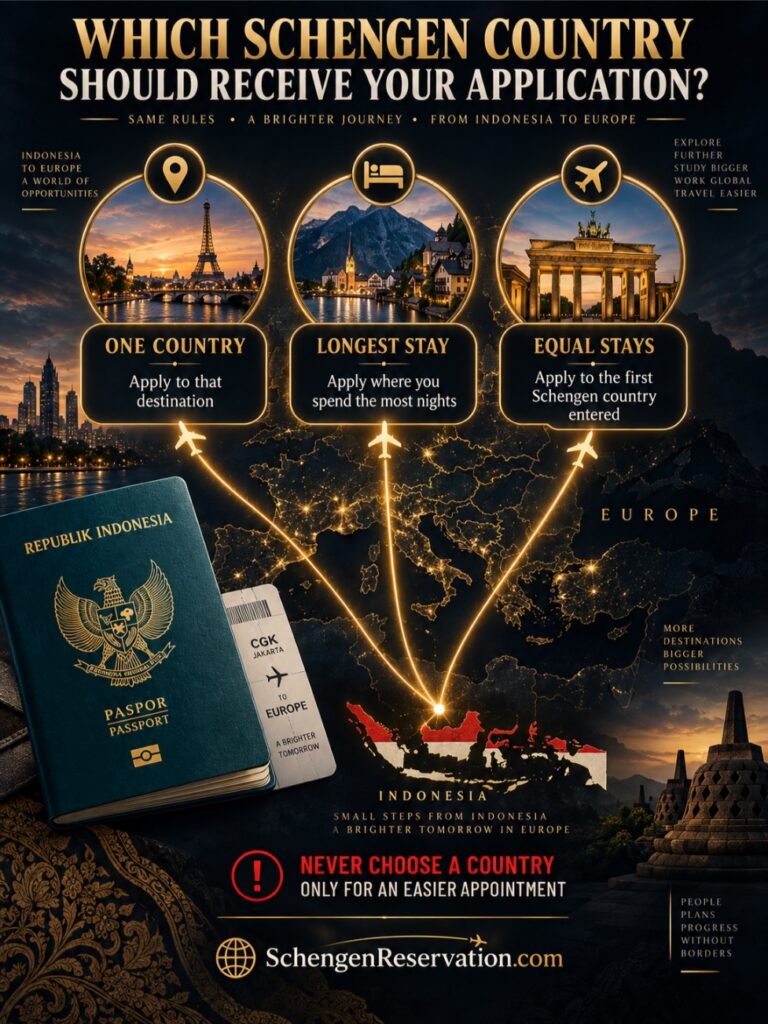
The European Commission states that when a traveller visits several Schengen countries, the application should normally be lodged with the country where the traveller will spend the longest period. When the stays are equal, the application generally belongs to the country of first entry.
Rule 1: Apply to Your Only Destination
If the entire holiday is in Italy, the application belongs to Italy.
Rule 2: Apply to Your Main Destination
Consider this itinerary:
France – 6 nights
Belgium – 2 nights
Netherlands – 3 nights
France is ordinarily the main destination because the traveller will spend the greatest part of the trip there.
Rule 3: Consider the Principal Purpose
Duration is important, but the primary purpose can also be decisive.
An Indonesian company director attending a specialist industrial conference in Germany before spending several leisure days elsewhere may need to apply through Germany where the professional event is clearly the principal reason for travelling.
Rule 4: Use First Entry When the Stays Are Equal
Suppose an itinerary contains:
Austria – 4 nights
Czech Republic – 4 nights
First Schengen entry – Vienna
Where there is no stronger principal purpose, Austria would generally be the competent country.
First Entry Does Not Automatically Mean Main Destination
A common misunderstanding is that applicants must always apply to the country where the aircraft first lands.
An Indonesian traveller could fly:
Jakarta → Amsterdam → Rome
and remain in Italy for ten nights.
Passing immigration in Amsterdam does not automatically make the Netherlands the correct visa authority. If Italy is genuinely the main destination, the application normally belongs to Italy.
Why Visa Shopping Is Particularly Risky
“Visa shopping” means restructuring an application around a supposedly easier embassy instead of the real journey.
Examples include:
- Applying to the Netherlands while spending almost the entire trip in France
- Reserving several artificial nights in one country to create jurisdiction
- Cancelling the stated main destination immediately after approval
- Producing a hotel sequence inconsistent with the cover letter
- Applying through a country because online forums claim it has a higher approval rate
Schengen authorities can compare itinerary information, visa history, entry and exit records and supporting documents.
With the Entry/Exit System fully operational since 10 April 2026, relevant short-stay border movements are also recorded electronically rather than relying solely on passport stamps.
The safer strategy is simple: determine the genuine journey first and choose the embassy second.
Schengen Visa Types from Indonesia
Selecting the correct Schengen visa type is mandatory because the legal purpose, duration and supporting evidence differ between categories.
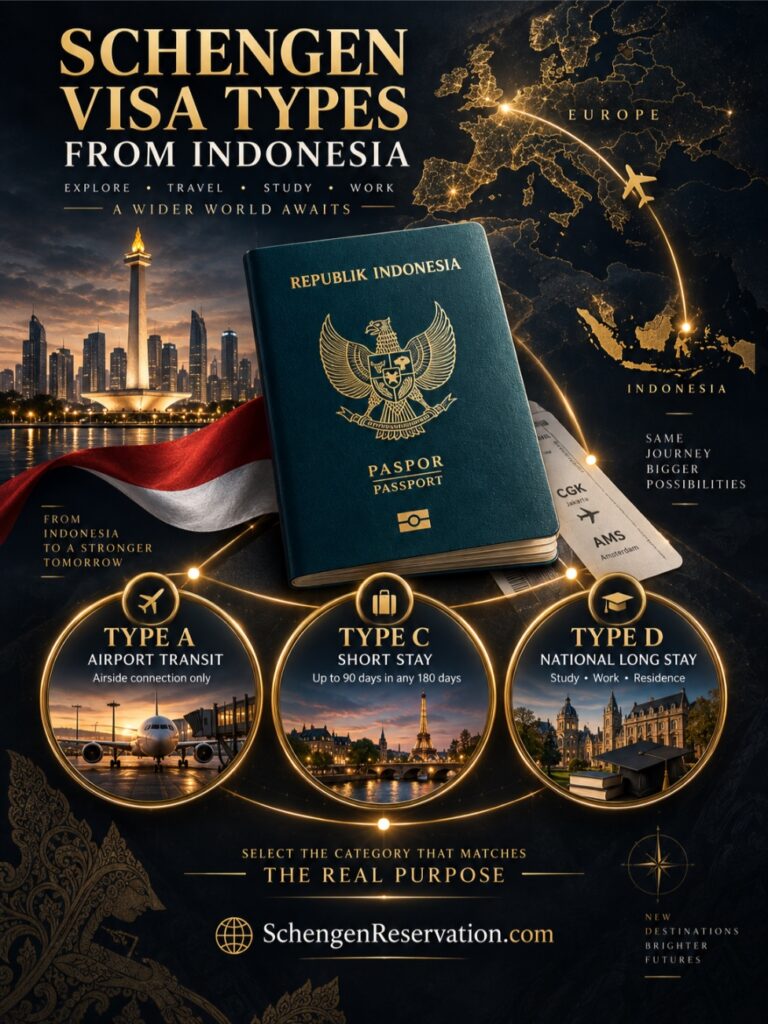
Type A – Airport Transit Visa
A Type A visa is designed for travellers who need to pass through the international transit area of a Schengen airport while continuing to a destination outside the Schengen territory.
It generally does not permit the holder to:
- Enter the Schengen territory
- Leave the international transit area
- Stay at a hotel outside the airport
- Travel between different airports
- Continue by rail, road or a domestic flight requiring formal entry
Indonesian travellers should check the specific transit requirements for the airport and itinerary before applying because airport-transit obligations depend on nationality, route, existing visas or residence permits and the country through which transit occurs.
Do not assume a connection is airside merely because both flights use the same airport.
Type C – Short-Stay Schengen Visa
The Type C visa is the principal category used by Indonesian tourists, business travellers and private visitors.
It permits temporary stays subject to the 90-days-in-any-180-days rule and may be issued for:
- Tourism
- Family visits
- Friend visits
- Business meetings
- Trade exhibitions
- Conferences
- Short professional assignments that do not constitute prohibited employment
- Medical treatment
- Cultural participation
- Sporting events
- Short educational visits
- Religious events
- Official visits
Single-Entry Schengen Visa
The holder may enter the Schengen area once.
Once the traveller leaves the Schengen area, the visa’s entry entitlement is normally consumed even where unused authorised days remain.
Double-Entry Schengen Visa
The holder may enter the Schengen territory twice during the period authorised by the visa.
Multiple-Entry Schengen Visa
A multiple-entry visa permits repeated entries while the visa remains valid, provided that the traveller continues respecting the authorised stay and the 90/180-day rule.
Important 2025–2026 Advantage for Indonesian Nationals: Five-Year Multiple-Entry Visa Cascade
Indonesia gained an important Schengen visa facilitation in July 2025.
Under the newer EU “cascade” regime, Indonesian nationals residing in Indonesia may qualify for a multiple-entry Schengen visa valid for five years after obtaining and lawfully using one Schengen visa during the previous three years, provided that the passport remains valid for the necessary period and the other conditions are satisfied.
This is a significant development for frequent Indonesian travellers.
It does not mean:
- Every second application automatically receives five years
- Previous lawful travel eliminates financial requirements
- The holder may remain in Europe for five continuous years
- The holder may work freely
- Border entry becomes automatic
The 90-days-in-180-days limitation still applies.
For a repeat traveller, previous compliant travel has therefore become even more valuable. Preserve copies of previous visas and ensure every previous trip respected the permitted duration.
Type D – National Long-Stay Visa
A Type D visa belongs to the national immigration system of an individual Schengen state.
It may be relevant to:
- University study
- Employment
- Family reunification
- Research
- Long-term professional assignments
- Residence
- Certain internships
- Other stays exceeding 90 days
A Type D visa should not be confused with a long-validity Type C multiple-entry visa.
A five-year Type C visa still governs short visits. It does not create a five-year residence right.
Ultimate Schengen Visa Requirements from Indonesia
The exact documentation depends on the destination country, visa purpose and applicant profile. Nevertheless, Indonesian applications generally contain a recognisable core set of evidence.
Official Schengen rules require evidence relating to the journey’s purpose, accommodation, sufficient financial means and circumstances enabling the authority to assess whether the applicant intends to leave before the permitted stay expires.
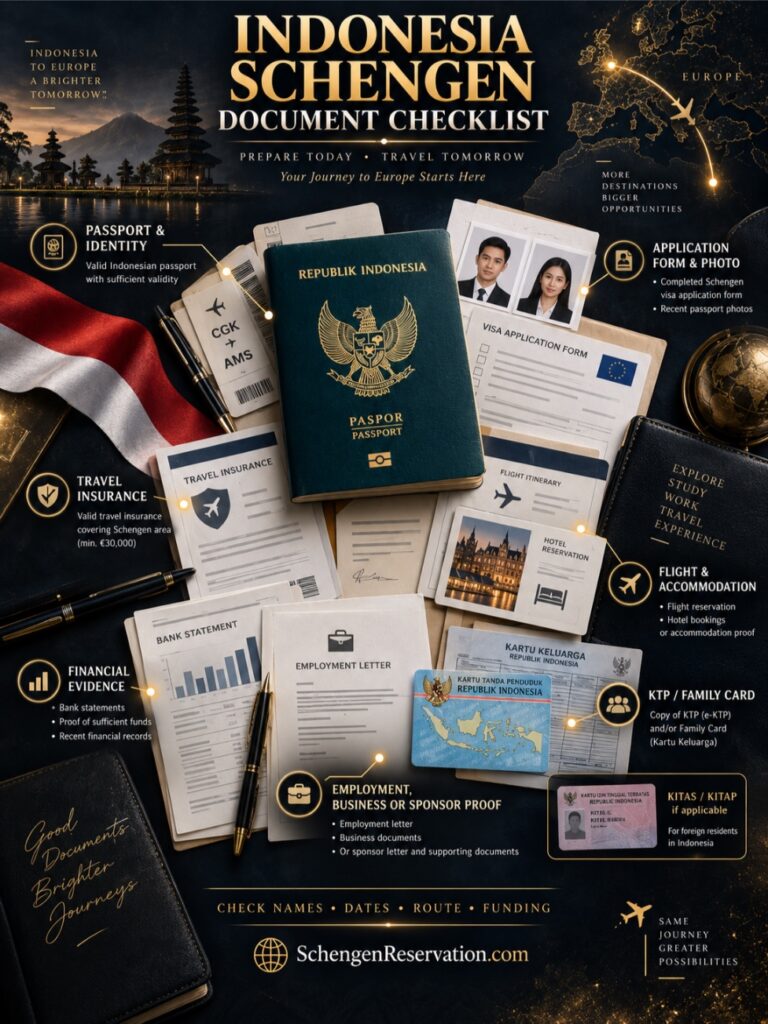
- Valid Indonesian Passport
The passport should normally:
- Have been issued within the previous 10 years
- Remain valid for at least three months after the intended departure from the Schengen area
- Contain at least two blank pages
- Be intact and readable
- Carry the applicant’s correct identity details
Previous passports can also be useful where they demonstrate lawful travel history.
For some application channels, particular attention is paid to the passport holder’s signature. For example, Dutch guidance specifically notes recognition requirements relating to signed Indonesian passports or the appropriate endorsement.
- Completed Schengen Visa Application Form
Every field should agree with the supporting documentation.
Double-check:
- Name
- Previous surname
- Date and place of birth
- Passport number
- Nationality
- Occupation
- Employer
- Travel dates
- Main destination
- First destination
- Number of entries requested
- Accommodation
- Host information
- Who pays for the journey
A typographical error in a hotel name is different from a material contradiction. Passport numbers, travel dates and destination details deserve a character-by-character check.
- Recent Visa Photograph
Provide a recent photograph meeting the biometric specifications required by the competent country.
Avoid:
- Old photographs
- Heavy digital retouching
- Incorrect dimensions
- Inappropriate backgrounds
- Images materially different from your current appearance
- Indonesian Identity and Family Documentation
Indonesia-specific supporting documents can be important.
Depending on the embassy and purpose, applicants may be asked for documents such as:
- KTP – Kartu Tanda Penduduk
- Kartu Keluarga – Family Card
- Birth certificate
- Marriage certificate
- Other civil-status documents
Spain’s current tourism checklist, for example, requires Indonesian applicants to provide KTP and Kartu Keluarga copies. Harmonised documentation used in Indonesia also recognises family and civil documents as evidence of socio-economic and social ties.
- Proof of Legal Residence for Non-Indonesian Applicants
Foreign nationals applying from Indonesia normally need evidence of lawful residence.
Depending on the embassy, this may include:
- KITAS
- KITAP
- Other accepted Indonesian residence authorisation
Germany’s current Jakarta checklist, for example, requires non-Indonesian applicants to show KITAS/KITAP meeting the stated validity requirements.
A tourist temporarily visiting Indonesia should not assume that being physically present in Jakarta makes them eligible to submit a Schengen application there.
- Travel Medical Insurance
Standard Schengen rules require adequate travel medical insurance.
The policy should generally:
- Cover all Schengen states
- Cover the entire intended stay
- Provide at least €30,000 medical coverage
- Include emergency medical treatment
- Include hospital treatment
- Include medical repatriation
- Meet any additional requirements specified by the destination country
The policy dates should agree with the journey.
Insurance ending before the return flight is an avoidable inconsistency.
- Flight Reservation or Travel Itinerary
A flight itinerary establishes the planned movement into and out of Europe.
Depending on the journey, this might include:
- Round-trip flight reservation
- Multi-city itinerary
- Connecting flights
- Ferries
- Rail connections
- Cross-border transport reservations
The schedule should make geographical sense.
For example:
Jakarta → Paris
Paris → Brussels by rail
Brussels → Amsterdam by rail
Amsterdam → Jakarta
is easier to understand than disconnected reservations that omit the movement between destination cities.
Do You Need to Buy the Final Flight Ticket?
Follow the wording of the competent embassy’s checklist.
Several Schengen checklists request a reservation or itinerary rather than requiring applicants to expose themselves prematurely to the full cost of restrictive air tickets.
A reservation used for a visa application must nevertheless represent the applicant’s real travel plan.
Never present a reservation as a paid e-ticket if it is not one.
- Proof of Accommodation
The accommodation file should account for every night.
Acceptable evidence can include:
- Hotel reservations
- Serviced-apartment confirmations
- Tour accommodation
- Official host accommodation documents
- Private invitation
- Mixed hotel and family accommodation
For a multi-country journey, check:
Flight arrival: 4 May
Paris hotel: 4 – 7 May
Brussels hotel: 7 – 10 May
Amsterdam hotel: 10 – 13 May
Return flight: 13 May
There should not be an unexplained night on 9 May or an accommodation booking beginning after the applicant reaches the city.
- Proof of Financial Means
Financial evidence is one of the most misunderstood parts of the application.
A high bank balance does not automatically equal a strong file.
A consular authority may consider:
- Amount available
- Regular income
- Account activity
- Source of funds
- Travel duration
- Number of travellers
- Accommodation cost
- Sponsor arrangements
- Financial obligations in Indonesia
Official supporting-document guidance used for applicants in Indonesia includes recent personal bank statements or balances, and may also accept evidence connected with international credit cards or income.
Three-Month Financial Narrative
Where an embassy requests the previous three months of banking activity, evaluate the statement as a narrative rather than a single number.
A stable pattern such as:
salary → normal expenditure → regular saving → sufficient closing balance
is usually easier to understand than:
almost empty account → enormous unexplained cash deposit → visa application three days later.
Large Deposits Are Not Automatically Fatal
Legitimate recent funds might come from:
- Annual bonus
- Sale of property
- Business payment
- Matured investment
- Family transfer
- Dividend
- Reimbursement
- Rental income
The key issue is traceability.
Provide documentation that explains the transaction where necessary.
- Employment Evidence
Employees may need documentation such as:
- Employment certificate
- Position
- Employment start date
- Salary
- Approved leave
- Labour contract
- Recent payslips
- Employer contact details
- Bank records showing salary credits
The employment letter should support rather than contradict the itinerary.
If the employer grants leave from 3 to 12 September, the travel itinerary should not show a return on 21 September without explanation.
- Business Owners and Self-Employed Applicants
An Indonesian business owner may need to demonstrate that the business genuinely exists and that the applicant is financially connected to it.
Depending on the business structure and embassy checklist, useful material might include:
- NIB or applicable business registration
- Company incorporation documents
- Tax documents
- Company bank records
- Personal bank records
- Contracts
- Invoices
- Ownership evidence
- Client activity
- Company profile
Avoid treating company money and personal money as interchangeable without explaining the relationship.
- Students
Students may provide:
- Current enrolment certificate
- Student card
- Academic schedule
- School or university letter
- Holiday confirmation
- Sponsor documents
- Sponsor’s bank statements
- Proof of relationship
A student proposing travel during examination week should address that discrepancy rather than hoping it goes unnoticed.
- Retired Applicants
Retired travellers can demonstrate circumstances through:
- Pension evidence
- Savings
- Bank statements
- Property
- Family ties
- Previous travel
- Sponsorship where appropriate
Retirement does not mean the applicant lacks return ties.
The file simply needs to present those ties differently.
- Unemployed Applicants
Unemployment does not automatically make someone ineligible for a Schengen visa.
The file may instead rely on:
- Personal savings
- Sponsor
- Spouse’s income
- Family responsibilities
- Current training
- Property
- Genuine personal circumstances
- Evidence explaining the reason for the journey
Inventing an employer is considerably more damaging than truthfully explaining unemployment.
- Proof of Travel Purpose
The application must establish why the trip exists.
Tourism
A tourism application may include:
- City itinerary
- Hotel bookings
- Flight reservation
- Internal transport
- Leave approval
- Activity plan
- Cover letter
Avoid creating a theatrical itinerary containing ten tourist attractions every day.
A realistic schedule is more credible than an impossible one.
Family or Friend Visit
Possible documentation includes:
- Invitation
- Host identity
- Host address
- Residence permit
- Proof of relationship
- Sponsorship undertaking
- Destination-specific accommodation declaration
Business
A business application may contain:
- European company invitation
- Indonesian employer letter
- Meeting agenda
- Conference registration
- Trade-fair entry
- Evidence of commercial relationship
- Expense responsibility
- Return-to-work evidence
The Indonesian company and European host should describe the same trip.
Medical Treatment
Evidence may include:
- Diagnosis or referral
- European medical provider confirmation
- Treatment schedule
- Cost estimate
- Financing
- Accommodation
- Accompanying-person details
Cultural or Sporting Purpose
Provide evidence from the participating organisation, event or association demonstrating:
- Applicant identity
- Event
- Dates
- Venue
- Role
- Financial responsibility
- Proof of Intention to Return to Indonesia
A temporary visa file should make return plausible.
Useful factors can include:
- Continuing employment
- Business ownership
- Current education
- Dependent family members
- Property
- Lease
- Professional engagements
- Return-to-work deadline
- Academic obligations
- Established economic activity
Kartu Keluarga, birth records and employment documentation can also help demonstrate social and socio-economic context.
No single “home ties certificate” exists.
The authority evaluates the applicant’s situation as a whole.
- Cover Letter
A well-written Schengen visa cover letter can function as the narrative index of the file.
It can explain:
- Purpose
- Travel dates
- Main destination
- Secondary destinations
- Why this embassy is competent
- Employment
- Funding
- Accommodation
- Transport
- Sponsor
- Previous travel
- Unusual financial activity
- Return obligations
Keep the letter factual.
Avoid repeatedly stating:
“I guarantee I will return.”
Evidence is stronger than promises.
- Requirements for Minors from Indonesia
A minor may need:
- Separate application
- Passport
- Birth certificate
- Kartu Keluarga
- Parents’ identity documents
- Financial sponsorship
- School certificate
- Insurance
- Reservations
- Parental authorisation
For a child travelling with only one parent, written permission from the non-travelling parent may be required. Depending on the competent country’s checklist, notarisation or other formalisation may also be necessary.
Indonesia-Specific Approval Matrix: The Four Files Inside Your File
Instead of viewing the application as one pile of documents, divide it mentally into four evidence systems.
File A: Identity
The question:
Who is travelling?
This includes:
- Passport
- Application form
- KTP
- Kartu Keluarga
- Civil-status records
- Residence permit where relevant
File B: Journey
The question:
What exactly is the applicant planning to do?
This includes:
- Cover letter
- Flight itinerary
- Hotels
- Invitations
- Transport
- Business meetings
- Event registrations
File C: Financial Capacity
The question:
Can this person realistically finance the journey?
This includes:
- Bank statements
- Salary
- Savings
- Sponsor
- Business income
- Travel budget
File D: Return Context
The question:
Why does the journey logically end with a return to Indonesia?
This includes:
- Job
- Business
- School
- Family
- Assets
- Professional obligations
- Previous compliant travel
A strong application is created when all four files support one another.
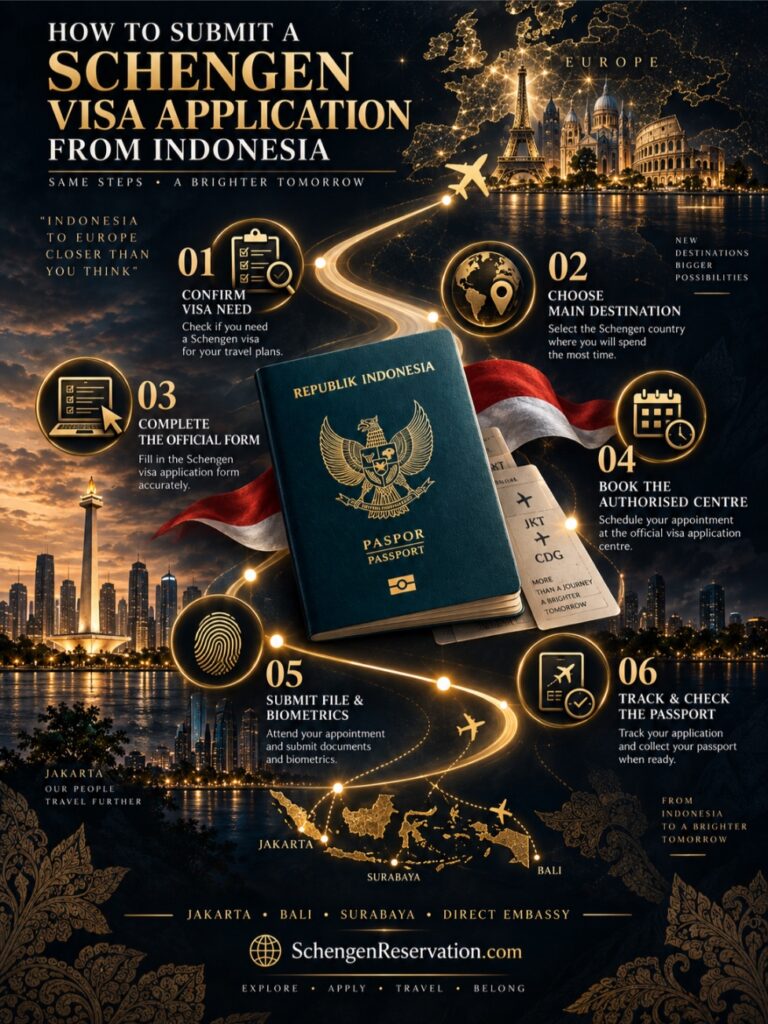
Step-by-Step Schengen Visa Application Process from Indonesia
Step 1: Build the Actual Journey
Decide:
- Purpose
- Destination
- Dates
- Number of nights
- Funding
- Accommodation
- Internal transport
Only then identify the responsible embassy.
Step 2: Identify the Competent Schengen State
Apply according to:
- Sole destination
- Main destination
- Principal purpose
- First entry where stays are equal
Do not begin by searching for the embassy with the shortest queue.
Step 3: Find the Correct Indonesian Submission Channel
Indonesia has several types of channels:
- VFS Global
- TLScontact
- BLS International
- Direct embassy/consular submission
- Schengen representation arrangements
A VFS appointment for Germany cannot be substituted for a VFS appointment for Italy merely because both operate from the same building.
Step 4: Download the Exact Checklist
The checklist must match:
- Country
- Visa category
- Purpose
- Applicant profile
A Dutch tourism checklist should not be used as the final checklist for a Spanish business application.
Step 5: Prepare the Time-Sensitive Documents
A useful sequence is:
- Confirm leave
- Fix itinerary
- Prepare flight reservation
- Arrange accommodation
- Obtain insurance
- Collect recent bank statements
- Prepare employer/business documents
- Complete form
- Prepare cover letter
- Conduct consistency audit
Step 6: Book Through the Authorised Portal
Do not buy appointments from social-media intermediaries.
Official visa providers repeatedly warn applicants that premium services and third parties cannot influence visa decisions. Spain’s BLS portal specifically warns against intermediaries selling appointments and confirms that the decision remains with the competent authorities.
Step 7: Attend the Submission Appointment
At the appointment, the applicant may:
- Submit documents
- Present passport
- Pay fees
- Provide fingerprints
- Provide photograph
- Answer basic questions
Under Schengen rules, fingerprints are generally collected unless an applicable exemption exists or valid prior biometric data can be reused under the relevant procedure.
Step 8: Pay Visa and Service Fees
The standard Schengen short-stay visa fee is currently:
Adults: €90
Children aged 6 to under 12: €45
Children under 6: generally exempt
External service-centre charges may be payable separately.
The Indonesian-rupiah equivalent can change with the exchange rate used by the mission or provider.
Step 9: Wait for the Decision
The standard processing period is generally around 15 calendar days, although individual applications can be extended to 45 days where additional examination is required.
Submission through regional centres can also introduce transportation time.
For example, Germany currently advises that applications submitted in Bali and Surabaya can require additional time compared with Jakarta because of courier movement.
Step 10: Examine the Visa Sticker
After approval, verify:
- Name
- Passport number
- Valid from
- Valid until
- Number of entries
- Duration of stay
- Territorial validity
An error should be reported immediately.
When Should You Apply from Indonesia?
A Schengen application can generally be submitted up to six months before travel and should normally be lodged at least 15 days before departure.
Waiting until the final legal deadline is unwise.
Appointment shortages, courier movement, public holidays, document requests and additional examination can all delay the process.
For peak travel periods, begin planning considerably earlier.
Schengen Visa Application Channels in Indonesia
Indonesia’s application network is more decentralised than that of many other countries.
VFS Global
VFS handles a large proportion of Schengen destinations and maintains application operations in Jakarta as well as selected services in cities such as Bali and Surabaya depending on the destination.
TLScontact
France currently uses TLScontact in Jakarta. Applicants first complete the France-Visas procedure and then lodge the application through TLScontact.
BLS International
Spain uses BLS International as its authorised visa application channel in Indonesia.
Direct Embassy Routes
Certain states operate direct or partially direct consular routes. Poland, Greece and Romania are important examples where applicants should pay close attention to the embassy’s own procedure.
Where to Apply for Every Schengen Country from Indonesia
Provider relationships can change. Applicants should reconfirm the live embassy or authorised provider page before booking.
Applying for an Austrian Schengen Visa from Indonesia
Austria uses VFS Global for visa applications in Indonesia.
The Austrian Embassy in Jakarta also represents Malta and Slovenia for relevant short-stay Type C visa applications.
Applicants should therefore select Austria only where Austria is genuinely their competent destination; Malta and Slovenia cases should follow the specific representation instructions.
Austria Visa Application Centres in Indonesia:
Jakarta: VFS Global, Kuningan City Mall, 1st Floor, L1 30–32, Jl. Prof. Dr. Satrio Kav. 18, Setiabudi, Kuningan 12940, Jakarta, Indonesia.
Bali: VFS Global, Park 23, 3rd Floor, Units L3-22, 23 and 23A, Jl. Kediri, Tuban, Kuta, Badung Regency, Bali 80361, Indonesia.
Applying for a Belgian Schengen Visa from Indonesia
Belgium has a short-stay representation arrangement with the Netherlands in Indonesia.
Belgian Schengen visa applicants therefore use the Dutch/Benelux VFS Global application network for eligible Type C applications.
Netherlands Visa Application Centres in Indonesia:
Bali: VFS Global, Park 23, 3rd Floor, Units L3-22, 23 and 23A, Jl. Kediri, Tuban, Kuta, Badung Regency, Bali 80361, Indonesia.
Jakarta: VFS Global, Kuningan City Mall, 1st Floor, Units L1-30–32, Jl. Prof. Dr. Satrio Kav. 18, Setiabudi, Kuningan, Jakarta 12940, Indonesia.
Surabaya: VFS Global, Graha Bukopin, 12th Floor, Jl. Panglima Sudirman No. 10–18, Embong Kaliasin, Surabaya, East Java 60271, Indonesia.
Applying for a Bulgarian Schengen Visa from Indonesia
Bulgaria currently works with VFS Global in Indonesia for visa application intake.
Applicants should use the Bulgarian VFS channel rather than outdated pre-Schengen guidance.
Bulgaria Visa Application Centre in Indonesia:
Jakarta: VFS Global Bulgaria Visa Application Centre, Kuningan City Mall, 1st Floor, No. L1-30/32, Jl. Prof. Dr. Satrio Kav. 18, Setiabudi, Kuningan, Jakarta 12940, Indonesia.
Applying for a Croatian Schengen Visa from Indonesia
Croatia receives visa applications through VFS Global in Indonesia.
The Croatian VFS channel identifies itself as the official partner of the Croatian Embassy, with Schengen submission available in Jakarta.
Croatia Visa Application Centre in Indonesia:
Jakarta: VFS Global Croatia Visa Application Centre, Schengen Visa Application Centre, Kuningan City Mall, 1st Floor, Jl. Prof. Dr. Satrio Kav. 18, Setiabudi, Kuningan, Jakarta, Indonesia.
Applying for a Czech Republic Schengen Visa from Indonesia
Short-stay Czech Schengen visa applications are lodged through VFS Global in Jakarta.
The Czech Embassy confirms that ordinary short-stay applications use the external VFS provider, while certain special cases may be lodged directly with the embassy.
Czech Republic Visa Application Centre in Indonesia:
Jakarta: VFS Global Czech Republic Visa Application Centre, Kuningan City Mall, 1st Floor, L1-30–32, Jl. Prof. Dr. Satrio Kav. 18, Setiabudi, Kuningan, Jakarta 12940, Indonesia. VFS Global is the official partner of the Embassy of the Czech Republic in Indonesia.
Applying for a Danish Schengen Visa from Indonesia
Denmark uses VFS Global.
Applicants normally complete the Danish ApplyVisa process before attending the visa application centre.
Denmark Visa Application Centre in Indonesia:
Jakarta: VFS Global Denmark Visa Application Centre, Kuningan City Mall, 1st Floor, L1-30–32, Jl. Prof. Dr. Satrio Kav. 18, Setiabudi, Kuningan, Jakarta 12940, Indonesia.
Applying for an Estonian Schengen Visa from Indonesia
Finland represents Estonia for Schengen visa purposes in Indonesia.
Applicants whose genuine main destination is Estonia should therefore follow the designated Finland/VFS Global route while clearly presenting Estonia as the main destination.
Finland Visa Application Centres in Indonesia:
Jakarta: VFS Global Finland Visa Application Centre, Kuningan City Mall, 1st Floor, L1-30–32, Jl. Prof. Dr. Satrio Kav. 18, Setiabudi, Kuningan, Jakarta 12940, Indonesia.
Bali: VFS Global Finland Visa Application Centre, Park 23, 3rd Floor, Units L3-22, 23 and 23A, Jl. Kediri, Tuban, Kuta, Badung Regency, Bali 80361, Indonesia.
Applying for a Finnish Schengen Visa from Indonesia
Finland uses VFS Global.
Finland’s official guidance directs applicants to the designated Visa Application Centre and requires in-person submission where biometrics must be collected.
Finland Visa Application Centres in Indonesia:
Jakarta: VFS Global Finland Visa Application Centre, Kuningan City Mall, 1st Floor, L1-30–32, Jl. Prof. Dr. Satrio Kav. 18, Setiabudi, Kuningan, Jakarta 12940, Indonesia.
Bali: VFS Global Finland Visa Application Centre, Park 23, 3rd Floor, Units L3-22, 23 and 23A, Jl. Kediri, Tuban, Kuta, Badung Regency, Bali 80361, Indonesia.
Applying for a French Schengen Visa from Indonesia
France uses a two-stage process:
- Complete the application through France-Visas
- Book and submit through TLScontact Jakarta
TLScontact receives the file; the French consular authority decides it.
France Visa Application Centre in Indonesia:
Jakarta: TLScontact France Visa Application Centre, The Plaza Office Tower, 25th Floor, Jl. M.H. Thamrin Kav. 28–30, Jakarta 10350, Indonesia.
Applying for a German Schengen Visa from Indonesia
Germany uses VFS Global in Indonesia.
Visa application centres operate under the German Embassy’s authorised VFS system, with submission options including Jakarta and destination-specific services in Bali or Surabaya.
Germany Visa Application Centres in Indonesia:
Jakarta: VFS Global Germany Visa Application Centre, Kuningan City Mall, 1st Floor, L1 30–32, Jl. Prof. Dr. Satrio Kav. 18, Setiabudi, Kuningan, Jakarta 12940, Indonesia.
Bali: VFS Global Germany Visa Application Centre, Park 23, 3rd Floor, Units L3-22, 23 and 23A, Jl. Kediri, Tuban, Kuta, Badung Regency, Bali 80361, Indonesia. VFS confirms the Bali Germany centre is operational for VIS and non-VIS applications.
Surabaya: VFS Global Germany Visa Application Centre, Graha Bukopin, 12th Floor, Jl. Panglima Sudirman No. 10–18, Surabaya 60271, East Java, Indonesia.
Applying for a Greek Schengen Visa from Indonesia
The Greek Embassy announced that from 1 January 2026 and until further notice, the Consular Office of the Embassy of Greece in Jakarta is solely responsible for accepting visa applications.
Applicants should therefore follow the current embassy instructions rather than older provider arrangements.
Greece Visa Application Centre in Indonesia:
Jakarta: Consular Office, Embassy of Greece, Plaza 89, 12th Floor, Suite 1203, Jl. H.R. Rasuna Said Kav. X-7, No. 6, Jakarta 12940, Indonesia. Tourism visa applicants are instructed to book their appointment online through the designated Greece visa application system; applicants travelling for other purposes should contact the Consular Office of the Embassy of Greece in Jakarta.
Applying for a Hungarian Schengen Visa from Indonesia
Hungary receives applications through VFS Global.
The Hungarian Embassy states that VFS has handled visa submissions since 2023 and currently allows submission in Jakarta and Surabaya according to the published procedure.
Hungary also issues short-stay visas in Indonesia on behalf of Lithuania under the applicable representation arrangement.
Hungary Visa Application Centres in Indonesia:
Jakarta: VFS Global Hungary Visa Application Centre, Kuningan City Mall, 1st Floor, L1-30–32, Jl. Prof. Dr. Satrio Kav. 18, Setiabudi, Kuningan, Jakarta 12940, Indonesia.
Surabaya: VFS Global Hungary Visa Application Centre, Graha Bukopin, 12th Floor, Jl. Panglima Sudirman No. 10–18, Surabaya 60271, East Java, Indonesia.
Applying for an Icelandic Schengen Visa from Indonesia
Iceland now has its own VFS Global Indonesia application channel.
Applicants should note an important 2026 change: Denmark announced that it stopped representing Iceland in Indonesia from 3 February 2026. Iceland applications should therefore follow the current Iceland VFS procedure rather than older Denmark-based instructions.
Iceland Visa Application Centres in Indonesia:
Jakarta: VFS Global Iceland Visa Application Centre, Kuningan City Mall, 1st Floor, No. L1-30–32, Jl. Prof. Dr. Satrio Kav. 18, Setiabudi, Kuningan, Jakarta 12940, Indonesia.
Bali: VFS Global Iceland Visa Application Centre, Park 23, 3rd Floor, Units L3-22, 23 and 23A, Jl. Kediri, Tuban, Kuta, Badung Regency, Bali 80361, Indonesia.
Surabaya: VFS Global Iceland Visa Application Centre, Graha Bukopin, 12th Floor, Jl. Panglima Sudirman No. 10–18, Surabaya 60271, East Java, Indonesia.
Applying for an Italian Schengen Visa from Indonesia
Italy uses VFS Global.
Schengen applications for the Italian Embassy in Jakarta are submitted through the authorised Italy Visa Application Centre according to the current appointment process.
Italy Visa Application Centre in Indonesia:
Jakarta: VFS Global Italy Visa Application Centre, VFS Services Indonesia, Chubb Square, 9th Floor, Jl. M.H. Thamrin Kav. 8–9, Kebon Melati, Jakarta 10230, Indonesia.
Applying for a Latvian Schengen Visa from Indonesia
For short-stay Latvian Schengen visas, Germany represents Latvia in Indonesia.
Applicants use the German-authorised VFS route for the short-stay process rather than assuming that an honorary Latvian consulate can accept applications.
Latvia also has separate VFS arrangements for certain Latvian visa functions, so applicants should carefully distinguish the short-stay Schengen route from other Latvian visa procedures.
Germany Visa Application Centres in Indonesia:
Jakarta: VFS Global Germany Visa Application Centre, Kuningan City Mall, 1st Floor, L1 30–32, Jl. Prof. Dr. Satrio Kav. 18, Setiabudi, Kuningan, Jakarta 12940, Indonesia.
Bali: VFS Global Germany Visa Application Centre, Park 23, 3rd Floor, Units L3-22, 23 and 23A, Jl. Kediri, Tuban, Kuta, Badung Regency, Bali 80361, Indonesia. VFS confirms the Bali Germany centre is operational for VIS and non-VIS applications.
Surabaya: VFS Global Germany Visa Application Centre, Graha Bukopin, 12th Floor, Jl. Panglima Sudirman No. 10–18, Surabaya 60271, East Java, Indonesia.
Applying for a Liechtenstein Schengen Visa from Indonesia
Liechtenstein’s Schengen visa interests are handled through Switzerland.
Applicants whose genuine main destination is Liechtenstein should use the Swiss application route through VFS Global and ensure the itinerary establishes Liechtenstein as the primary destination.
Switzerland Visa Application Centre in Indonesia:
Jakarta: VFS Global Switzerland Visa Application Centre, Kuningan City Mall, 1st Floor, L1-30–32, Jl. Prof. Dr. Satrio Kav. 18, Setiabudi, Kuningan, Jakarta 12940, Indonesia.
Applying for a Lithuanian Schengen Visa from Indonesia
Hungary represents Lithuania for short-stay Schengen visa issuance in Indonesia.
Applicants should use the Hungarian VFS Global route where instructed and ensure that Lithuania, not Hungary, is clearly demonstrated as the genuine main destination.
Hungary Visa Application Centres in Indonesia:
Jakarta: VFS Global Hungary Visa Application Centre, Kuningan City Mall, 1st Floor, L1-30–32, Jl. Prof. Dr. Satrio Kav. 18, Setiabudi, Kuningan, Jakarta 12940, Indonesia.
Surabaya: VFS Global Hungary Visa Application Centre, Graha Bukopin, 12th Floor, Jl. Panglima Sudirman No. 10–18, Surabaya 60271, East Java, Indonesia.
Applying for a Luxembourg Schengen Visa from Indonesia
Luxembourg participates in the Benelux representation arrangement.
Short-stay applications are processed through the Netherlands’ VFS Global network in Indonesia.
Netherlands Visa Application Centres in Indonesia:
Bali: VFS Global, Park 23, 3rd Floor, Units L3-22, 23 and 23A, Jl. Kediri, Tuban, Kuta, Badung Regency, Bali 80361, Indonesia.
Jakarta: VFS Global, Kuningan City Mall, 1st Floor, Units L1-30–32, Jl. Prof. Dr. Satrio Kav. 18, Setiabudi, Kuningan, Jakarta 12940, Indonesia.
Surabaya: VFS Global, Graha Bukopin, 12th Floor, Jl. Panglima Sudirman No. 10–18, Embong Kaliasin, Surabaya, East Java 60271, Indonesia.
Applying for a Maltese Schengen Visa from Indonesia
The Austrian Embassy in Jakarta represents Malta for eligible short-stay Schengen visa applications.
Applicants should therefore use the designated Austria/VFS Global route for Malta.
Austria Visa Application Centres in Indonesia:
Jakarta: VFS Global, Kuningan City Mall, 1st Floor, L1 30–32, Jl. Prof. Dr. Satrio Kav. 18, Setiabudi, Kuningan 12940, Jakarta, Indonesia.
Bali: VFS Global, Park 23, 3rd Floor, Units L3-22, 23 and 23A, Jl. Kediri, Tuban, Kuta, Badung Regency, Bali 80361, Indonesia.
Applying for a Netherlands Schengen Visa from Indonesia
The Netherlands receives applications through VFS Global.
Official Dutch guidance currently lists visa submission facilities in:
- Bali
- Jakarta
- Surabaya
These centres also serve the relevant Belgian and Luxembourg short-stay representation arrangements.
Netherlands Visa Application Centres in Indonesia:
Bali: VFS Global, Park 23, 3rd Floor, Units L3-22, 23 and 23A, Jl. Kediri, Tuban, Kuta, Badung Regency, Bali 80361, Indonesia.
Jakarta: VFS Global, Kuningan City Mall, 1st Floor, Units L1-30–32, Jl. Prof. Dr. Satrio Kav. 18, Setiabudi, Kuningan, Jakarta 12940, Indonesia.
Surabaya: VFS Global, Graha Bukopin, 12th Floor, Jl. Panglima Sudirman No. 10–18, Embong Kaliasin, Surabaya, East Java 60271, Indonesia.
Applying for a Norwegian Schengen Visa from Indonesia
Norway uses VFS Global in Indonesia.
Applicants should start through the Norwegian application process and follow the current VFS submission instructions.
Norway Visa Application Centre in Indonesia:
Jakarta: VFS Global Norway Visa Application Centre, Kuningan City Mall, 1st Floor, Jl. Prof. Dr. Satrio Kav. 18, Setiabudi, Kuningan, Jakarta 12940, Indonesia. Norway’s official Indonesia guidance directs visa applicants to the VFS Schengen Visa Application Centre in Jakarta.
Applying for a Polish Schengen Visa from Indonesia
Poland currently accepts Schengen applications directly through the Consular Section of the Embassy of Poland in Jakarta.
Appointments are booked through the official e-Konsulat system, and applications are generally submitted personally.
Poland Visa Application Centre in Indonesia:
Jakarta: Consular Section of the Embassy of the Republic of Poland, Jl. H.R. Rasuna Said Kav. X, Blok IV/3, Setiabudi, Jakarta 12950, Indonesia.
Applying for a Portuguese Schengen Visa from Indonesia
Portugal uses VFS Global as its official visa application partner in Indonesia.
Applicants should select the correct short-stay category and follow the Portugal-specific checklist.
Portugal Visa Application Centre in Indonesia:
Jakarta: VFS Global Portugal Visa Application Centre, Kuningan City Mall, 1st Floor, L1-30–32, Jl. Prof. Dr. Satrio Kav. 18, Setiabudi, Kuningn, Jakarta 12940, Indonesia.
Applying for a Romanian Schengen Visa from Indonesia
Romania now participates fully in the Schengen framework.
Applicants should begin with Romania’s official E-VIZA process and follow the instructions for lodging the physical application with the competent Romanian diplomatic mission in Indonesia. Romania maintains an embassy in Jakarta.
Romania Visa Application Centre in Indonesia:
Jakarta: Consular Section, Embassy of Romania, 42A Jl. Teuku Cik Ditiro, Menteng, Central Jakarta 10310, Indonesia.
Applying for a Slovak Schengen Visa from Indonesia
Slovakia maintains an embassy in Jakarta and has outsourced the submission of Schengen applications to a Visa Application Centre in Jakarta BLS International.
The Slovak Embassy confirms that third-country nationals residing in Indonesia may lodge short-stay Schengen applications through the authorised visa application centre.
Applicants should verify the current centre and booking route immediately before submission because outsourced-provider arrangements can change.
Slovakia Visa Application Centres in Indonesia:
Jakarta: BLS International Slovakia Visa Application Centre, Unit No. 805, 8th Floor, Menara Thamrin, Jalan M.H. Thamrin Kav. 03, Central Jakarta 10250, Indonesia.
Denpasar (Bali): BLS International Slovakia Visa Application Centre, Unit No. L2-26A, 2nd Floor, PARK 23, Jl. Kediri, Tuban, Badung, Kuta, Bali 80361, Indonesia.
Applying for a Slovenian Schengen Visa from Indonesia
Austria represents Slovenia for eligible Type C short-stay visa applications in Indonesia.
Applicants therefore follow the authorised Austria/VFS Global route while presenting Slovenia as the actual main destination.
Austria Visa Application Centres in Indonesia:
Jakarta: VFS Global, Kuningan City Mall, 1st Floor, L1 30–32, Jl. Prof. Dr. Satrio Kav. 18, Setiabudi, Kuningan 12940, Jakarta, Indonesia.
Bali: VFS Global, Park 23, 3rd Floor, Units L3-22, 23 and 23A, Jl. Kediri, Tuban, Kuta, Badung Regency, Bali 80361, Indonesia.
Applying for a Spanish Schengen Visa from Indonesia
Spain uses BLS International.
BLS Indonesia receives short-stay visa applications on behalf of the Spanish authorities and publishes purpose-specific checklists for tourism and other categories.
Spain Visa Application Centre in Indonesia:
Jakarta: BLS International Spain Visa Application Centre, Unit No. 805, 8th Floor, Menara Thamrin, Jalan M.H. Thamrin Kav. 03, Central Jakarta 10250, Indonesia.
Applying for a Swedish Schengen Visa from Indonesia
Sweden uses VFS Global as its official application partner in Indonesia.
Applicants should use the Swedish VFS portal rather than relying on appointment resellers.
Sweden Visa Application Centre in Indonesia:
Jakarta: VFS Global Sweden Visa Application Centre, Kuningan City Mall, 1st Floor, L1-30–32, Jl. Prof. Dr. Satrio Kav. 18, Setiabudi, Kuningan, Jakarta 12940, Indonesia. VFS Global is the official partner of the Embassy of Sweden in Indonesia.
Applying for a Swiss Schengen Visa from Indonesia
Switzerland accepts Schengen applications through VFS Global.
The Swiss authorities also retain provision for certain direct embassy submissions by prior arrangement, but VFS is the normal application channel.
Switzerland Visa Application Centre in Indonesia:
Jakarta: VFS Global Switzerland Visa Application Centre, Kuningan City Mall, 1st Floor, L1-30–32, Jl. Prof. Dr. Satrio Kav. 18, Setiabudi, Kuningan, Jakarta 12940, Indonesia.
The Seven Consistency Checks That Strengthen an Indonesian Schengen Visa File
- Passport-to-Form Consistency
Names, passport number and date of birth should match exactly.
- Form-to-Itinerary Consistency
Travel dates and destination countries should align.
- Flight-to-Hotel Consistency
Every arrival and departure should fit the accommodation schedule.
- Finance-to-Trip Consistency
The budget should make sense relative to income and savings.
- Employment-to-Dates Consistency
Approved leave should cover the actual journey.
- Invitation-to-Purpose Consistency
A business invitation should not contradict a tourism narrative.
- Return-to-Indonesia Consistency
The proposed departure from Europe should logically connect with the applicant’s ongoing circumstances at home.
Common Reasons an Indonesian Schengen Visa Application Can Be Weakened
Wrong Embassy
The itinerary does not support the country receiving the application.
Last-Minute Financial Inflation
A large unexplained deposit appears immediately before submission.
Incomplete Route
Hotels are provided but transport between countries is missing.
Excessive Journey for Financial Profile
The proposed holiday costs an amount disproportionate to the applicant’s normal income without sponsorship or explanation.
Generic Purpose
The cover letter says only:
“I want to travel around Europe.”
without presenting a credible route.
Employer Contradiction
The leave letter and travel dates do not agree.
Sponsor Is Poorly Documented
The sponsor provides money but no clear proof of relationship, income or reason for sponsorship.
Accommodation Gaps
Several nights are unaccounted for.
Incorrect Representation Route
The applicant looks for a separate Lithuanian centre although Hungary represents Lithuania, or uses outdated Denmark information for Iceland after the 2026 change.
False Documents
Altered bank statements, fictitious employers and fabricated reservations are particularly dangerous because the problem becomes one of credibility rather than mere incompleteness.
A Practical 48-Hour Pre-Appointment Audit
Two days before submission, review the file as though you were seeing it for the first time.
Identity
- Passport details correct?
- KTP details consistent?
- Kartu Keluarga appropriate?
- Name spellings identical?
- Civil-status differences explained?
Journey
- Main destination correct?
- Every night covered?
- Flight dates correct?
- Internal transport logical?
- Invitation dates aligned?
Finance
- Bank statements complete?
- Large deposits explained?
- Sponsor relationship proven?
- Trip affordable?
- Salary corresponds with employment evidence?
Return
- Leave approval included?
- Work or study continuation shown?
- Family/business commitments evident?
- Return date credible?
Presentation
- Current checklist used?
- Documents arranged correctly?
- Photocopies readable?
- Translations supplied where required?
- Old or contradictory reservations removed?
How Schengen Reservation Can Support Applicants from Indonesia
Transport and accommodation evidence sits at the centre of a Schengen itinerary.
For travellers who do not want to commit immediately to every expensive or restrictive travel purchase before the visa decision, Schengen Reservation can help prepare travel-documentation components aligned with the planned application.
Services can support applicants requiring:
Flight Reservation for Schengen Visa Application from Indonesia
A structured flight itinerary can show:
- Applicant name
- Proposed departure
- Proposed return
- Airline
- Routing
- Flight details
- Entry and exit logic
For travellers visiting several European destinations, a multi-city itinerary can present the complete travel route more clearly.
Hotel Booking for Schengen Visa Purposes from Indonesia
Accommodation evidence can demonstrate:
- Destination city
- Property
- Guest
- Check-in
- Check-out
- Number of nights
Multi-country trips should cover each overnight stay.
Flight and Hotel Reservations for Schengen Visa from Indonesia
Preparing both travel layers together can reduce date conflicts between transport and accommodation.
Schengen Reservation does not decide visas and cannot guarantee approval. The final decision remains entirely with the competent embassy or consular authority.
Travel reservations also do not substitute for:
- Bank statements
- Insurance
- Employment documents
- Business documents
- Invitation
- Civil-status documents
- Proof of return
- Destination-specific requirements
Their purpose is to support the travel-evidence layer of an otherwise complete application.
Frequently Asked Questions About Applying for a Schengen Visa from Indonesia
Do Indonesian passport holders need a Schengen visa?
Yes. Indonesian ordinary-passport holders generally require a visa for short visits to the Schengen area.
Can Indonesians obtain a five-year Schengen visa?
Eligible Indonesian nationals residing in Indonesia can benefit from the newer EU cascade regime. After obtaining and lawfully using one Schengen visa within the previous three years, an applicant may qualify for a five-year multiple-entry visa if the passport has sufficient validity and the other conditions are satisfied.
It is an eligibility framework, not an unconditional approval guarantee.
What is the easiest Schengen visa for Indonesian applicants?
There is no legally designated “easiest Schengen country.”
Applicants should apply to the country that is genuinely competent for their journey.
Approval depends on the individual application rather than internet rankings.
Is there a fixed bank balance required for a Schengen visa from Indonesia?
No single balance applies to every Schengen application.
The required financial capacity depends on:
- Destination
- Trip duration
- Accommodation
- Number of travellers
- Prepaid costs
- Sponsor arrangement
- Country-specific subsistence rules
A credible financial history is normally more useful than an unexplained high closing balance.
Do I need KTP and Kartu Keluarga?
These documents are commonly relevant to Indonesian applicants, but the exact checklist depends on the destination.
Some official country checklists specifically require them, while harmonised guidance also treats family documentation as useful evidence of social ties.
Can foreigners with KITAS or KITAP apply from Indonesia?
In many cases, yes, provided they meet the responsible embassy’s residence requirements.
Different missions may impose different validity conditions, so foreign residents should verify the destination-specific rule before booking.
Can I apply from Bali or Surabaya instead of Jakarta?
It depends on the destination.
Some countries have VFS submission options outside Jakarta, while others accept applications only in Jakarta.
For example, the Netherlands currently lists Bali, Jakarta and Surabaya, while Finland lists Jakarta and Bali.
Check the specific country’s application-centre page rather than assuming every Schengen visa is available at every VFS location.
Do I have to buy a confirmed airline ticket before applying?
Follow the exact checklist of the embassy.
Where a flight reservation or itinerary is requested, applicants should not unnecessarily expose themselves to a non-refundable purchase before a visa decision.
Never misrepresent a reservation as a paid ticket.
Can a family member sponsor my trip?
Potentially, yes.
A sponsor file should normally establish:
- Sponsor identity
- Relationship
- Income
- Bank funds
- Residence
- Reason for sponsorship
- Expenses covered
The applicant’s own circumstances should still be documented.
How early can I apply?
Generally up to six months before the journey. Applications should ordinarily be filed at least 15 days before departure.
How long does processing take?
The standard Schengen decision period is generally 15 days, although it can extend to 45 days where additional examination is necessary.
Individual providers may recommend allowing additional time.
Is VFS Global responsible for approving my Schengen visa?
No.
VFS, TLScontact and BLS primarily receive applications and perform administrative functions. The relevant diplomatic authority makes the visa decision.
Will premium lounge service improve my approval chances?
No.
Optional centre services do not give an applicant preferential consideration by the embassy.
Can I visit several Schengen countries with one visa?
Yes, where the visa is valid for the relevant Schengen territory and the travel remains within its entry and duration conditions.
However, the initial application must be submitted to the correct main destination.
Does a Schengen visa guarantee entry into Europe?
No.
A valid visa authorises travel to the external border but does not eliminate border-control requirements.
Travellers may still be asked to demonstrate:
- Purpose
- Accommodation
- Return transport
- Financial means
- Insurance
- Compliance with the visa
What changed at Schengen borders in 2026?
The Entry/Exit System became fully operational at Schengen external border points on 10 April 2026 for relevant short-stay non-EU travellers.
It digitally records travel-document and entry/exit information and relevant biometric data.
What should I do if my Schengen visa is refused?
Read the refusal decision carefully.
Depending on the circumstances, the applicant may:
- Appeal according to the issuing country’s procedure
- Correct the weakness and reapply
- Provide stronger financial evidence
- Correct the destination country
- Explain return circumstances
- Restructure an unrealistic itinerary
Submitting the identical application immediately rarely resolves the underlying problem.
Final Schengen Visa Checklist for Indonesian Applicants
Before attending the appointment, confirm that:
- The correct Schengen country has been selected
- The visa type matches the travel purpose
- Passport validity is sufficient
- The passport has blank pages
- The application form is complete
- KTP is included where required
- Kartu Keluarga is included where relevant
- KITAS/KITAP is valid for foreign residents where required
- Photograph meets specifications
- Insurance covers the complete journey
- Flight itinerary reflects the genuine route
- Accommodation covers every night
- Internal transport is explained
- Financial evidence is recent
- Large deposits are traceable
- Employment or business evidence is current
- Leave dates match travel dates
- Sponsor documents are complete
- Civil-status evidence is consistent
- Minor authorisations are included where necessary
- The cover letter explains the journey clearly
- The correct authorised application channel has been used
- Previous visa history is declared accurately
- All documents are genuine
- Translations comply with the destination’s rules
- The entire file tells one coherent story
Conclusion
Applying for a Schengen visa from Indonesia is not a contest to produce the thickest document folder. The objective is to make the proposed journey intelligible.
A strong application allows the decision-maker to understand, without unnecessary speculation:
who is travelling, why the trip is taking place, which country is responsible, how the journey will be financed, where the traveller will stay and why the trip will end with a return to Indonesia.
Indonesia’s extensive visa-application network gives travellers several convenient submission options, but it also makes choosing the correct route essential. Belgium and Luxembourg are handled through the Netherlands for relevant short stays; Estonia through Finland; Lithuania through Hungary; Malta and Slovenia through Austria; Latvia’s short-stay applications through German representation; Liechtenstein through Switzerland; while France, Spain, Poland, Greece and Romania operate distinct procedures that applicants should not confuse with the general VFS network.
For Indonesian nationals with a positive Schengen travel history, the 2025 multiple-entry visa cascade has also created a significant new advantage: qualifying repeat travellers may now become eligible for substantially longer-validity multiple-entry visas. That makes compliant use of every previous visa increasingly important.
Ultimately, visa approval remains a discretionary consular decision. The most productive strategy is therefore not to search for shortcuts, “easy embassies” or artificial financial signals. It is to present a truthful, economically plausible and meticulously aligned application in which every major document confirms the same proposed journey.