
How to Apply for a Schengen Visa from Egypt: Types, Requirements and Travel Reservations
A European journey often begins with a practical question in Cairo, Alexandria or another Egyptian city: which visa application should I prepare, and what will the embassy need to see?
The answer depends on your destination, travel purpose, residence status and the length of your proposed visit. A holiday in Italy, a conference in Germany and a family visit to France may all involve a short-stay Schengen application, but their supporting evidence and appointment procedures are different.
To apply for a Schengen visa from Egypt, identify the country responsible for your trip, select the appropriate category, collect the relevant Egyptian and travel documents, and submit through the authorised channel. Your flight reservation, accommodation schedule, financial evidence and explanation of the visit should agree with one another.
This guide explains Schengen visa types, requirements for Egyptian applicants, submission routes for all 29 destinations, fees, processing times and the role of travel reservations. It also includes practical advice for employees, business owners, freelancers, students, families and foreign residents of Egypt.
Meeting the document requirements supports an application; the consular authority still evaluates the individual case and decides whether to issue a visa.
Schengen Visa from Egypt at a Glance
| Question | Practical answer |
| Who normally needs a visa? | Egyptian ordinary-passport holders visiting the Schengen area for a short stay |
| Usual category for tourism or a short business visit | Type C short-stay visa |
| General short-stay limit | Up to 90 days in any rolling 180-day period, subject to the visa issued |
| Earliest ordinary application | Six months before the planned journey |
| Ordinary latest submission | At least 15 days before departure; leave more time for appointments and examination |
| Standard decision period | Normally 15 calendar days, potentially extended to 45 |
| Standard short-stay visa fee | EUR 90 for adults; EUR 45 for children aged six to under twelve; under-six applicants generally exempt |
| Additional costs | Provider fees, insurance, translations and any optional services |
| Who makes the decision? | The responsible embassy or consular authority |
Local appointment instructions and category-specific exceptions also matter. Check the procedure for your destination before arranging your appointment and preparing the final application.
Who Can Submit a Schengen Application in Egypt?
Egyptian Citizens Living in Egypt
Egyptian ordinary-passport holders generally need a visa before a short visit to the Schengen area. A passport alone does not authorise a holiday, business meeting or private visit. Exemptions can apply to specific traveller categories, so holders of diplomatic or official passports should check their own situation.
For most residents, the application starts with the embassy or authorised visa centre serving their European destination in Egypt.
Foreign Nationals Legally Resident in Egypt
An Egyptian residence permit may allow a non-Egyptian applicant to lodge a visa application locally, but nationality and residence are separate questions. A person may need a Schengen visa because of their passport nationality while relying on Egyptian residence to establish where they can apply.
Non-Egyptian nationals applying through the Egyptian route generally need to show lawful residence valid for three months beyond their intended departure from the Schengen territory. Missions may also impose local residence conditions.
For example, certain third-country applicants using the Czech application route must meet conditions concerning a preceding period of non-touristic residence. Check eligibility before paying for translations or booking an appointment.
Egyptians Who Live Outside Egypt
An Egyptian citizen working or studying abroad should normally apply in the country of lawful residence. Returning to Egypt for a brief visit does not automatically make the Egyptian submission route appropriate.
Exceptions for legally present non-residents require justification and acceptance by the competent mission. Establish where you can apply before collecting documents for a particular submission centre.
Choosing the Schengen Country Responsible for Your Application
Choose the destination from your genuine travel plan. An available appointment should not determine the itinerary.
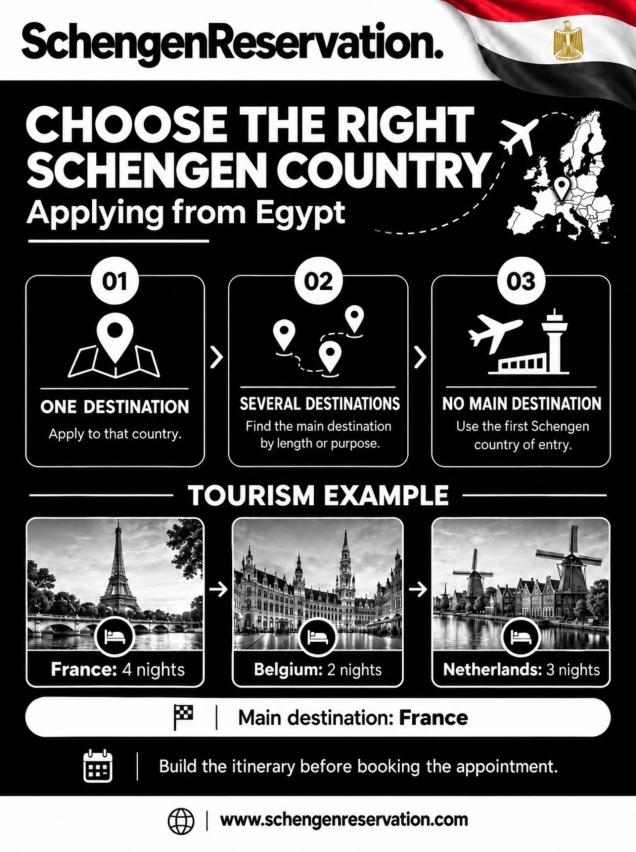
If you will visit one Schengen state, apply to that state. For several destinations, identify the main destination by the length or principal purpose of the stay. If no main destination can be established, the first Schengen country of entry determines responsibility. This distinction matters because the country where you first land is not always the country that should process your visa application.
One Destination
A traveller plans nine nights in Spain and returns to Egypt. Spain is the appropriate destination for the application, even if the flight connects through another country. The application form, accommodation evidence and cover letter should consistently describe the Spanish visit.
Several Destinations with Different Lengths of Stay
A leisure trip includes six nights in France, three in Belgium and two in the Netherlands. France is the main destination on the stated plan. Arriving through Amsterdam does not, by itself, make the Netherlands responsible. Your arrival airport and your main destination can be different.
A Trip Built Around a Specific Purpose
An Egyptian researcher attends a documented professional event in Germany and adds a leisure visit elsewhere. The event may establish the principal purpose. Explain the itinerary and, if responsibility is unclear, ask the relevant mission before submitting. The invitation, event dates and surrounding travel arrangements should help make the purpose understandable.
Equal Stays Without a Separate Principal Purpose
A holiday includes four nights in Italy and four in Austria, with entry into the Schengen area in Italy. Where neither destination has a stronger principal purpose, Italy is the relevant first-entry country. Keep the hotel schedule and arrival details consistent with that explanation.
Why Changing Hotel Bookings to Obtain an Appointment Creates Problems
An artificial itinerary can produce contradictions between the application form, flights, accommodation and the applicant’s actual intentions. It can also make later changes difficult to explain. Use reservations that reflect the trip you genuinely intend to make. A convenient appointment should fit a credible journey rather than become the reason for inventing one.
Schengen Visa Types from Egypt
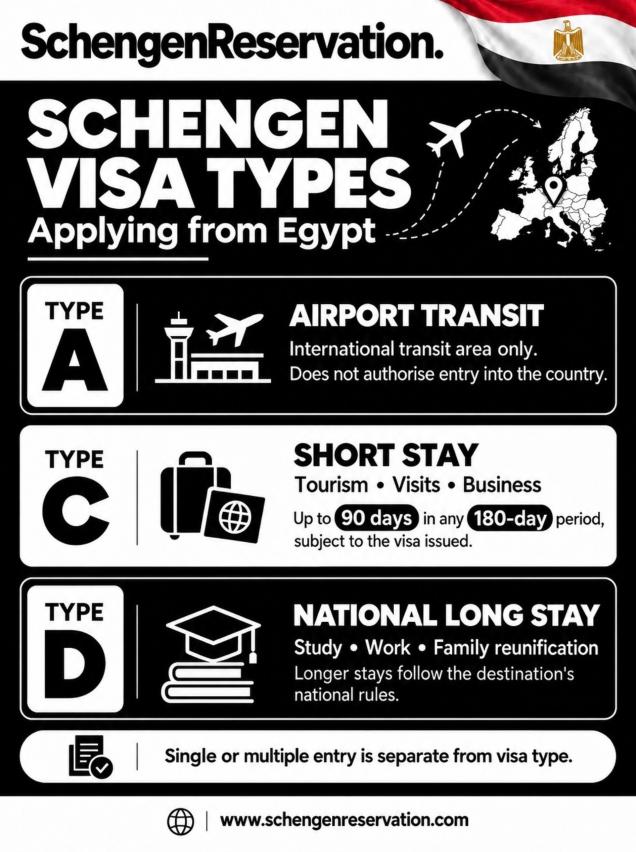
Selecting the visa type is essential. The letter on the visa describes its legal category; the purpose selected on the application explains what you plan to do.
Before arranging a flight reservation for a Schengen visa from Egypt, establish whether your journey involves airport transit, a short visit or a longer period of residence.
Type A Airport Transit Visa
A Type A visa permits qualifying airport transit through the international transit area. It does not authorise entry into the country, sightseeing during a connection or an overnight stay outside that area. Transit requirements depend on nationality, the transit state and applicable exemptions.
Egyptian travellers should pay particular attention to airport-specific rules. Transit through a Spanish airport can involve an airport-transit visa requirement for Egyptian nationals, subject to applicable exemptions and individual circumstances. Check the relevant conditions if your route uses a Spanish airport on the way to a non-Schengen destination.
Two Schengen airport connections can also change the analysis. A Cairo-to-Paris-to-Amsterdam-to-London itinerary involves movement between two Schengen airports. A Type A visa alone would not cover entry for that intra-Schengen flight.
Verify the complete route before reserving it. Changing airports, collecting baggage or passing through border control can affect the permission you need.
Type C Short-Stay Schengen Visa
Type C is the usual category for a temporary visit within the permitted short-stay period. It may cover:
- Tourism and holidays.
- Visits to family members or friends.
- Business meetings and conferences.
- Medical visits.
- Cultural and sporting activities.
- Certain short courses or training programmes.
The stay normally falls within the 90-days-in-180-days framework. Your issued visa can authorise fewer days, so inspect both its dates and its permitted duration.
A business visit does not automatically authorise employment. Activities such as paid performances, practical work or internships may require separate permission even when the proposed stay is short.
Select the category based on the activity itself. A short trip can still involve a purpose that needs additional authorisation.
Type D National Long-Stay Visa
Type D is a national visa associated with a longer stay, commonly for employment, extended study, family reunification or another residence purpose. It is governed by the destination’s national rules and is distinct from the uniform short-stay Schengen visa.
Admission letters, employment authorisations, accommodation conditions and insurance requirements can therefore differ substantially from a tourism checklist. Some applications also begin through a national immigration or online consular system.
Do not assume that the provider accepting a country’s Type C applications accepts every Type D category. Lithuania, for example, has different arrangements for short-stay applications, national visas and residence permits.
Identify the correct long-stay process before booking an appointment or ordering travel documents.
Single Entry and Multiple Entries
Entry permission is a separate issue from visa type. A single-entry visa allows one entry into the Schengen area. A multiple-entry visa permits repeated entries within its conditions. Longer validity does not remove the short-stay limit.
If your journey includes leaving Schengen for the UK and then returning to Europe, check that the requested and issued entry permissions cover both entries. An internal flight between two Schengen states is different from leaving and re-entering the area. Moving from France to Italy does not, by itself, create a new external entry.
Essential Schengen Visa Requirements for Applicants from Egypt
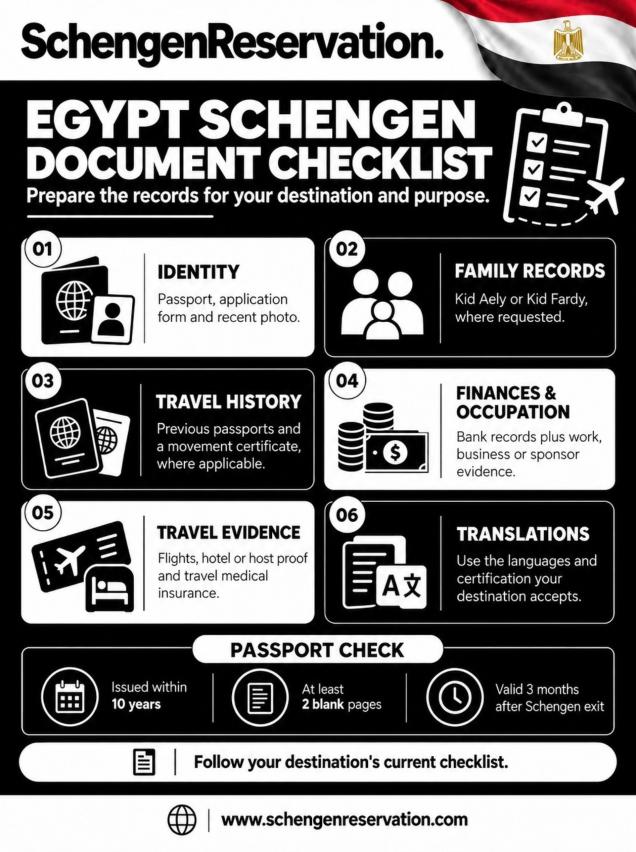
Use the current checklist for your destination and travel purpose as the final document list. The items below explain the main evidence and the Egyptian records that deserve early attention.
A complete application should tell one consistent story: who you are, why you are travelling, how you will pay, where you will stay and how the visit fits your circumstances.
- Passport and Previous Travel Documents
Your passport should have been issued within the previous ten years, contain at least two blank pages and remain valid for at least three months after the intended departure from Schengen.
Provide the requested copies and previous passports where required. Check the passport before completing reservation forms. The spelling of your name, passport number and date of birth should be consistent throughout the application.
Use the passport’s Latin-script spelling rather than creating a fresh transliteration for each document. If an older passport contains relevant visas or travel stamps, include it according to the checklist. A clear travel history is easier to assess than an unexplained reference to documents that are missing.
- Application Form and Photographs
Complete the destination’s required application form and sign the relevant sections. Some states use their own online preparation system; a printed generic form may not replace that process.
Use a recent photograph meeting the mission’s specifications. Avoid editing facial features or recycling an old photograph simply because it was accepted for a previous application. The number, dimensions and presentation of photos should follow the selected checklist.
For children, check who must sign and whether the child must attend. Also ensure the appointment category matches the actual travel purpose. Selecting the wrong category can prevent acceptance of the file before the application reaches the decision stage.
- Egyptian Civil-Status and Family Records
The Kid Aely, or family-register extract, can be required as evidence of family ties and marital status. Applicants for Germany should prepare the translated Egyptian family-register extract required for the relevant tourism or visit application. Destination instructions can distinguish between married, unmarried and minor applicants.
For Malta tourism applications, for example, the requirements distinguish between Kid Aely for married applicants, Kid Fardy for unmarried applicants and the father’s family register identifying a minor. These are destination-specific details to check, rather than a reason to substitute one record for another. Request the correct document early and make sure the names and family information correspond with the rest of the application.
- Movement Certificate Where Applicable
A movement certificate records relevant passport and travel history. It can be required for first-time applicants or applicants who have lost their passport. Ask the competent mission what period, issue date and translation rules apply to your case.
For Poland, the requirements refer to a Mogamma certificate covering seven years for first-time travellers or passport-loss cases. Other destinations may specify their own presentation and translation conditions. A generic document name is therefore insufficient. The receiving authority can specify the detail it needs. Allow time to obtain the certificate and any required translation before the appointment.
- Travel Medical Insurance
Short-stay insurance should cover the intended visit throughout the Schengen territory and provide at least EUR 30,000 of cover for the required medical and repatriation risks. Check emergency treatment, hospital care and repatriation wording, alongside the dates and traveller identity.
A policy beginning a day after arrival leaves a gap. A policy ending before the return journey finishes can do the same. Compare the insurance schedule with the actual itinerary, including overnight flights.
Certain Egyptian application routes contain additional insurance requirements. Malta tourism applications, for example, require the Aman travel-insurance sticker on Egyptian passports. Check whether your destination also needs separate policy evidence and whether the cover meets the required conditions.
- Bank Statements and Accessible Funds
Prepare a financial history rather than relying only on a closing-balance certificate. Applicants from Egypt should generally prepare six months of account activity, subject to the destination’s exact requirements and permitted alternatives.
Provide the original statements, copies, translations, bank stamping and signatures requested by the checklist.
Review your statements before the appointment:
- Are salary deposits identifiable?
- Are transfers from a sponsor supported?
- Does an unusually large credit have a document explaining its source?
- Are the funds genuinely available for the proposed journey?
A legitimate property sale, matured deposit or business payment can increase a balance. Provide relevant evidence instead of allowing the transaction to look unexplained.
Likewise, distinguish money genuinely available for travel from business turnover that must cover other obligations.
There is no universal Egyptian-pound balance guaranteeing approval for every Schengen destination. Compare the trip’s costs with the destination’s financial requirements and your own documented circumstances.
- Employment Evidence and Approved Leave
An employee’s file should explain their job and its connection to the proposed absence. A useful employer letter identifies the employer, position, recruitment date, remuneration and leave approval, with a verifiable signatory and contact details.
Check that approved leave covers the complete journey. If the outbound flight departs after midnight, the practical absence from work may begin earlier. If the return flight reaches Egypt the following morning, a leave letter ending on the European departure date may need clarification.
When salary payments and the employer letter differ, explain the reason with records where relevant. Bonuses, commissions or a recent promotion should not be left for the reviewer to guess. Your employment evidence should make the proposed travel period understandable within your normal responsibilities.
- Business Ownership and Self-Employment
Company owners should prepare the commercial-registration and tax records requested by the checklist. These establish the business behind the applicant’s stated occupation. Include the relevant account evidence and make the funding understandable.
If the trip is paid from personal funds, show the personal account. If a company pays, explain the business purpose and authorised expenditure. A large company balance is not automatically the applicant’s personal travel budget.
Freelancers can organise evidence around the work they genuinely perform: contracts, invoices, payment records, relevant registrations and ongoing assignments, where applicable. Explain how income is received and who will cover the trip. These practical supporting records do not replace any mandatory destination-specific document.
- Students, Retired Travellers and Applicants Without Employment
Students should show current enrolment and identify the person financing the visit. Where parental financial support is required, include the relevant parental bank evidence. Term dates, examination schedules and the proposed return can help explain how the journey fits the applicant’s studies.
Retired applicants can explain pension income, savings and relevant commitments in Egypt. An applicant without current employment can present genuine savings or documented sponsorship and explain their present circumstances.
Use the profile that actually applies. A fabricated job letter creates a credibility problem that an honest explanation of unemployment would not solve. The practical objective is to support the real situation with understandable records.
- Sponsorship Documents
Explain who the sponsor is, their relationship to you and the expenses they will pay. Depending on the destination, the required evidence may include identity, residence, income, bank statements and a prescribed sponsorship undertaking.
For a family or friend visit, accommodation support and financial sponsorship may require specific national forms. A simple invitation should not be assumed to replace a required undertaking. Make the division of expenses clear.
If a host provides accommodation while the applicant pays flights and daily expenses, say so. If an employer funds the whole trip, the employer letter and applicant’s explanation should describe the same arrangement. Clear sponsorship evidence connects the person paying with the actual costs of the visit.
- Flight Reservation and Onward Travel
Provide the travel evidence requested by the mission: departure from Egypt, entry into Schengen, any relevant onward transport and the intended return. A flight itinerary should show the traveller’s name, route, dates and flight details clearly. Some destinations advise buying the final ticket after the visa is issued. Applicants should still follow the exact transport-document instruction for their destination.
A flight reservation for a Schengen visa from Egypt should match the application form, insurance period and accommodation schedule. If the itinerary involves several countries, make the movement between them understandable. The return flight alone may not explain the complete route.
- Accommodation for the Complete Itinerary
Hotel confirmations should identify the guest, property, location and check-in and check-out dates. Where you will stay with a host, provide the private-accommodation evidence required by the destination. Prepare accommodation evidence covering the whole trip. A booking for the main destination alone may leave nights elsewhere unexplained.
Treat a hotel checkout date as the departure from that property, not an additional night there. If you check out in Paris on 12 November and check in in Brussels that afternoon, the accommodation schedule can join neatly without a missing night. For family applications, check that the booking clearly identifies or appropriately covers everyone who will stay.
- Purpose-Specific Evidence
For tourism, explain the cities, dates and practical itinerary. For a business visit, provide the required invitation and sending-company evidence showing the purpose, participants, duration and expense responsibility. Private visits require appropriate host evidence.
Medical travel should connect an Egyptian referral or medical explanation with acceptance by the receiving institution, expected treatment costs and the financial arrangements. Cultural or sporting applications need evidence identifying the event and the applicant’s participation.
For short study or training, check the category and permissions attached to the programme. If the course includes practical work, its legal treatment may differ from attending classroom sessions. The supporting documents should explain the actual activity rather than rely on a broad label such as “visit.”
- Cover Letter
A concise cover letter can connect the documents without repeating every page. Identify the purpose, dates, responsible destination, funding, accommodation and relevant commitments in Egypt.
Explain unusual points directly: a sponsor with a different surname, an overnight flight, a significant account credit or a mixed business-and-leisure schedule. Refer to the supporting records so the explanation can be checked.
Write around the applicant’s circumstances. A generic letter praising Europe offers less useful information than a factual explanation of the proposed visit. A clear cover letter helps the reader understand why the documents belong together.
- Documents for Children
Children generally need their own application and travel-document evidence. Check birth records, parental identity, financial support and the authority to travel.
Where a child travels without both legal guardians, prepare the required consent using the applicable notarised certificate or prescribed signing procedure, together with supporting identity and birth records. Custody or guardianship situations may require additional evidence.
Keep a separate checklist for each child, even where the family shares flights and hotels. A family booking should identify everyone it is intended to cover. Also confirm who signs the application and whether the child must attend the appointment.
- Translations and Document Presentation
Check the accepted language and translator requirements before submitting Arabic documents. For German applications, Arabic documents generally need accompanying German or English translations through the recognised arrangements required for the application.
Other destinations can have different instructions. Match each translation to its original, keep names consistent and retain the bank’s original authentication.
Do not assume that an informal translation is acceptable or that legalisation is required for every document. Follow the receiving authority’s actual instructions. Organise originals, copies and translations so the relationship between them is easy to follow.
Matching the Evidence to Your Egyptian Applicant Profile
Different applicants can demonstrate a credible temporary journey in different ways. Use this table as a preparation aid alongside the destination’s checklist.
| Applicant profile | Evidence to organise | Point that often needs explanation |
| Salaried employee | Employer letter, leave approval, salary records and personal statements | How the trip fits the authorised absence and available funds |
| Business owner | Registration, tax records, relevant accounts and purpose evidence | Whether the applicant or business is paying |
| Freelancer | Genuine contracts, invoices, payments and ongoing work | Income that arrives irregularly or through several channels |
| Student | Enrolment, term dates and sponsor evidence | Who pays and how the journey fits studies |
| Retired traveller | Pension, savings and relevant commitments | How the planned costs will be met |
| Family travelling together | Individual files, shared itinerary and funding explanation | Which documents and bookings cover each person |
| Foreign resident | Passport, qualifying Egyptian residence and local circumstances | Eligibility to apply from Egypt and return after travel |
There is no single ideal applicant profile. The practical aim is to make the real situation understandable and support it with records.
A salaried employee and a freelancer may both have a credible reason to travel, but the documents explaining their income and responsibilities will naturally differ.
Planning a Travel Budget That Can Be Traced
Work out the trip cost before choosing the length of the visit.
Your budget should consider flights, accommodation, transport between destinations, meals, insurance and personal expenses. Separate money already paid from costs still to be paid. A hotel reservation marked payable at the property remains a future expense.
An invitation promising free accommodation can reduce hotel expenditure, but it should be supported in the form required by the destination. If the bank account is in Egyptian pounds and the main expenses are in euros, show the calculation clearly and identify the exchange rate used for your planning.
Build a reasonable allowance for changes instead of presenting the last pound in the account as expendable travel money. This budget is a practical explanation, not a replacement for national subsistence requirements. It helps the applicant check whether the intended trip is affordable and helps a reader understand how the funding fits together.
A shorter journey with clear financial support can be easier to explain than a longer itinerary whose costs do not correspond with the available funds.
How to Apply for a Schengen Visa from Egypt: Step by Step
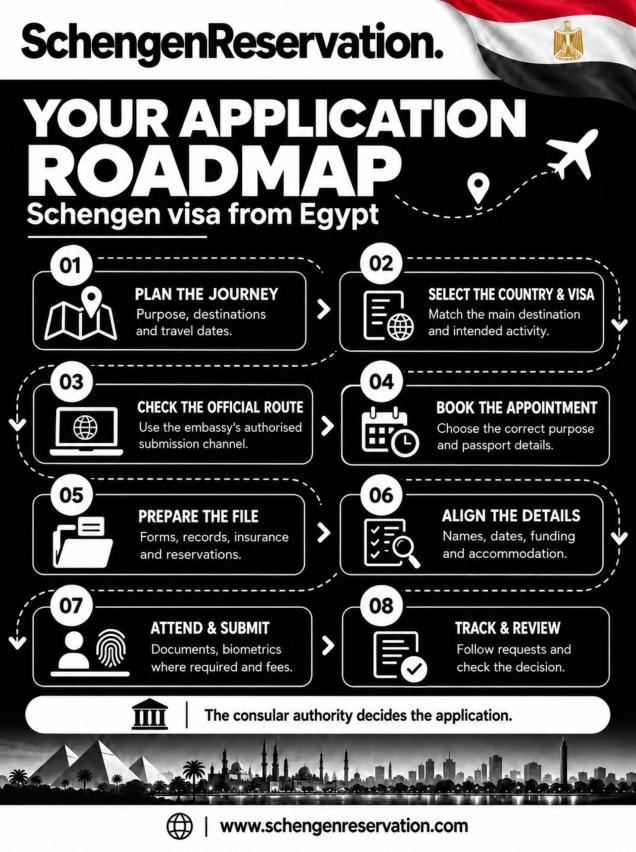
Step 1: Set a Workable Journey
Decide the purpose, destinations, approximate dates and who will pay. Check whether the activities require a short-stay visa or national permission before collecting a tourism file. Start with a journey that fits your available time, financial circumstances and actual reason for travelling.
Step 2: Confirm Responsibility and Local Eligibility
Identify the competent Schengen destination and whether you qualify to apply in Egypt. Check consular jurisdiction where the country distinguishes between Egyptian regions or passport-issuing offices. Foreign residents should also confirm whether their residence category and validity allow submission through the intended route.
Step 3: Find the Official Application Route
Start from the embassy or government’s designated application process and follow the authorised provider route. Confirm whether applications go through VFS Global, TLScontact, BLS, AlmavivA or the embassy itself. The destination directory below explains the principal arrangements. Using a familiar provider name does not mean every country follows the same booking procedure.
Step 4: Obtain the Exact Checklist
Download the version matching your visa purpose. Record requirements that take time, such as civil-status records, movement certificates, employer approval, host undertakings or translations. Preparing these early can prevent an appointment from arriving before essential documents are ready.
Step 5: Follow the Appointment Procedure
Some destinations use an online calendar; others have registration or allocation procedures. Keep access to your own email and application account. Check that the booked purpose and passport details are correct. French applications can involve category-specific appointment-allocation procedures, while Czech applications follow their own embassy registration arrangements. Read the procedure for the actual destination before relying on a general description of booking an appointment.
Step 6: Prepare Recent Records and Aligned Reservations
Collect bank evidence and employer records within the destination’s required issue windows. Arrange transport, accommodation and insurance around the same travel dates. Complete the application and write the cover letter against that final schedule. If one date changes, review the other documents affected by it.
Step 7: Review the Complete File
Check every name, passport number, travel date and sponsor reference. Arrange the papers in checklist order and keep originals, copies and translations available as instructed. Read the application from beginning to end as if you were seeing it for the first time. Missing connections between documents are often easier to notice during this final review.
Step 8: Attend and Provide Biometrics Where Required
Bring the appointment confirmation, passport, application, supporting papers and accepted payment method. For short-stay applications, children under twelve are generally exempt from fingerprint collection. Previous fingerprints may be reusable within 59 months, but fresh collection or attendance can still be required. Do not assume that having supplied fingerprints previously removes every requirement to attend.
Step 9: Follow Any Document Request
Monitor the official contact channels while the case is examined. Respond to requests using the prescribed method and within the stated period. A passport-return notification does not necessarily reveal whether the application was approved. Wait until the decision or passport has been received before drawing conclusions.
Step 10: Check the Decision and Travel Conditions
If approved, inspect identity details, visa dates, permitted days, entries and territorial validity. Report errors promptly. If refused, read the reasons and appeal instructions before deciding how to respond. A visa’s validity period and its permitted duration of stay are separate details. Make sure your actual journey fits both.
Application Timing, Fees and Payment Preparation
Allow Time for the Appointment as Well as the Decision
The application window is not an appointment guarantee. Waiting lists, document preparation and passport transport can add time before and after the consular examination. For France, applicants should plan to obtain a short-stay appointment at least sixty days before departure. For Switzerland, early submission around seven to eight weeks ahead is recommended.
These planning periods are useful when choosing dates for a Schengen visa application from Egypt. Avoid planning around the shortest possible decision period when the trip requires several documents, translations or a difficult-to-obtain appointment.
Check How the Selected Centre Accepts Payment
Visa fees and provider charges are separate. Optional services, such as courier delivery or photocopying, may add further costs. Verify the current amount and method with your chosen destination. Do not assume every Egyptian visa centre takes every charge in Egyptian pounds.
For Spain applications through BLS, visa and BLS service fees are payable in US-dollar cash under the applicable payment instructions, while other additional services can require Egyptian-pound payment. Recheck the current instructions before attending.
Avoid quoting a permanent EGP equivalent for a euro-denominated fee. The amount payable locally can change. Preparing the correct currency and payment method helps prevent an avoidable problem on appointment day.
Schengen Visa Application Channels in Egypt
VFS Global handles applications for many destinations. TLScontact receives applications for France, Germany and Belgium through their respective arrangements. Spain uses BLS International, and Italy directs applicants to AlmavivA. Certain destinations retain direct embassy procedures or operate through representation by another Schengen state.
These organisations provide administrative intake services. Their staff do not determine the merits of a visa application. Paid lounges, courier options or appointment assistance do not purchase a favourable decision. Use the directory for the intended destination, then confirm its current procedure. A provider name shared by several countries does not make their appointment systems or checklists interchangeable.
Submission Routes for All 29 Schengen Destinations from Egypt
The following directory concerns the principal short-stay Type C routes.
National visas can follow different procedures. Check the selected country’s current instructions for the submission centre, jurisdiction and appointment category.
Applying for an Austrian Schengen Visa from Egypt
Austria uses VFS Global in Egypt. Start with the Austria-specific application process and select the category matching your purpose. Prepare the supporting documents required for applicants submitting from Egypt. Confirm the available centre and appointment details before travelling to submit.
Austria Visa Application Centres in Egypt:
Cairo: VFS Global, 52 Lebanon Street, 5th Floor, Mohandessin, Giza, Egypt.
Alexandria: VFS Global, 696 Al Horeya Street, 1st Floor, Office 1, Lauran, access from Shaarawy Street, opposite American Furniture, Alexandria, Egypt.
Applying for a Belgian Schengen Visa from Egypt
Belgium’s ordinary application route in Egypt is TLScontact. Use the Belgium-specific channel and its checklist, including the appropriate private-visit or sponsorship requirements where relevant. A TLScontact appointment for another destination does not cover a Belgian application.
Belgium Visa Application Centre in Egypt:
Cairo (El-Sheikh Zayed): TLScontact, Building B9, 3rd Floor, Capital Business Park, Western Periphery of El-Sheikh Zayed City, 6th of October, Egypt.
Applying for a Bulgarian Schengen Visa from Egypt
Begin with the Bulgarian Embassy in Cairo. Obtain the current appointment, visa-service and category instructions from the mission before preparing to attend. Do not assume that a Bulgarian VFS arrangement in another country applies in Egypt. Confirm the Egyptian submission process for your intended visa category.
Bulgaria Visa Application Office in Egypt:
Cairo: Consular Office, Embassy of the Republic of Bulgaria, 6 El Malek El Afdal Street, Zamalek, Cairo 11211, Egypt.
Applying for a Croatian Schengen Visa from Egypt
Croatia has an authorised VFS Global Egypt channel. Use its current short-stay application instructions and Croatia-specific document list. Check the available submission location and whether your purpose requires any additional evidence before booking.
Croatia Visa Application Centre in Egypt:
Cairo: VFS Global, 52 Lebanon Street, 5th Floor, Mohandessin, Giza, Egypt.
Applying for a Czech Republic Schengen Visa from Egypt
Follow the Czech Embassy in Cairo’s appointment procedure. Tourism registration has its own instructions, while other short-stay purposes follow the relevant embassy process. Read the correct purpose procedure carefully. The Egyptian route should not be inferred from Czech VFS arrangements elsewhere.
Czech Republic Visa Application Office in Egypt:
Cairo: Consular Section, Embassy of the Czech Republic, 4 Dokki Street, Giza 12511, Cairo, Egypt.
Applying for a Danish Schengen Visa from Egypt
Denmark directs applicants to VFS Global. Follow the Danish application preparation process and the Egypt submission instructions before attending. Verify the required form, payment evidence and supporting documents through the Denmark-specific route.
Denmark Visa Application Centres in Egypt:
Cairo: VFS Global, 52 Lebanon Street, 5th Floor, Mohandessin, Giza, Egypt.
Alexandria: VFS Global, 696 Al Horeya Street, 1st Floor, Office 1, Lauran, access from Shaarawy Street, opposite American Furniture, Alexandria, Egypt.
Applying for an Estonian Schengen Visa from Egypt
Estonia has its own VFS Global route in Egypt for Type C applications. Use Estonia’s checklist and booking channel for a journey whose main destination is Estonia. Prepare the file for the actual travel purpose rather than selecting a category only because it has an available appointment.
Estonia Visa Application Centres in Egypt:
Cairo: VFS Global, 52 Lebanon Street, Mohandessin, Giza, Egypt.
Alexandria: VFS Global, 62 Geish Road, 1st Floor, Ibrahimya, Bab Sharki, Alexandria, Egypt.
Applying for a Finnish Schengen Visa from Egypt
Finland’s mission directs Schengen applicants to VFS Global. Applicants of nationalities other than Egyptian or Sudanese should contact the embassy before reserving a visa appointment. Foreign residents should check that condition alongside their Egyptian residence evidence and the purpose of the intended visit.
Finland Visa Application Centres in Egypt:
Cairo: VFS Global, 52 Lebanon Street, 5th Floor, Mohandessin, Giza, Egypt.
Alexandria: VFS Global, 62 Geish Road, 1st Floor, Ibrahimya, Bab Sharki, Alexandria, Egypt.
Applying for a French Schengen Visa from Egypt
Prepare the application through France-Visas, then follow the designated TLScontact submission process. Submission arrangements include centres in Cairo, East Cairo, Alexandria and Hurghada, with specified cases eligible for direct consular appointments. Check centre and category availability before finalising the appointment.
France Visa Application Centres in Egypt:
Cairo (El-Sheikh Zayed): TLScontact, Building B9, 3rd Floor, Capital Business Park, Western Periphery of El-Sheikh Zayed City, 6th of October, Egypt.
New Cairo (El Tagamoa): TLScontact, SODIC Eastown EDNC, Building 6, 1st Floor, Office 2, New Cairo 1, Cairo Governorate, Egypt. Entrance through Gate 8 or 9.
Alexandria: TLScontact, 2 Patrice Lumumba Street, 3rd Floor, Bab Sharky, Alexandria, Egypt.
Hurghada: TLScontact, 291 Mohamed Saied Street, Al Kawther Division, Unit A, Ground Floor, opposite CIB Bank, Hurghada, Red Sea, Egypt.
Applying for a German Schengen Visa from Egypt
Germany receives ordinary short-stay applications through TLScontact. Prepare the VIDEX form, accompanying declarations and the checklist for your purpose. The translation requirements are particularly relevant to Arabic supporting records. Make sure the documents and translations meet the applicable presentation rules.
Germany Visa Application Centres in Egypt:
Cairo (El-Sheikh Zayed): TLScontact, Building B9, 3rd Floor, Capital Business Park, Western Periphery of El-Sheikh Zayed City, 6th of October, Egypt.
New Cairo: TLScontact, SODIC Eastown EDNC, Building 6, 1st Floor, Office 2, New Cairo 1, Cairo Governorate, Egypt. Entrance through Gate 8 or 9.
Alexandria: TLScontact, 2 Patrice Lumumba Street, 3rd Floor, Bab Sharky, Alexandria, Egypt.
Hurghada: TLScontact, Property 291, Al Kawther Division, Unit A, Ground Floor, opposite CIB Bank, beside the Egyptian National Security Agency, Hurghada, Red Sea, Egypt.
Applying for a Greek Schengen Visa from Egypt
Greece uses VFS Global in Egypt, with separate Cairo and Alexandria jurisdiction instructions. Centre allocation can depend on Egyptian passport-issuing offices or residence details. Check that allocation before choosing the more convenient city. The closest centre is not automatically the correct one for every applicant.
Greece Visa Application Centres in Egypt:
Cairo: VFS Global, 52 Lebanon Street, 5th Floor, Mohandessin, Giza, Egypt.
Alexandria: VFS Global, 62 Geish Road, 1st Floor, Ibrahimya, Bab Sharki, Alexandria, Egypt.
Applying for a Hungarian Schengen Visa from Egypt
Hungary uses VFS Global for ordinary Type C submissions. National-visa procedures are separate, and direct consular short-stay submissions are limited to cases receiving special consideration. Use the Hungarian Egypt route for the appointment and the checklist corresponding to the actual purpose.
Hungary Visa Application Centre in Egypt:
Giza (Cairo): VFS Global, 52 Lebanon Street, 4th Floor, Mohandessin, Giza, Cairo, Egypt.
Applying for an Icelandic Schengen Visa from Egypt
For short visits to Iceland, follow the Denmark representation procedure in Egypt, using the designated Danish submission route. The application must clearly identify Iceland as the destination. Representation affects where you submit; it does not change the country you intend to visit.
Denmark Visa Application Centres in Egypt:
Cairo: VFS Global, 52 Lebanon Street, 5th Floor, Mohandessin, Giza, Egypt.
Alexandria: VFS Global, 696 Al Horeya Street, 1st Floor, Office 1, Lauran, access from Shaarawy Street, opposite American Furniture, Alexandria, Egypt.
Applying for an Italian Schengen Visa from Egypt
Italy directs visa applicants to AlmavivA, with centres in Cairo and Alexandria. Follow the current Italian category and appointment instructions. Special walk-in arrangements can apply to specified previous tourism-visa holders. Check eligibility before assuming an appointment is unnecessary.
Italy Visa Application Centres in Egypt:
Cairo: Almaviva Visa Services, 20 El Madinah El Monawara Street, Dokki, Giza, Cairo, Egypt.
Alexandria: Almaviva Visa Services, Building No. 230, Abdel Salam Aref Street, Loran, El Raml Awal, Alexandria, Egypt, opposite Loran Tram Station.
Applying for a Latvian Schengen Visa from Egypt
Latvia’s short-stay application route uses the VFS Global visa application centre in Cairo. Appointments are required. Use the Latvian application process rather than assuming that another state’s representation arrangement applies in Egypt.
Latvia Visa Application Centre in Egypt:
Cairo: VFS Global, 52 Lebanon Street, 4th Floor, Mohandessin, Giza, Cairo, Egypt.
Applying for a Liechtenstein Schengen Visa from Egypt
Liechtenstein generally accepts visa applications through the Swiss representation serving the applicant’s residence. For residents of Egypt, follow the Swiss Egypt submission procedure, normally involving VFS Global. Make clear that Liechtenstein is the intended main destination and prepare the relevant evidence for that journey.
Switzerland Visa Application Centre in Egypt:
Cairo: VFS Global, 52 Lebanon Street, Agouza, Cairo Governorate 3752340, Egypt.
Applying for a Lithuanian Schengen Visa from Egypt
Lithuanian short-stay applications are submitted through VFS centres in Cairo or Alexandria, rather than at the embassy premises. National-visa and residence-permit arrangements are different. Select the short-stay route only for an eligible temporary visit and check the conditions for your nationality and residence status.
Lithuania Visa Application Centres in Egypt:
Cairo: VFS Global, 52 Lebanon Street, 4th Floor, Mohandessin, Giza, Cairo, Egypt.
Alexandria: VFS Global, 62 Geish Road, 1st Floor, Ibrahimya, Bab Sharki, Alexandria, Egypt.
Applying for a Luxembourg Schengen Visa from Egypt
Short-stay applications for Luxembourg from Egypt are handled through the Belgian Embassy in Cairo. Follow the Belgian/TLScontact instructions applicable to represented Luxembourg cases and show Luxembourg as the actual main destination. Representation does not turn the trip into a Belgian visit.
Belgium Visa Application Centre in Egypt:
Cairo (El-Sheikh Zayed): TLScontact, Building B9, 3rd Floor, Capital Business Park, Western Periphery of El-Sheikh Zayed City, 6th of October, Egypt.
Applying for a Maltese Schengen Visa from Egypt
Malta accepts applications through VFS Global in Cairo and Alexandria. Prepare the Malta-specific file, including the applicable Egyptian civil-register, insurance and bank-document requirements. Review these documents early rather than using another destination’s checklist as a substitute.
Malta Visa Application Centres in Egypt:
Cairo: VFS Global, 52 Lebanon Street, 4th Floor, Mohandessin, Giza, Cairo, Egypt.
Alexandria: VFS Global, 62 Geish Road, 1st Floor, Ibrahimya, Bab Sharki, Alexandria, Egypt.
Applying for a Netherlands Schengen Visa from Egypt
The Netherlands directs applicants to VFS Global in Cairo. Separate appointments are required for individual applicants, including those applying together. Complete the Dutch application process before the appointment and check the requirements concerning attendance, tracking and passport collection.
Netherlands Visa Application Centre in Egypt:
Cairo: VFS Global, 52 Lebanon Street, 4th Floor, Mit Akaba, Agouza, Giza Governorate 3752340, Egypt.
Applying for a Norwegian Schengen Visa from Egypt
Norway uses VFS Global for submission in Egypt. The Norwegian Embassy in Abu Dhabi handles applications lodged through the Egyptian route. Allow for the applicable processing and passport-handling arrangements rather than expecting a decision at the intake centre.
Norway Visa Application Centre in Egypt:
Cairo: VFS Global, 52 Lebanon Street, 5th Floor, Mohandessin, Giza, Cairo, Egypt.
Applying for a Polish Schengen Visa from Egypt
Poland’s Type C applications are submitted in person at the Consular Office of the Embassy of Poland in Cairo. Appointments are booked through e-Konsulat. Register the correct Schengen category and prepare Poland’s supporting-document requirements, including any relevant movement-certificate conditions.
Poland Visa Application Office in Egypt:
Cairo: Consular Section, Embassy of the Republic of Poland, 5 El Aziz Osman Street, Zamalek, Cairo, Egypt.
Applying for a Portuguese Schengen Visa from Egypt
Portugal has a VFS Global application route in Egypt. Use its purpose-specific instructions for tourism, business or another eligible short visit. Distinguish the short-stay checklist from Portugal’s separate national and temporary-stay visa requirements.
Portugal Visa Application Centres in Egypt:
Cairo: VFS Global, 52 Lebanon Street, 4th Floor, Mohandessin, Giza, Cairo, Egypt.
Alexandria: VFS Global, 62 Geish Road, 1st Floor, Ibrahimya, Bab Sharki, Alexandria, Egypt.
Applying for a Romanian Schengen Visa from Egypt
Begin through Romania’s E-VIZA system and follow the instructions for the competent Romanian mission in Egypt. Online preparation is followed by the required consular submission steps. It should not be mistaken for automatic approval of an electronic travel authorisation.
Romania Visa Application Office in Egypt:
Cairo: Consular Section, Embassy of Romania, 6 El Kamel Mohamed Street, Zamalek, Cairo, Egypt.
Applying for a Slovak Schengen Visa from Egypt
BLS International and VFS Global are short-stay submission options for Slovakia in Egypt. Arrange the appointment directly with the selected authorised centre and follow its document instructions. Direct embassy submission is reserved for justified cases agreed in advance.
Slovakia Visa Application Centres in Egypt:
Cairo: BLS International, Building No. 39, 6th Floor, Lebanon Street, Agouza, Giza, Egypt.
Alexandria: BLS International, Qasr Al Salam Building, Office No. 11, 2nd Floor, intersection of Abdel Salam Aref Street and Shaarawy Street, opposite Laurent Tram Station, Alexandria, Egypt.
Cairo: VFS Global, 52 Lebanon Street, 4th Floor, Mohandessin, Giza, Cairo, Egypt.
Alexandria: VFS Global, 62 Geish Road, 1st Floor, Ibrahimya, Bab Sharki, Alexandria, Egypt.
Applying for a Slovenian Schengen Visa from Egypt
Eligible residents submit through the Embassy of Slovenia in Cairo. Contact the embassy through its appointment procedure before preparing to attend. Applicants should also check any relevant representation rules. Do not assume a Slovenian VFS arrangement in another country applies locally.
Slovenia Visa Application Office in Egypt:
Cairo: Consular Section, Embassy of the Republic of Slovenia, 21 Soliman Abaza Street, Mohandessin 12311, Cairo, Egypt.
Applying for a Spanish Schengen Visa from Egypt
Spain uses BLS International in Egypt. Select the appropriate short-stay purpose, book through the authorised system and review the current payment instructions. Also check airport-transit requirements where the flight connects through Spain to a non-Schengen country.
Spain Visa Application Centres in Egypt:
Cairo: BLS International, Building No. 39, 6th Floor, Lebanon Street, Agouza, Giza, Egypt.
Alexandria: BLS International, Qasr Al Salam Building, Office No. 11, 2nd Floor, intersection of Abdel Salam Aref Street and Shaarawy Street, opposite Laurent Tram Station, Alexandria, Egypt.
Applying for a Swedish Schengen Visa from Egypt
Sweden has an authorised VFS Global Egypt application channel. Follow its current category, booking and document requirements. Check the applicable submission and processing arrangements before choosing your intended travel dates.
Sweden Visa Application Centres in Egypt:
Cairo: VFS Global, 52 Lebanon Street, 4th Floor, Mohandessin, Giza, Cairo, Egypt.
Alexandria: VFS Global, 62 Geish Road, 1st Floor, Ibrahimya, Bab Sharki, Alexandria, Egypt.
Applying for a Swiss Schengen Visa from Egypt
Switzerland’s normal short-stay submission route is VFS Global. Allow substantial lead time when preparing the appointment and application. Certain family-member cases can have direct-submission rights. Check the relevant procedure before booking through the ordinary route.
Switzerland Visa Application Centre in Egypt:
Cairo: VFS Global, 52 Lebanon Street, Agouza, Cairo Governorate 3752340, Egypt.
Travel Reservations for a Schengen Visa Application from Egypt
Reservations should make the proposed journey easy to follow. Their value comes from accurate travel details and consistency with the application.
A flight reservation, hotel booking and insurance policy should describe the same intended visit. When the dates or route differ, the reader has to work out which document represents the actual plan.
Flight Reservation Versus Paid Airline Ticket
A reservation records a proposed or held journey. A paid ticket is a ticketed purchase subject to its fare conditions. Do not describe one as the other. Before purchasing, read the mission’s wording. A request for a flight itinerary does not necessarily mean a non-refundable ticket must be bought. Conversely, where a checklist specifies a particular confirmed or paid arrangement, provide what it requires.
The booking reference, often called a PNR, should correspond to the actual reservation supplied. Where airline verification is available, check the record using the correct airline reference and passenger surname. A reference printed on a page does not independently establish how long a booking will remain active. Ask about the reservation’s status and conditions before relying on it for the appointment.
Hotel Reservations Versus Accommodation with a Host
Hotel evidence should cover the places and dates where you intend to stay. Check the guest names, property address and any payment or cancellation terms. If a relative hosts you for part of the trip, document those dates through the required host evidence.
Your schedule can combine private accommodation and hotels as long as it clearly accounts for the stays. Booking an unnecessary hotel to conceal a genuine family visit can create conflicting evidence about purpose. For a multi-country journey, review the complete accommodation sequence. Each checkout should connect sensibly with the next check-in or an explained overnight journey.
Planning the Reservation’s Active Period
Arrange time-limited reservations with the submission date in mind. Ask when validity begins, how the booking can be verified and what support is available if the appointment or planned dates change. Schengen Reservation offers up to 14 days of validity, subject to the relevant service and booking conditions. That active window is different from the embassy’s processing time.
Ask about the available arrangements if examination continues beyond the reservation period. Do not assume that a booking remains active for 45 days simply because a visa application can take that long. Planning the reservation around the actual appointment helps keep the travel evidence current when it is submitted.
A Worked Itinerary from Cairo to Europe
The following example demonstrates date alignment. It is a planning illustration, not an actual airline or hotel confirmation.
| Travel date | Planned location or movement | Accommodation record |
| 8 November 2026 | Depart Cairo and arrive in Paris | Paris check-in on 8 November |
| 8 to 12 November | Four nights in Paris | Paris hotel from 8 to 12 November |
| 12 November | Travel from Paris to Brussels | Brussels check-in on 12 November |
| 12 to 14 November | Two nights in Brussels | Brussels hotel from 12 to 14 November |
| 14 November | Travel from Brussels to Amsterdam | Amsterdam check-in on 14 November |
| 14 to 17 November | Three nights in Amsterdam | Amsterdam hotel from 14 to 17 November |
| 17 November | Depart Amsterdam for Cairo | No European overnight stay if departure is that day |
On this leisure plan, France has the longest stay. The application, transport evidence and explanation should reflect that. Nine overnight stays run from 8 to 17 November, but both the entry and exit dates count towards the short-stay duration. This example uses ten days.
The traveller also needs to account for the Paris-to-Brussels and Brussels-to-Amsterdam transfers. A return flight alone does not explain how the intermediate destinations connect. If the outbound arrival moves to 9 November, review the first hotel booking and insurance. If the return reaches Egypt after midnight, check the leave letter against the actual arrival date. One change can affect several documents. Review the whole schedule rather than correcting only the flight reservation.
How Schengen Reservation Supports Travellers Applying from Egypt
At Schengen Reservation, we help applicants organise the flight and accommodation evidence for their intended trip. Whether you are departing from Cairo or another Egyptian airport, the reservation request should start with your actual passenger details, destinations and dates. A useful reservation presents the proposed journey clearly and corresponds with the rest of the application.
Flight Reservation
Our Flight Reservation service can support applicants who need an itinerary showing intended outward, return or multi-city travel without purchasing the final airfare too early. Where applicable, the booking includes a reference and airline-site verification guidance.
Urgent delivery within one to two hours, monitoring during the committed validity period and round-the-clock support are available subject to the relevant service conditions. Confirm the available timing and booking conditions for your order.
Before requesting the reservation, review passenger names, departure cities, destination airports and return dates. Accurate instructions help the travel evidence reflect the intended journey from the beginning.
Hotel Booking
Our Hotel Booking service helps present the accommodation portion of the visit. Supply the destination cities, guest details and exact dates so the stay evidence can be prepared around the proposed route.
For families, explain who travels together and who each booking must cover. For several destinations, review every property and date rather than checking only the first hotel. Accommodation evidence should support the complete journey, including any changes of city or country.

Flight and Hotel Bookings
The combined service brings the transport and accommodation request together. It is particularly useful where a multi-city journey would otherwise require several separate reservation instructions.
Before ordering, finalise the main destination, appointment timing and traveller names. After delivery, compare the documents with your visa form and insurance schedule.
Travel reservations support the travel portion of the file. Applicants still need the relevant identity, financial, purpose, residence and other supporting evidence. Visa decisions remain with the competent authorities.
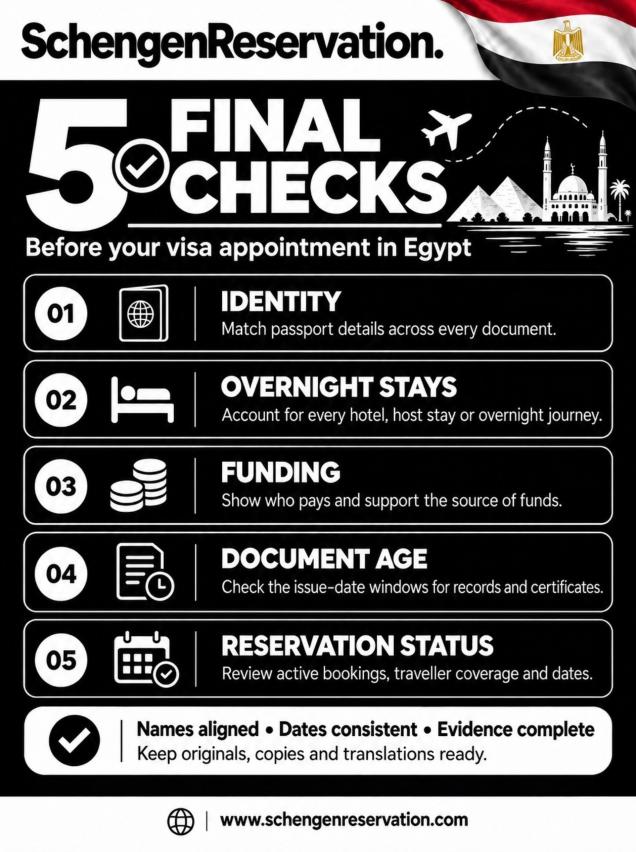
Five Practical Checks Before Your Appointment
A final review can catch inconsistencies that individual document checks miss.
Identity Check
Compare the passport with the application and reservations. Confirm consistent Latin-script names, passport numbers and dates of birth, including those of accompanying children. Pay attention to middle names and transliteration differences. A small spelling change can make documents appear to concern different people.
Overnight Check
Read the itinerary one night at a time. Identify each hotel, host stay or overnight journey. Make sure arrival times support the check-in dates you have selected. For an overnight flight, distinguish the departure date from the arrival date. The accommodation schedule should reflect when you actually reach the destination.
Funding Check
Trace the main expenses to the person or organisation paying them. Remove contradictions between sponsor letters, company evidence and your own explanation. If different people cover different costs, make the division understandable. The funding arrangement should agree with the bank evidence and the stated purpose.
Document-Age Check
Confirm the permitted issue windows for bank statements, civil records and certificates. A document that was suitable for a previous appointment may need refreshing after a postponement. Check issue dates before printing the final file, especially where the destination requires recently issued financial or employment evidence.
Reservation Check
Verify the status where the relevant system permits it. Check the active period, guest coverage and dates shortly before submission. Ask for corrections before the appointment if anything differs from your final plan. Review the flight reservation and hotel booking together. A correct flight document can still conflict with an otherwise valid accommodation schedule.
Issues That Can Weaken a Schengen Visa Application from Egypt
An application can become difficult to assess when its purpose is vague, the financial support is unexplained or the itinerary does not establish the destination receiving it. Other avoidable problems include missing consent for a child, incomplete translations, gaps between hotel stays and an employer letter that does not cover the journey.
An application prepared under the wrong appointment category may also encounter intake problems before consular examination begins. Watch for copied explanations that do not match the applicant.
A business owner should not submit a letter describing salaried employment simply because it appeared in a sample. A private visit should be explained as a private visit even if the applicant also plans sightseeing.
Use genuine records.
If something is missing or unusual, obtain it or explain the situation with the relevant authority rather than altering a bank statement, inventing an employer or creating a false confirmation. A well-organised file should allow the reader to understand the purpose, funding, travel schedule and applicant’s circumstances without having to resolve unnecessary contradictions.
What to Check After Approval and Before Leaving Egypt
Read the visa sticker and plan within its limits. A long validity period and a permitted stay of a small number of days are different things. Carry the relevant travel and supporting records for the actual journey. Border authorities can still ask about purpose, accommodation, funds and onward travel. Holding a visa does not confer an unconditional right of entry. Check that your actual reservations and travel arrangements correspond with the visit you can explain at the border.
EES Registration at the Schengen Border
The Entry/Exit System became fully operational on 10 April 2026. It records entry and exit information and relevant biometrics for covered short-stay non-EU travellers.
This border procedure is separate from submitting fingerprints for the visa application. Travellers should allow time for the applicable arrival formalities and follow the instructions at the border crossing.
ETIAS Is a Separate System
ETIAS is intended for eligible visa-exempt travellers. It does not replace a Schengen visa for an Egyptian ordinary-passport holder who is required to obtain one.
Check the applicable entry requirements for your nationality rather than paying for an authorisation that does not apply to your circumstances.
Any Egyptian Departure Permission Relevant to You
Check separate Egyptian requirements that apply to your circumstances, including military-status-related travel permission where relevant.
A Schengen visa does not substitute for an Egyptian departure permission that you are required to obtain. Review these requirements before the departure date so the journey is ready from both the Egyptian and European sides.
Frequently Asked Questions About Schengen Visas from Egypt
Do Egyptian Citizens Need a Schengen Visa for Tourism?
Egyptian ordinary-passport holders generally need a visa for a short tourist visit. Specific exemptions depend on the traveller’s circumstances, documents and destination. Identify the relevant visa category before arranging the application appointment.
Is There an Online Schengen Visa for Egypt That Avoids an Appointment?
Online systems often prepare the form or book an appointment. They do not automatically remove requirements to submit a passport, supporting documents or biometrics. Follow the actual procedure for the country you are visiting. An online application account is only one part of the process.
Can I Submit My Application in Alexandria?
For some destinations, yes. Italy, Lithuania and Malta have Alexandria submission options. Other routes are centred in Cairo or follow regional jurisdiction rules. Confirm the option for your destination before booking. Your passport-issuing office, residence or application category can affect the appropriate centre.
How Much Money Should I Show in My Egyptian Bank Account?
There is no single balance that guarantees a visa for every itinerary. Check the destination’s financial criteria and support the trip with a credible account history, identifiable funding and a realistic budget. The length of the visit, accommodation arrangements, sponsorship and costs still to be paid can affect the financial explanation.
Do I Need Six Months of Bank Statements?
Applicants submitting from Egypt should generally prepare six months of account activity, subject to the destination’s requirements and any permitted alternatives. Check the instructions for authentication, translations and how recently the statements must be issued. A balance certificate alone may not provide the financial history required for the application.
Does Every Applicant Need a Movement Certificate?
A movement certificate can be required for first-time applicants and passport-loss cases. Check your situation and the destination’s detailed conditions rather than assuming it is required for every repeat traveller. The period covered, issue date and translation requirements can differ.
Can My Spouse or Parent Pay for My Trip?
A documented sponsor may support the visit. Explain the relationship, available means and expenses covered, and supply any prescribed sponsorship form. The applicant’s own circumstances still need to be presented accurately. If the sponsor covers only some costs, clearly identify what the applicant will pay.
Do I Have to Buy a Non-Refundable Ticket Before Applying?
Follow the mission’s transport requirement. A flight reservation may be appropriate where an itinerary or booking is requested. Some destinations ask for an air-travel reservation and advise purchasing the final ticket after approval. Where a particular confirmed or paid arrangement is required, provide the evidence specified for that application.
Can I Use One Booking for the Entire Family?
A shared reservation can cover several travellers if the document clearly identifies them. Each applicant still needs their individual visa file and any required appointment. Check guest coverage on accommodation as well as passenger names on flights. A booking prepared for one traveller should not be assumed to cover the whole family.
Does a 14-Day Reservation Cover the Full Processing Period?
Not necessarily. A reservation’s active period and the authority’s examination time are separate. Ask about the booking conditions and available support if your timetable changes or processing continues beyond the stated validity. Arrange the reservation with the actual submission date in mind.
Can I Stay with Relatives Instead of Reserving Hotels?
Yes, where the destination accepts the appropriate private-accommodation evidence. Follow its host-document requirements and clearly identify the dates covered. Use hotels for the parts of the journey that actually involve hotel stays. A mixed accommodation plan should explain each part of the visit without leaving nights unaccounted for.
Is a Business Visa Permission to Work in Europe?
A short business visit and employment are different activities. Check whether the planned work, training or paid activity requires national authorisation, even when the journey lasts fewer than ninety days. The permission depends on what you will actually do, not only on how long you intend to stay.
Will Premium Visa-Centre Services Improve Approval Chances?
Optional services provide convenience. They do not buy preferential consideration. Visa decisions belong to the competent authorities. A paid lounge, courier service or assisted appointment arrangement does not replace a complete and credible application.
Can I Change My Itinerary After Receiving the Visa?
Check the issuing country’s instructions before making material changes. For Slovakia, changes in travel conditions, including flights, accommodation or itinerary, must be communicated to the consular section under the applicable procedure. Updated plans must remain genuine and comply with the visa. Review the validity dates, permitted stay, entries and main purpose before changing the journey.
What Should I Do If the Visa Is Refused?
Read the written decision and its appeal procedure. If reapplying, address the actual issue with corrected plans, clearer explanations or stronger relevant evidence. Sending the same documents again without resolving the reason is unlikely to help. Use the refusal explanation to identify what needs attention before preparing the next application.
Final Checklist for a Schengen Application from Egypt
Before submission, confirm that:
- The responsible destination and appointment category fit the real trip.
- Your passport meets the validity, issue-date and blank-page conditions.
- The form, photographs and signatures follow the destination’s instructions.
- Egyptian residence evidence is included if you apply as a foreign resident.
- Civil-register and movement records are supplied where applicable.
- Financial documents cover the required period and identify accessible funding.
- Employment, business, study or sponsorship evidence matches your circumstances.
- Purpose evidence explains the actual visit.
- Flights, accommodation and insurance use consistent dates.
- All overnight stays and important transfers are accounted for.
- Children’s consent and supporting records are complete where needed.
- Originals, copies and translations follow the receiving authority’s checklist.
- Payment is ready in the accepted currency and form.
- Reservations have been reviewed against the final application.
Conclusion
Preparing a Schengen visa from Egypt becomes more manageable when each decision follows the journey you intend to take. Identify the responsible destination, choose the correct visa type and collect the evidence relevant to your own circumstances before arranging the final travel documents. Egyptian civil records, movement certificates where applicable, traceable finances and appropriate translations deserve the same attention as flights and hotels. The country-specific submission route matters too: a well-prepared file needs to reach the correct authority through the correct procedure.
At Schengen Reservation, our Flight Reservation, Hotel Booking and combined services can help applicants organise the travel evidence around their planned dates and destinations. Start with an accurate itinerary, review the booking conditions and make sure the documents correspond with the rest of your application. Careful preparation gives the consular authority a clearer basis for assessing the visit and gives you a travel plan you can explain with confidence.