How to Get Flight Reservation for Australia Visa: Visitor, Student, Work and Family Travel Plans
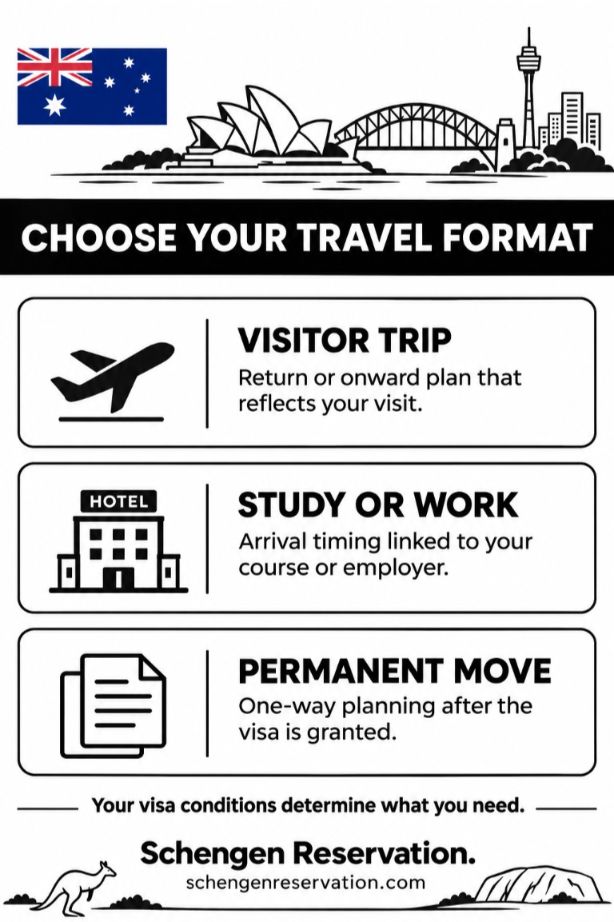
An Australian travel itinerary should explain a journey that makes sense: where you will arrive, what brings you there, how your accommodation fits, and when you expect to leave or begin your authorised stay. A two-week family holiday in Sydney needs a different plan from a university arrival in Melbourne or a permanent move to Perth.
If you need a flight reservation for Australia visa preparation, first check what your particular application asks you to provide. The Australian Department of Home Affairs advises applicants to buy flights after their visa is granted. Its visitor guidance says an itinerary can help explain proposed activities; that does not make a paid ticket or a commercial reservation compulsory for every applicant.
Schengen Reservation provides flight reservations, hotel bookings and combined travel-document services for international journeys, including Australia. This guide explains how those services can fit genuine travel planning, which Australian visa names to look for, what a useful reservation contains, and how to coordinate routes, dates and accommodation from departure countries worldwide.
Is a Flight Reservation for Australia Visa Required?
Home Affairs recommends waiting before purchasing flights
Home Affairs gives this direct advice: “We suggest you book your flight after we grant your visa.” The practical starting point is therefore your application checklist, rather than a ticket purchase. Check the relevant subclass page, the documents requested in your application and any later correspondence.
For a Visitor visa, a proposed itinerary can describe your plans. It might be a written schedule of places and dates. A flight reservation can add transport detail when useful or specifically requested, but it does not replace evidence of funds, employment, family circumstances or the purpose of your visit.
Australian embassies reinforce the distinction
Australia’s official visa information for applicants in the United States advises against making flight bookings or travel commitments before holding a valid visa. The Australian Embassy’s China guidance similarly recommends allowing sufficient processing time and waiting before finalising travel arrangements.
The Australian High Commission in Kenya also explains that an airline ticket is not, by itself, a visa requirement or a reason for granting a visa. These statements support careful planning; they do not establish a universal requirement to purchase a reservation service.
Transit applications have a specific onward-booking requirement
The Transit visa (subclass 771) is different. Home Affairs requires evidence of a confirmed booking to another country within 72 hours of arrival, along with the documents needed to enter that country. Separate rules apply when joining a ship as crew.
Check whether your proposed evidence meets that requirement. An unconfirmed itinerary, an expired hold or a document showing proposed dates alone should not be assumed sufficient. Travellers who qualify to transit without a visa must still satisfy the applicable conditions.
Flight Itinerary, Reservation and Paid Ticket: What Is the Difference?
These terms often appear together in searches, but they describe different things.
| Document or term | What it tells the reader | What to check |
| Proposed travel itinerary | Intended dates, destinations and activities | Whether a written plan answers the requested information |
| Flight reservation or booking hold | A booking record for specified flights during an active period | Passenger details, booking status, verification method and expiry |
| Paid airline ticket | A ticket issued under the airline’s fare conditions | Ticket status, baggage, change rules and refund conditions |
| Return flight plan | The journey to Australia and the planned journey back | Whether both directions match the actual visit |
| Onward travel arrangement | Departure from Australia to another destination | Permission to enter the next country and any transit conditions |
| Hotel reservation | Intended accommodation for specified nights | Property details, guest names, dates and booking conditions |
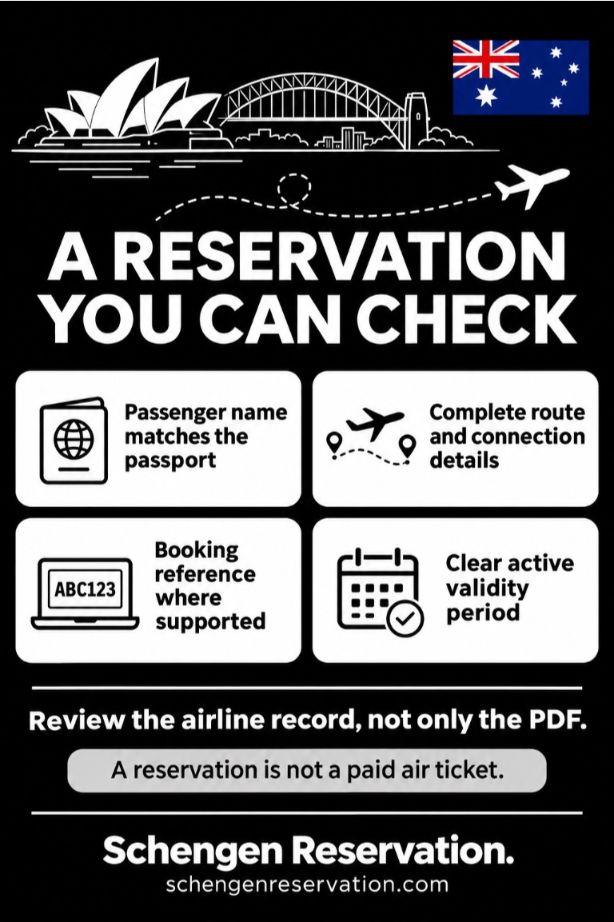
A booking reference does not automatically establish that an air ticket has been issued. Likewise, an attractive PDF is not proof that a reservation remains active. Check the underlying record and understand exactly what you have purchased.
Some travellers search for an Australia visa dummy ticket, a temporary flight booking, an airline itinerary or a flight reservation without payment. If you use a reservation service, “without payment” normally means without paying the full airfare; a preparation or reservation fee can still apply. The document must accurately represent its booking status.
Australian Visa Types and the Travel Plans They May Need
Australia uses temporary, provisional and permanent visa categories, with subclasses and, in many cases, separate streams. It is more accurate to use those official names than to apply another country’s short-stay or long-stay terminology.
The overview below connects the main visa families with reservation planning. It is not a list of visas that universally require flight bookings. Eligibility and evidence depend on the individual subclass and circumstances.
| Visa family | Official names and key subclasses | Reservation-planning focus |
| Tourism, family visits and business visits | Visitor visa 600; Electronic Travel Authority 601; eVisitor 651 | Proposed entry, activities and departure where relevant |
| Transit | Transit visa 771 | Confirmed onward travel and the permitted transit interval |
| Medical visits | Medical Treatment visa 602 | Treatment schedule, recovery allowance and accompanying travellers |
| Study and guardianship | Student visa 500; Student Guardian visa 590 | Course commencement, arrival arrangements and accommodation |
| Occupational training | Training visa 407 | Approved training location and programme dates |
| Working holidays | Working Holiday visa 417; Work and Holiday visa 462 | Arrival planning consistent with the relevant programme |
| Temporary work | Skills in Demand visa 482; Temporary Work visas 400 and 403; Temporary Activity visa 408 | Employer, assignment or activity schedule |
| Graduate and regional pathways | Temporary Graduate visa 485; provisional regional visas 491 and 494 | Current travel rights, work location and realistic arrival dates |
| Permanent skilled migration | Employer Nomination Scheme 186; Skilled Independent 189; Skilled Nominated 190; Permanent Residence (Skilled Regional) 191; Skilled Regional 887 | Relocation after grant and any relevant entry instructions |
| Innovation and business pathways | National Innovation visa 858; Business Innovation and Investment (Permanent) visa 888 | Genuine settlement or business plans under the relevant permission |
| Partners and marriage | Partner visas 309/100 and 820/801; Prospective Marriage visa 300 | Family reunion or relocation rather than an invented holiday |
| Parents and other family | Parent, child, adoption, carer and other relative subclasses | Whether the journey is a temporary visit or settlement |
| Pacific migration | Pacific Engagement visa 192 | Programme eligibility and travel following approval |
| Returning residents and New Zealand citizens | Resident Return visas 155/157; Former Resident visa 151; Special Category visa 444; family relationship visa 461 | Existing status and permission to enter or return |
| Bridging, crew and humanitarian cases | Relevant bridging, crew, refugee, protection and humanitarian subclasses | Individual travel authority and case-specific instructions |
Visitor visa 600 Tourist stream: a reservation for an Australian holiday
For a tourist itinerary, connect the proposed flight dates to a manageable holiday. A Sydney arrival followed by a Melbourne departure can work if you explain the domestic journey between them. A short visit should not contain so many distant destinations that the travel plan becomes impractical.
The Tourist stream also covers visits to family or friends. If you will stay with a relative, use the actual hosting arrangement rather than adding a hotel for nights you do not intend to book. A return reservation, when useful, should match the length and purpose of the visit.
Visitor visa 600 Tourist stream inside Australia: onward travel planning
Home Affairs also has a Tourist stream for eligible applicants applying in Australia. If you are already there, a new inbound reservation may be irrelevant to your current application. Focus on the journey you actually propose to make and the evidence requested for your circumstances.
Before leaving Australia during processing, check the conditions of your existing visa and any bridging permission. A proposed departure date and a flight back do not establish that you can return or satisfy an application-location requirement.
Visitor visa 600 Business Visitor stream: flights around meetings and conferences
A business travel reservation should follow the dates and location of your meetings, trade enquiries or conference attendance. Allow sensible arrival time before the first appointment and an appropriate departure after the final activity.
Business visitor activities are different from taking employment in Australia. Do not describe a work assignment as a business meeting simply to fit a visitor itinerary. The invitation, employer explanation, accommodation and proposed route should describe the same purpose.
Visitor visa 600 Sponsored Family stream: a booking that fits the host’s plans
For the Sponsored Family stream, coordinate dates with the Australian family member and the intended visit. When a host is providing accommodation, the stay details should reflect that address. Separate hotel bookings may be relevant for a genuine side trip.
A reservation cannot establish sponsor eligibility or replace a security bond if one is requested. Its role is limited to explaining the transport arrangement.
Approved Destination Status and Frequent traveller streams: coherent trip records
The Approved Destination Status stream concerns eligible Chinese group tourism. An individual flight plan should not contradict the approved group arrangements. The Frequent traveller stream is for eligible passport holders who travel regularly for permitted visitor purposes.
For either stream, describe the trip actually being planned. A multiple-entry visa does not require you to invent future holidays or reserve every flight you might take over several years. Each proposed visit should remain consistent with its permitted duration and activities.
Electronic Travel Authority 601: arrange flights after the ETA outcome
The Electronic Travel Authority (subclass 601) is an Australian visa available to eligible passport holders for permitted short visits. Applications use the Australian ETA app. Residence in an eligible country does not make an otherwise ineligible passport eligible.
If you are planning an arrival from the USA, Canada, Japan or another eligible departure market, check your passport eligibility before ordering supporting travel services. A reservation does not replace an ETA, and buying one is not a way to secure an earlier decision.
eVisitor 651: an itinerary for eligible European passport holders
The eVisitor (subclass 651) is available to citizens holding eligible European passports, including qualifying British Citizen passports. A Schengen residence permit alone does not qualify its holder for an eVisitor.
Your proposed flights should reflect the permitted visit. A university degree, Australian job or permanent move needs the appropriate permission rather than an itinerary written to resemble a short holiday. Check the eVisitor conditions before turning a plan into paid travel.
Transit visa 771: a confirmed onward itinerary
An Australian transit booking should show the arrival flight and onward departure clearly enough to calculate the time in Australia. Include airport codes and local dates, especially where overnight flights cross calendar days.
Check whether your connection requires collecting baggage, changing airports or leaving the international transit area. The 72-hour Transit visa rules and the separate transit-without-a-visa conditions must be assessed against the actual journey.
Medical Treatment visa 602: flights that allow for care and recovery
The official name is Medical Treatment visa (subclass 602). It can cover relevant treatment, consultation, organ donation and eligible support-person circumstances.
Plan travel around the medical provider’s advice. A proposed return date should allow for the likely treatment and recovery period, while a companion’s flight and accommodation should match the support arrangement. Explain uncertainty honestly instead of presenting a medically unrealistic departure as fixed.
Student visa 500: arrival planning around enrolment
Australia uses Student visa (subclass 500), rather than Canada’s study permit terminology. A student flight itinerary should be coordinated with the Confirmation of Enrolment, course commencement, accommodation availability and applicable health insurance cover.
A one-way arrival can reflect a genuine longer course of study. Do not invent a short return journey merely because a holiday template contains one. Confirm the visa outcome and entry conditions before purchasing the ticket, and consider orientation and the journey from the airport to the campus.
Student Guardian visa 590: coordinated travel for the student and guardian
For the Student Guardian visa (subclass 590), flight planning should support the approved care arrangements. Where a child and guardian travel together, check names, sectors and arrival dates across both records.
The hotel or other accommodation must fit the student’s location and actual welfare arrangements. A guardian’s reservation cannot replace the evidence required to establish their relationship, financial capacity or ability to provide support.
Training visa 407: a flight schedule linked to occupational training
The Training visa (subclass 407) concerns eligible occupational training or professional development, rather than an ordinary holiday. A relevant itinerary should identify the training destination and allow arrival before the approved programme begins.
Use dates consistent with the sponsor’s documents. Check the current application rules carefully, particularly when planning travel from inside Australia; a reservation does not resolve an application-location restriction or establish sponsorship.
Working Holiday 417 and Work and Holiday 462: flexible arrival plans
These are two distinct Working Holiday Maker visas, with different eligible passports and programme requirements. Check the Working Holiday visa (subclass 417) or Work and Holiday visa (subclass 462) page that applies to you.
An arrival reservation can support practical planning after the relevant approval. Avoid arranging a fixed work start or non-refundable flight around an assumed processing date. If your programme has a ballot or other preliminary selection process, selection is not the same as a visa grant.
Skills in Demand visa 482: an itinerary for sponsored employment
Use the current name Skills in Demand visa (subclass 482). It replaced the Temporary Skill Shortage visa for new applications in December 2024. Current streams include Core Skills, Specialist Skills and Labour Agreement.
For flight planning, confirm the work location, intended start date and any employer-provided accommodation. An arrival at a major hub may need an additional domestic sector. The reservation should follow the employment arrangements and eventual visa conditions rather than create an artificial tourist return date.
Temporary Work 400 and International Relations 403: assignment-based reservations
The Temporary Work (Short Stay Specialist) visa (subclass 400) concerns qualifying short-term specialist work. Its flight itinerary should match the assignment described by the Australian organisation.
The Temporary Work (International Relations) visa (subclass 403) has specific streams, including government-related arrangements and Pacific Australia Labour Mobility. Transport and accommodation may be organised through an employer or programme. Check those arrangements before ordering separate documents.
Temporary Activity visa 408: event, research and cultural travel
The Temporary Activity visa (subclass 408) covers specified activities under different streams. These include relevant entertainment, sport, research, religious work, cultural participation and government-endorsed events.
Arrange flights around the actual activity, including any required preparation or completion days. Hotel dates for a performer, researcher or invited participant should follow the host’s arrangements. Attending an event as a spectator and working at it are different circumstances; the itinerary must describe the correct activity.
Temporary Graduate visa 485: check travel rights before leaving Australia
The Temporary Graduate visa (subclass 485) includes Post-Vocational Education Work, Post-Higher Education Work and Second Post-Higher Education Work streams.
For someone already in Australia, the key issue may be permission to return rather than a first arrival. Check your current visa status and travel conditions before planning an overseas trip. A pending application and a return flight reservation do not, by themselves, provide re-entry authority.
Regional visas 491 and 494: plan beyond the international gateway
The Skilled Work Regional (Provisional) visa (subclass 491) and Skilled Employer Sponsored Regional (Provisional) visa (subclass 494) are regional pathways. A booking should fit the relevant regional destination, employment and residence arrangements.
If your international flight lands in Sydney but your intended home is elsewhere, explain how you will reach it. Do not confuse the airport where you first enter Australia with the place where your visa conditions permit you to live and work.
Permanent skilled visas: flight arrangements for settlement
Permanent skilled pathways include the Employer Nomination Scheme (186), Skilled Independent (189), Skilled Nominated (190), Permanent Residence (Skilled Regional) (191) and Skilled Regional (887) visas, subject to their individual criteria.
Once a relevant visa is granted, a one-way booking may accurately represent relocation. Check the grant notice, travel facility and any entry instructions. Short-term accommodation can cover the initial arrival period without pretending to be the family’s permanent housing.
National Innovation 858 and business investment pathways: realistic relocation dates
The National Innovation visa (subclass 858) is an invitation-only permanent pathway. Expressions of interest, invitations and visa grants are different stages; a flight reservation does not establish eligibility or an entitlement to an invitation.
The Business Innovation and Investment (Permanent) visa (subclass 888) remains relevant to eligible applicants under its rules. The provisional subclass 188 programme closed to new applications in July 2024. Existing applicants and holders should follow their own pathway rather than a generic investor travel template.
Partner visas and Prospective Marriage 300: travel for family reunion
Partner pathways include 309/100 and 820/801. The Prospective Marriage visa (subclass 300) is a separate route. A flight plan should reflect whether the person is joining a partner, relocating after grant, or making another authorised journey.
Coordinate accommodation with the genuine living arrangement. For applicants already in Australia, verify their current travel authority before leaving. A wedding date or a partner’s invitation does not make a flight reservation sufficient evidence for the visa.
Parent visas: distinguish a visit from migration
Parent pathways include Parent 103, Aged Parent 804, Contributory Parent (Temporary) 173, Contributory Parent 143, Contributory Aged Parent (Temporary) 884, Contributory Aged Parent 864, and Sponsored Parent (Temporary) 870.
A temporary family stay and permanent settlement require different transport plans. Some parent applications involve long queues, making a short reservation window unsuitable for covering the entire decision period. Plan any necessary travel around the actual stage of the application and the traveller’s current permission.
Child, adoption, carer and relative visas: coordinated family reservations
Child-related pathways include Child 101/802, Adoption 102, Dependent Child 445, and Orphan Relative 117/837. Other family routes include Carer 116/836, Remaining Relative 115/835, and Aged Dependent Relative 114/838.
Coordinate accompanying adults, passenger names and the destination address. A flight reservation does not replace consent, custody, adoption or dependency evidence. When a child will travel separately, assess the airline’s requirements and the lawful care arrangements before choosing a route.
Pacific Engagement visa 192: travel after programme approval
The Pacific Engagement visa (subclass 192) includes the Pacific Engagement stream and a Treaty stream for Tuvalu. Eligibility, ballot arrangements and invitation conditions are programme-specific.
For travel planning, distinguish a ballot registration from an approved visa. Arrange a realistic arrival once the relevant requirements and travel instructions are known. Do not purchase reservation documents on the assumption that they improve ballot selection.
Resident Return, Former Resident and New Zealand-related journeys
Permanent residents considering travel should check the validity of their travel facility. A Resident Return visa (subclass 155 or 157) may be needed to return as a permanent resident; an airline reservation cannot extend that facility. The Former Resident visa (151) is a separate, limited pathway.
Eligible New Zealand citizens with valid New Zealand passports may receive a Special Category visa (444) on entry. Non-New Zealand family members do not automatically qualify on that basis; the New Zealand Citizen Family Relationship (temporary) visa (461) may be relevant in eligible cases.
Bridging visas: a return booking is not permission to return
Bridging visas include A (010), B (020), C (030), D (040/041) and E (050/051), with different purposes and conditions. The Bridging visa B (subclass 020) provides a specified travel period in eligible circumstances and must be granted before departure if it is being relied on for return.
Fit any itinerary within the granted travel period. Do not assume that a Bridging visa A or a pending substantive application lets you leave Australia and return. Check the actual permission before paying for the journey.
Crew, refugee, protection and humanitarian cases: follow individual instructions
Crew arrangements can involve the Maritime Crew visa (988), Crew Travel Authority (942) and specific transit rules. Transport should be coordinated with the operator or employer rather than treated as an ordinary tourist booking.
Refugee and humanitarian pathways include offshore subclasses 200, 201, 202, 203 and 204. Protection and related pathways include 866, 785, 790 and 851, subject to eligibility and current rules. Travel may involve settlement assistance, travel-document restrictions or individual permission. Follow the responsible authority’s instructions before ordering commercial reservations.
Older visa names should not shape a new booking request
Older search results can refer to retired or restricted programmes. Examples include the former Temporary Skill Shortage label, Global Talent terminology, provisional business investment applications and earlier regional pathways such as subclass 489. The Regional Sponsored Migration Scheme (187) also has restricted legacy arrangements rather than being a general new-applicant route. Do not assume that every subclass still appearing in an old guide is open to new primary applicants.
Use the current official visa page and your own grant or application documents. The reservation should describe the journey you are lawfully planning, not reproduce a travel format from an outdated visa category.
What a Useful Australia Visa Flight Reservation Should Include
A flight reservation for Australia visa preparation should be easy to compare with the rest of your travel documents. Before ordering, agree on the information you need and the status the provider will deliver.
Passenger details that match the passport
Use the traveller’s name consistently, including spelling and name order. Where a reservation system has character limits or handles names differently, ask how the record relates to the passport. Supply passport information only where the service or booking requires it; passport numbers are not printed on every airline itinerary.
Complete routes and sensible connections
Look for departure and arrival airports, travel dates, flight numbers, local times and all relevant connecting sectors. A journey through a hub should show the connection rather than jump from the original departure city to Australia with missing information.
Allow enough time for airport transfers, baggage handling and any separate-ticket formalities. Check transit and entry rules for the countries on the route. A low-priced journey can become unsuitable if it needs a visa or airport change you cannot manage.
A booking reference and an explained verification method
When the service promises a verifiable reservation, ask which reference is used and where it can be checked. Airline and travel-agent record locators can differ. A common six-character PNR can contain letters and numbers; it is not necessarily six numerical digits.
A clear active period
Ask when the reservation becomes active and when its committed validity ends. An email delivery date, a proposed travel date and an airline ticketing deadline are different pieces of information. Keep the provider’s written confirmation of what its service covers.
Dates that work across the whole application
Compare the itinerary with your leave approval, invitation, course or event dates, accommodation and proposed activities. A flight arriving the morning after a hotel check-in may need an explanation or an adjustment. Do not use inaccurate dates simply to fill a gap.
Reservation Features Available for Australia Travel Planning
Schengen Reservation advertises the following service features, subject to the selected booking and applicable terms.
| Feature | Practical use |
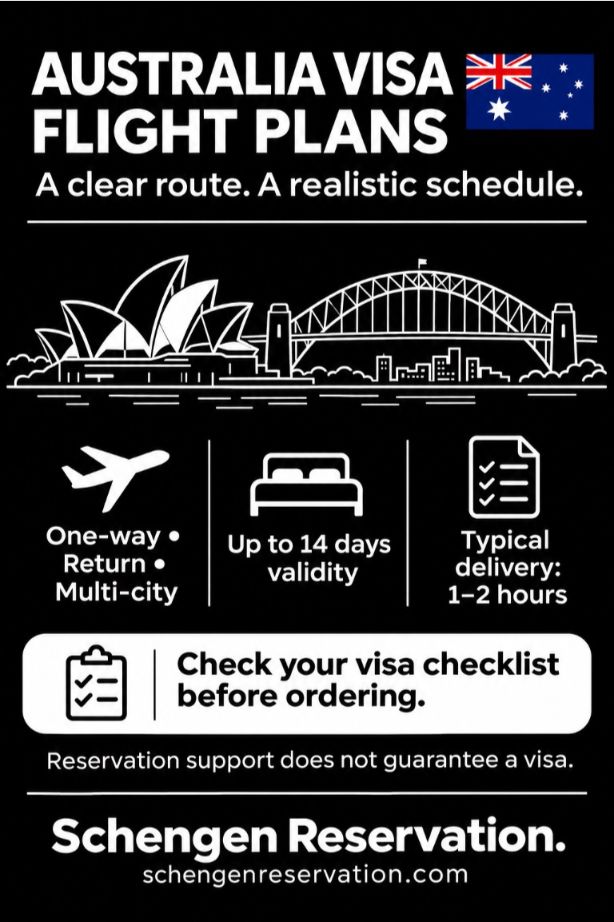
| Up to 14 days of reservation validity | An active window for the agreed preparation or submission period |
| Typical email delivery within 1–2 hours | Prompt document preparation when route availability allows |
| One-way, return and multi-city options | A travel format suited to the actual journey |
| Booking reference where applicable | A route to checking the reservation record |
| Airline Manage Booking guidance where supported | Help locating the airline-side booking |
| Hotel-only and combined options | Accommodation support for genuine intended stays |
| Up to four corrections on eligible bookings | Scope to resolve covered document details |
| Multiple-traveller discount options | A possible saving for family or group orders |
| Support during the committed validity period | Assistance if a covered reservation issue arises |
Availability and terms should be confirmed for the specific order. A provider’s document-delivery estimate is separate from Home Affairs processing time. The advertised reservation period is also separate from the duration of any visa granted.
Australia Flight Reservation and Hotel Booking Prices
If you are comparing the cost of a flight reservation for Australia visa preparation, the advertised service prices reviewed on 3 November 2026 are shown below. These are reservation-service charges, not airline fares, hotel room payments or Australian government visa fees.
| Service | Advertised price per traveller | Intended use |
| Flight reservation | US$10 | Flight-route and booking documentation |
| Hotel booking | US$10 | Accommodation booking documentation |
| Flight + Hotel package | US$15 | Coordinated transport and accommodation documents |
The combined base price is US$5 below purchasing the two US$10 services separately. For two travellers, the undiscounted arithmetic is US$20 for flight-only documents or US$30 for the combined package. Confirm any multiple-traveller discount at checkout.
The accommodation order form currently includes up to four hotels in one trip and states an additional US$8 charge for extra hotels. Confirm how any additional-property charge applies to your particular order before payment.
Prices are displayed in US dollars. If paying from an Australian-dollar or another currency account, your payment provider determines the conversion and any applicable charges. Check the final order total rather than treating an indicative currency conversion as a fixed quote.
Choose the service that answers your actual need
Use flight-only support when you need a transport reservation and already have genuine accommodation arrangements. Hotel-only support can suit a traveller whose transport is already arranged but who needs an actual short-stay booking.
The combined option can make date coordination easier when both records are needed. It is not automatically necessary for someone staying with relatives, using university housing or receiving employer accommodation. Book only the accommodation you genuinely intend to use under the stated terms.
Plan your Australia flights
Arrange a one-way, return or multi-city reservation from US$10 per traveller.
Hotel Booking for Australia Visa: Stays That Match Your Travel Plan
Keep your Australia hotel booking aligned with your flight itinerary. Schengen Reservation provides accommodation documents showing guest details, property information and check-in and check-out dates, with up to 14 days validity and typical email delivery within 1–2 hours. Arrange single-city or multi-city stays around your intended journey, subject to availability and booking terms.

How to Book an Australia Visa Flight Reservation Through Schengen Reservation
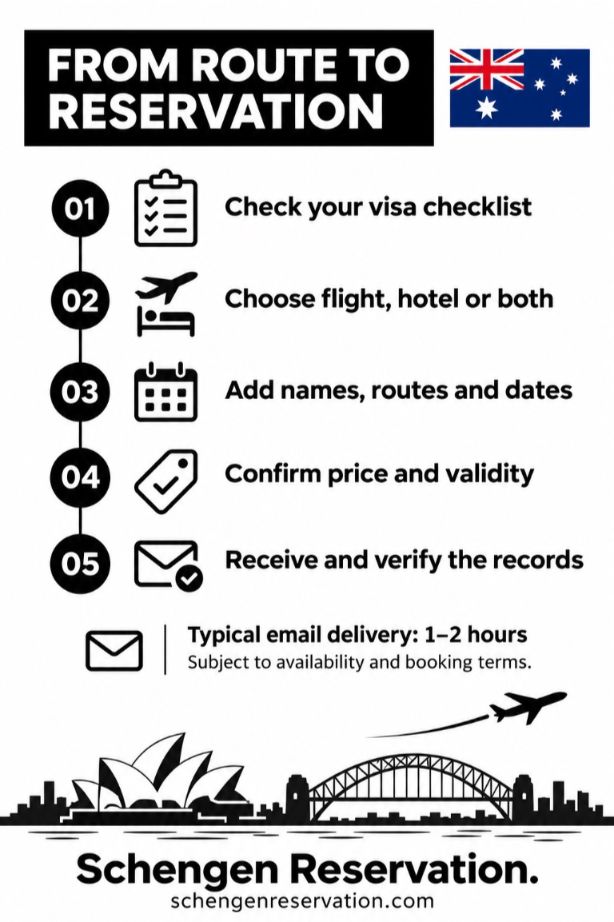
Step 1: Check whether you need a reservation
Read your subclass instructions and application checklist. Decide whether a written itinerary answers the request or whether a booking record is useful or specifically required. Transit travellers should check the confirmed onward-booking rule before selecting a service.
Step 2: Choose flight-only, hotel-only or combined support
Open the relevant service page. Select the product that fits your journey rather than automatically buying every document. Check the price basis, number of travellers and any additional accommodation requirements.
Step 3: Enter each traveller’s details carefully
Use names as shown in the passport and provide the required contact information. Check every accompanying traveller separately. Small differences are easier to resolve before a booking is created than after documents have been attached to an application.
Step 4: Provide the route and travel dates
State the departure city, Australian arrival city, journey type and intended dates. Include any different return airport, stopover or additional destination. Explain when the journey is a proposed relocation, a course arrival or a temporary visit so the record follows the genuine plan.
Step 5: Add accommodation and timing instructions
If ordering hotels, provide cities, check-in dates and check-out dates. Tell the provider when the reservation needs to be active and clarify the promised validity. An application lodgement date is not necessarily an interview date; use the relevant milestone for your case.
Step 6: Review the terms and complete payment
Confirm the final total and the scope of corrections, cancellation support and any extra-property charges. Read the booking conditions. Keep the payment confirmation and the written service details in case you need follow-up assistance.
Step 7: Receive, verify and check the documents
Review the emailed files against your passport and travel plan. Check the booking through the supported method and request any necessary correction before using the document. Upload supporting evidence only where the application instructions call for or allow it.
How to Verify a Flight Reservation for Australia Visa
Open the airline’s official website directly and locate its Manage Booking, Manage Trips or equivalent section. Use the airline booking reference and passenger surname supplied for that purpose. If the document includes both an agency reference and an airline locator, confirm which one the airline needs.
When the record is available, compare:
- The passenger name and the travellers included.
- The departure and arrival airports for every sector.
- Local travel dates and connection times.
- The displayed booking status and any ticketing information.
- Any deadline or other limitation affecting the reservation.
If you cannot retrieve it, contact the provider with the order details. Some records use a different locator or verification channel, but a promise of airline-site verification should be checked against the service actually delivered. Do not manually alter the PDF to conceal an error or change booking status.
How to check the hotel booking
Use the property’s independently verified contact details and provide the guest name, booking number and stay dates. Check the number of guests and rooms as well as arrival and departure dates. Supported booking platforms may offer another verification route, but the provider should explain what applies to that reservation.
If your accommodation is an invitation to stay in a private home, describe that arrangement accurately. It does not need to be turned into a hotel document simply to resemble a commercial travel package.
How Long Should the Reservation Stay Active?
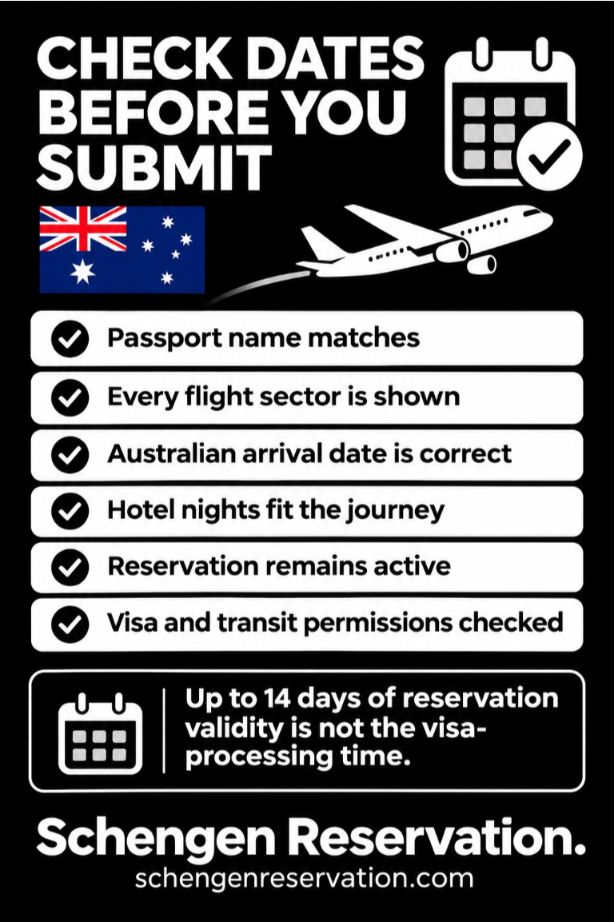
An advertised period of up to 14 days can be useful, but Australian visa processing may take longer. Do not assume a two-week reservation covers the entire assessment or that an old PDF remains a current booking after the underlying record expires.
Agree the activation and expiry dates before ordering. If a later official request requires fresh evidence, respond to that request with accurate information. Ask about a new reservation or an available update; do not describe an expired record as still confirmed.
Home Affairs publishes processing information as a guide, not an individual decision deadline. Your proposed dates should leave room for the actual application process, and final paid travel should follow the visa outcome and applicable entry conditions.
One-Way, Return or Multi-City: Which Australia Itinerary Fits?
Return reservations for a defined visit
A return itinerary can clearly show a temporary holiday, family visit or short business journey. The proposed departure should fit your intended visit and supporting explanation. It is one planning format, rather than a substitute for establishing that you satisfy the visa criteria.
One-way arrangements for a genuine longer stay
A student, sponsored worker or person relocating after permanent visa grant may have a genuine reason to plan an initial one-way journey. Explain the circumstances accurately. Do not create a fictional return booking simply to make the document resemble a tourist itinerary.
Multi-city and open-jaw travel
An open-jaw journey might arrive in Sydney and depart from Melbourne. A multi-city plan can also include another country. Identify the travel between destinations and check permission for each country separately. An Australian visa does not authorise entry into New Zealand or the countries used for transit.
Domestic connections and separate tickets
Where an international arrival connects to a domestic flight, account for immigration, baggage collection, customs and terminal changes as applicable. Separate tickets can create different baggage and missed-connection responsibilities. Confirm the operating arrangements before treating a tight connection as workable.
Flight Reservation for Australia Visa from Major Departure Countries
When planning Australia travel from abroad, departure location, citizenship and immigration status answer different questions. An Indian passport holder living in London does not become eligible for a British-passport eVisitor because the flight leaves the UK. A US resident travelling on another country’s passport must check that passport’s eligibility.
The examples below describe booking guidance and service availability. They do not claim that every nationality requires a reservation or that there are verified customer histories from every listed country.
India: match the flight plan to the application stage
For an Indian passport holder arranging Australia travel, check the relevant visa subclass and plan dates around the real purpose: tourism, study, work or family reunion. A connecting itinerary should identify every international sector and the final Australian destination.
Where to apply: use the official subclass application route, commonly ImmiAccount. New applications lodged in India from 26 October 2026 may involve a biometrics request. Follow the instructions issued to you, including whether an in-person centre or the Australian Immi App applies.
Pakistan: coordinate departure, host and arrival arrangements
For travel planned from Lahore, Islamabad or Karachi, include the connecting route where relevant and check the Australian arrival date carefully. If relatives will host you, align the flight plan with their invitation and address. A student or worker should use the actual course or employment destination.
Where to apply: follow the relevant Home Affairs online route. If biometrics are requested, use the current instructions and approved location or eligible digital option. Check the local arrangements before attending a centre.
Nigeria: make the itinerary practical for the proposed stay
A Nigeria-to-Australia reservation should show the complete route, including any connecting country. Ensure the proposed length of visit is consistent with work leave, family arrangements or the relevant course or employment documents.
Where to apply: use the appropriate Home Affairs application channel. If directed to an Australian Biometrics Collection Centre, the official list includes Abuja and Lagos. Confirm the current centre details through the link in the official guidance before attending.
Philippines: connect the booking to the correct visitor or longer-stay route
For an Australia itinerary from the Philippines, check whether the trip is a short visit, study, employment or settlement. Eligible applicants may also need to assess the specific Frequent traveller stream rules rather than assume all visitor applications are identical.
Where to apply: use the official route for the selected subclass, generally ImmiAccount. Follow any biometrics notification; official collection locations include Manila, Cebu and Davao, while eligible applicants may be directed to the Australian Immi App.
China: distinguish ordinary, group and frequent-travel arrangements
For mainland Chinese passport holders, the relevant visitor stream can affect how the travel plan is organised. Approved Destination Status group arrangements should remain consistent with the group’s itinerary. Other genuine travel purposes require their appropriate visa pathway.
Where to apply: the Australian Embassy in China directs most applicants to ImmiAccount and recommends applying well before the intended journey. Do not finalise paid travel around an assumed decision date.
Russia: show all connections and check current route availability
For journeys originating in Russia, ask for a realistic route available for the proposed dates. Include connecting airports and any airport changes. Availability, transit permission and the practical ability to use a connection must be checked for the individual traveller.
Where to apply: use the relevant Home Affairs application route. If biometrics are requested, consult the official current location list and your notice; do not assume that a reservation order includes an appointment.
Türkiye: use the actual destination and travel purpose
A flight plan from Türkiye should identify the Australian city that matches the invitation, university, workplace or genuine holiday. If a longer journey uses more than one carrier, ensure the itinerary includes all sectors and allows workable transfers.
Where to apply: use the official subclass application route. Follow any biometrics letter and check the collection or eligible app instructions. The reservation provider does not determine which identity procedure Home Affairs requires.
Morocco: check the passport route and any identity instructions
For travel from Morocco, start with the relevant Australian visa pathway and a practical international connection. Include all flight sectors and ensure accommodation begins on the actual Australian arrival date. A foreign residence permit does not, on its own, change passport-based ETA or eVisitor eligibility.
Where to apply: use the relevant official application channel. Follow any individual identity request and the Home Affairs overseas-services guidance; do not assume there is an Australian biometric centre in every country.
United States: check ETA eligibility before ordering documents
Eligible US passport holders may use the Electronic Travel Authority for permitted visits. US residence alone does not confer that eligibility on another passport. Work, study and migration plans need the appropriate Australian permission.
Where to apply: use the Australian ETA app if eligible for that visa, or the official application channel for another subclass. The Australian Embassy in the USA advises against booking flights or making travel commitments before a valid visa is in place.
United Kingdom: distinguish citizenship from UK residence
Qualifying British Citizen passport holders can assess eVisitor or ETA eligibility for permitted visits. Other British passport categories and non-British UK residents must check their own eligibility rather than rely on a London departure address.
Where to apply: use the official eVisitor application route, Australian ETA app or the channel specified for the required subclass. Coordinate an onward or return plan with your actual visit rather than assuming every UK departure needs the same paperwork.
Canada: an Australian travel reservation does not replace permission
Eligible Canadian passport holders can assess the ETA route for permitted visits. A Canadian study permit, work permit or residence status does not make a non-Canadian passport eligible by itself.
Where to apply: use the Australian ETA app if eligible or the relevant official subclass process. For longer stays, plan flights around the appropriate Australian visa outcome and supporting course, employment or family arrangements.
New Zealand: citizens and resident non-citizens have different routes
Eligible New Zealand citizens may receive a Special Category visa on entry. A person living in New Zealand on another passport must assess their own Australian entry requirements. Do not confuse New Zealand residence with New Zealand citizenship.
Where to apply: follow the official New Zealand-citizen entry guidance or the appropriate Australian subclass route for your passport and circumstances. If crossing between Australia and New Zealand, check each country’s permission separately.
UAE, Saudi Arabia, Qatar and other countries of residence
For expatriates applying from Gulf countries, flight and accommodation planning should reflect both the Australian journey and the traveller’s actual residence arrangements. A residence card may be relevant evidence, but it does not convert an ineligible passport into an ETA or eVisitor passport.
Where to apply: use the applicable official subclass process, and complete identity requirements only as directed. Check the transit countries as well as Australia when planning a connecting itinerary.
Australia Visa Flight Planning from All 29 Schengen Countries
Citizens holding eligible passports from the following countries can assess the eVisitor route for permitted visits. Applicants who only reside in these countries must check the rules for their own passport. The Schengen area and Australia have separate immigration systems.
For each country below, the relevant route is the official eVisitor application process when eligible; otherwise use the official application channel for the required Australian subclass. Residence in a listed country does not remove the need to check work, study or settlement requirements.
| Country | Country | Country |
| Austria | Belgium | Bulgaria |
| Croatia | Czechia (Czech Republic) | Denmark |
| Estonia | Finland | France |
| Germany | Greece | Hungary |
| Iceland | Italy | Latvia |
| Liechtenstein | Lithuania | Luxembourg |
| Malta | Netherlands | Norway |
| Poland | Portugal | Romania |
| Slovakia | Slovenia | Spain |
| Sweden | Switzerland | – |
Choose a flight plan based on your real departure airport and Australian destination. If the return journey ends in a different country, explain that onward arrangement. Do not reproduce an itinerary from another European applicant without checking your own dates and permission.
Worldwide Availability for Australia Travel Reservations
Reservation support is not limited to the example countries above. Enquiries can concern journeys from countries across Asia, Africa, Europe, the Americas, the Middle East and Oceania, subject to route and service availability. The table gives examples, not a record of previous customers or a passport-eligibility list.
| Region | Examples of departure countries and markets |
| South Asia | India, Pakistan, Bangladesh, Sri Lanka, Nepal, Bhutan, Maldives |
| East and Southeast Asia | China, Japan, South Korea, Mongolia, Philippines, Indonesia, Vietnam, Thailand, Malaysia, Singapore, Cambodia, Laos, Brunei, Timor-Leste |
| Africa | Nigeria, Morocco, Egypt, Algeria, Tunisia, Ghana, Kenya, Ethiopia, South Africa, Uganda, Tanzania, Zimbabwe, Mauritius |
| Middle East and nearby markets | UAE, Saudi Arabia, Qatar, Oman, Bahrain, Kuwait, Jordan, Lebanon, Türkiye |
| Europe | All 29 Schengen countries, UK, Ireland, Cyprus, Albania, Bosnia and Herzegovina, Serbia, Montenegro, North Macedonia, Moldova, Ukraine, Russia |
| Americas | USA, Canada, Mexico, Brazil, Argentina, Chile, Colombia, Peru, Ecuador, Uruguay |
| Oceania and Pacific | New Zealand, Papua New Guinea, Fiji, Samoa, Tonga, Vanuatu, Solomon Islands, Tuvalu and other Pacific markets |
Where to apply worldwide: use the official process for your subclass. Home Affairs says most applications can be made online without attending an embassy, high commission or consulate. If biometrics are requested, follow the individual letter and the approved collection or digital route.
Airlines and Connections for an Australia Flight Itinerary
Schengen Reservation’s advertised carrier examples include Qatar Airways, Emirates, Singapore Airlines, Turkish Airlines, KLM and Air France. These are examples of its wider service offering, not a promise that every carrier operates the requested Australia route or can provide the same holding period.
Select the airline and connection around the complete journey. Ask whether the itinerary uses one booking or separate tickets, whether baggage transfers through, and whether the connection requires an airport change or entry permission. A familiar airline name does not remove those checks.
For an Australian domestic sector, confirm the operating airline and conditions separately. Do not assume that international baggage allowances, change conditions or reservation validity automatically extend to a domestic booking. Any named carrier and route must be checked for the actual dates before a live reservation is issued.
Australian Cities You Can Include in a Flight and Hotel Plan
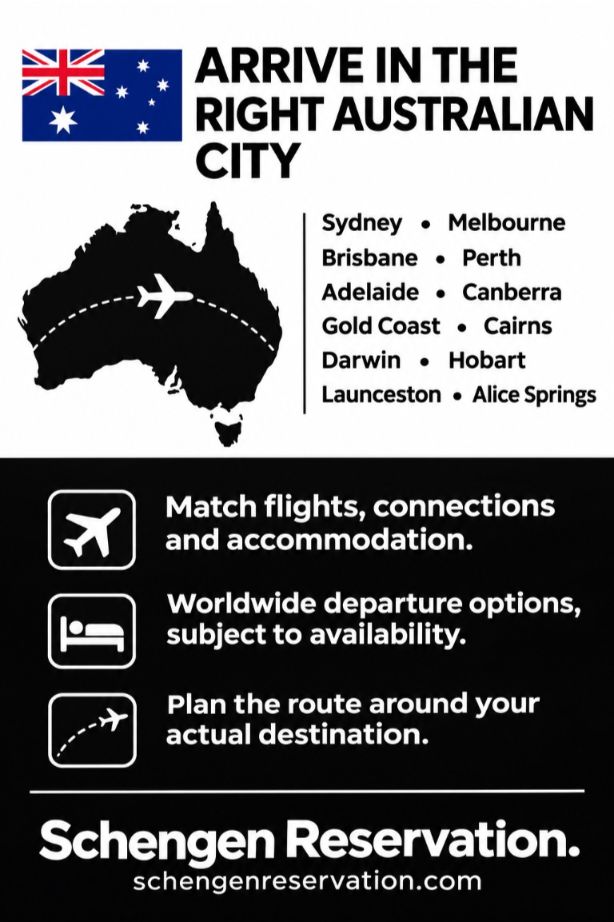
Choose destinations that fit the reason for travelling and the time available. The city examples below are planning options; they do not promise that a particular airline operates a direct route on your dates.
| City or destination | Airport code | Reservation-planning consideration |
| Sydney | SYD | Match an international arrival with the actual Sydney stay or onward connection |
| Melbourne | MEL | Coordinate city accommodation, course arrival or family arrangements |
| Brisbane | BNE | Check the final destination if continuing elsewhere in Queensland |
| Perth | PER | Plan the Western Australia stay and any separate onward flight |
| Adelaide | ADL | Align arrival with the genuine local accommodation or work destination |
| Canberra | CBR | Include any connection needed to reach the ACT |
| Gold Coast | OOL | Distinguish the intended arrival airport from Brisbane |
| Cairns | CNS | Check the routing and allow time for the actual northern Queensland visit |
| Darwin | DRW | Plan dates and onward transport around the intended Northern Territory stay |
| Hobart | HBA | Include the flight or other transport needed to reach Tasmania |
| Launceston | LST | Coordinate the Tasmania route with the correct accommodation city |
| Alice Springs | ASP | Account for the inland journey and the time available |
| Townsville | TSV | Match the route to the actual Queensland destination |
| Sunshine Coast | MCY | Check airport choice and the onward accommodation transfer |
Airport codes were checked against Australian Border Force and airport-operator information.
For a first visit, a shorter route with time in each place can be easier to explain than a rapid tour across several states. Australia’s distances matter: do not treat a change between distant cities as a short local transfer.
Before finalising a real booking, confirm airport codes, available flights and current operating arrangements with the airline or provider. City availability is not a guarantee of a nonstop flight, a specific carrier or a visa outcome.
Australia Visa Flight Reservation Samples
The following samples show how a flight reservation for Australia visa travel can present international flights, domestic connections and return or onward journeys. Each example follows the route and dates displayed in the supplied document.
The dates belong to the sample documents and do not represent current flight availability or confirmation that the bookings remain active.
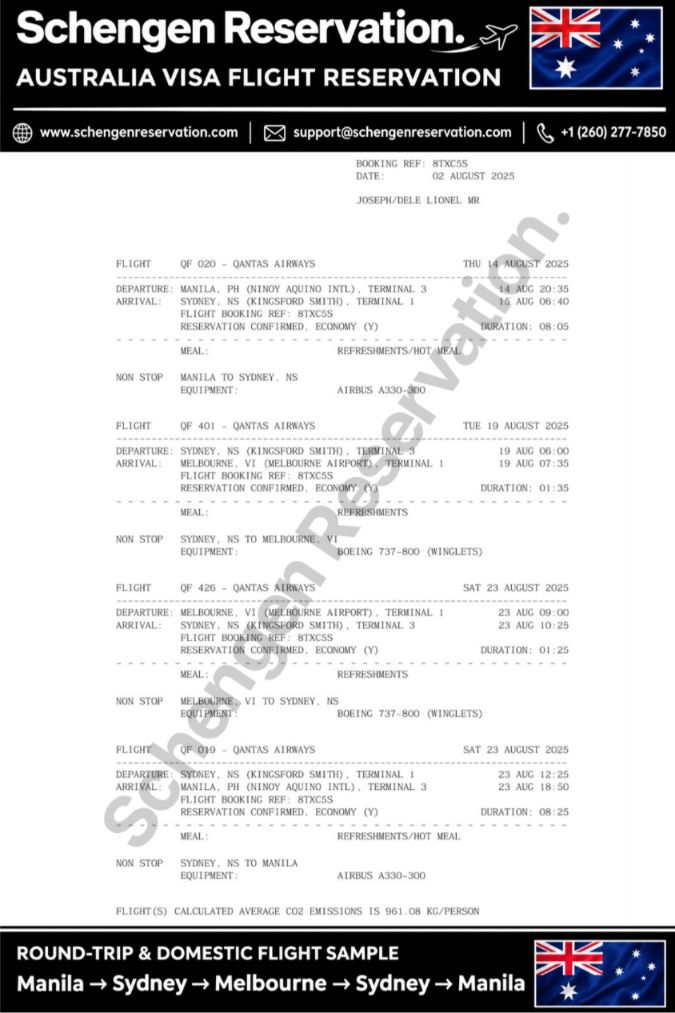
Sample 1: Philippines to Australia – Manila, Sydney and Melbourne
Route: Manila → Sydney → Melbourne → Sydney → Manila
This sample shows a return journey from the Philippines with a domestic visit to Melbourne. The traveller departs Manila on 14 August 2025 and arrives in Sydney on 15 August 2025, before continuing to Melbourne later in the trip.
| Travel date | Flight | Journey |
| 14–15 August 2025 | QF020 | Manila to Sydney |
| 19 August 2025 | QF401 | Sydney to Melbourne |
| 23 August 2025 | QF426 | Melbourne to Sydney |
| 23 August 2025 | QF019 | Sydney to Manila |
All four sectors are shown under Qantas Airways. This Australia flight itinerary sample demonstrates how international return flights and domestic travel can appear together in one reservation document.
It also highlights the importance of arrival dates when arranging accommodation. The traveller reaches Sydney on 15 August, although the outbound flight leaves Manila the previous day.
Sample 2: United Kingdom to Australia – Onward Travel to Canada via the USA
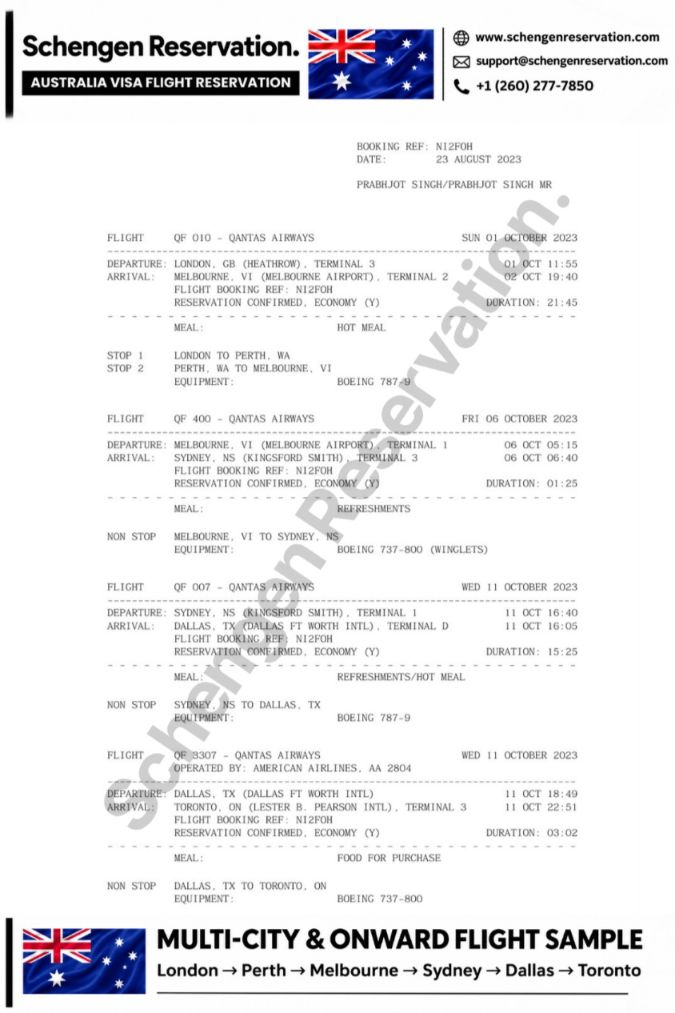
Route: London → Perth → Melbourne → Sydney → Dallas → Toronto
The second sample begins at London Heathrow and ends in Toronto. It includes travel to Melbourne via Perth, a domestic flight to Sydney, and an onward journey to Canada through Dallas.
| Travel date | Flight | Journey |
| 1–2 October 2023 | QF010 | London to Melbourne via Perth |
| 6 October 2023 | QF400 | Melbourne to Sydney |
| 11 October 2023 | QF007 | Sydney to Dallas |
| 11 October 2023 | QF3307, operated as AA2804 | Dallas to Toronto |
The Dallas–Toronto sector is listed as a Qantas codeshare operated by American Airlines. This example illustrates a multi-city flight reservation with a different final destination from the original departure country.
For an Australia visa travel itinerary, the complete sequence makes the journey easier to follow: arrival in Australia, movement between Australian cities and onward departure. Ending the document at Sydney would leave out the international continuation shown in this sample.
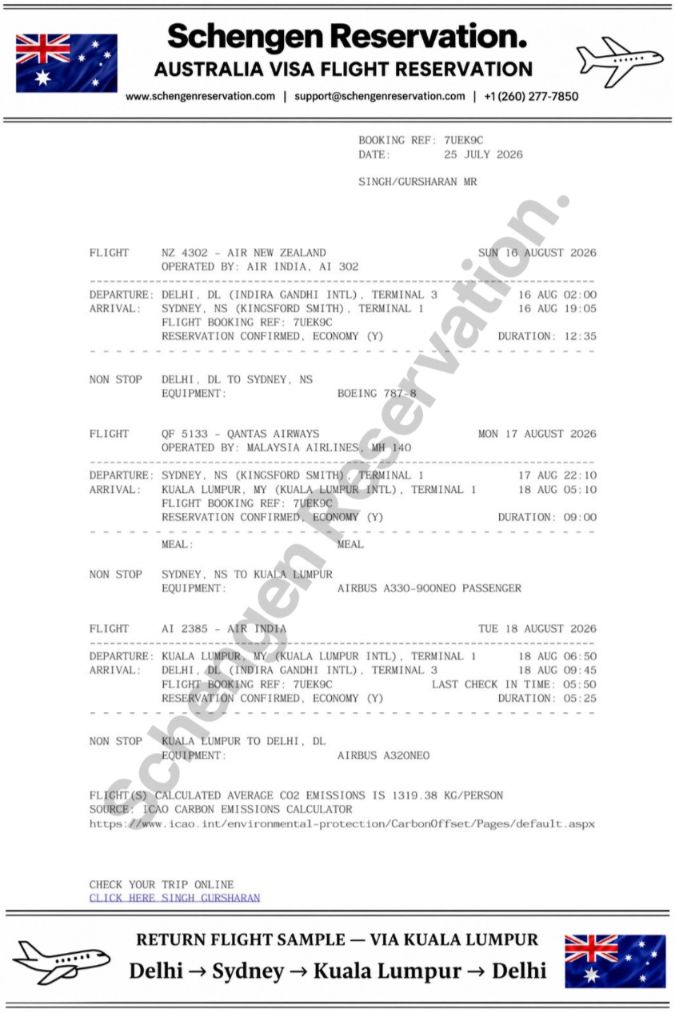
Sample 3: India to Australia – Delhi to Sydney, Returning via Kuala Lumpur
Route: Delhi → Sydney → Kuala Lumpur → Delhi
This sample shows a non-stop outbound journey from Delhi to Sydney on 16 August 2026. The return journey leaves Sydney on 17 August, reaches Kuala Lumpur on 18 August, and continues to Delhi that morning.
| Travel date | Flight shown | Journey and operating airline |
| 16 August 2026 | NZ4302 | Delhi to Sydney – operated by Air India as AI302 |
| 17–18 August 2026 | QF5133 | Sydney to Kuala Lumpur – operated by Malaysia Airlines as MH140 |
| 18 August 2026 | AI2385 | Kuala Lumpur to Delhi – Air India |
This flight reservation sample highlights the difference between the airline marketing a codeshare flight and the airline operating it. The outbound sector carries an Air New Zealand flight number but is operated by Air India. The Sydney–Kuala Lumpur sector carries a Qantas flight number and is operated by Malaysia Airlines.
It also demonstrates why connecting sectors and overnight arrival dates should remain visible in a return flight itinerary. The journey home continues through Kuala Lumpur rather than ending when the traveller leaves Australia.
Reservation Options Beyond These Samples
These examples illustrate selected routes from the Philippines, the United Kingdom and India. Flight reservation enquiries can also cover other departure countries and Australian destinations, subject to route availability. Choose a one-way, return or multi-city itinerary that reflects the journey you genuinely intend to make.
Match your flights and hotel for Australia
Coordinate the journey and genuine accommodation dates in one package from US$15 per traveller.
Common Reservation Mistakes to Resolve Before Submission
Check the following points while there is still time to correct the plan:
- Different names across documents: compare the passport, reservation and application details.
- Missing connection sectors: show how the traveller gets from the departure country to the final destination.
- Confusing departure and arrival dates: account for overnight flights and time zones.
- Hotel dates copied from the outbound flight: use the actual Australian arrival date and intended nights.
- An expired booking presented as current: check the underlying record and the promised validity period.
- A reservation described as a paid ticket: state the real booking status.
- An itinerary that contradicts the invitation or course: align the travel explanation before ordering.
- Assuming residency changes passport eligibility: check the passport used for the Australian application.
- Buying a flight instead of checking travel permission: verify the visa, travel facility or bridging travel period first.
- Assuming a reservation improves approval prospects: treat it as travel evidence where relevant, alongside the actual eligibility requirements.
Frequently Asked Questions
Is a flight reservation compulsory for every Australia visa?
No. Requirements depend on the subclass and your individual instructions. Home Affairs allows visitor applicants to explain proposed plans and advises waiting until visa grant before booking flights.
Does Australia require a paid air ticket before granting a visitor visa?
Do not assume that it does. Official guidance advises against committing to flights before the visa outcome. Follow your application checklist and respond accurately to any specific document request.
Can a written itinerary be enough?
For some purposes, a written plan of dates, destinations and activities can explain the proposed visit. Check what is requested in your application; an itinerary and a confirmed booking are different records.
What does an Australia visa flight reservation show?
It can show passenger details, proposed flights, dates, airports and booking-reference information. Its usefulness depends on accurate details, an appropriate booking status and whether that evidence is relevant to the application.
How much does the flight reservation service cost?
The reviewed advertised price is US$10 per traveller. Hotel booking is also US$10, and the combined package is US$15. Confirm the current final total and any additional requirements before payment.
Is the reservation fee the price of the flight?
No. A reservation-service charge is separate from the airfare. A booking document is not a boarding pass and should not be described as a fully paid ticket unless a ticket has actually been issued.
How long are the reservations valid?
The provider advertises up to 14 days, subject to the booking and terms. Confirm the actual activation and expiry dates for your order. This period is not the visa-processing time.
Can the reservation remain active throughout visa processing?
Do not assume so. Processing can take longer than the reservation period. If updated evidence is requested, provide an accurate current record or explanation rather than reusing an expired booking as confirmed.
How quickly can I receive the documents?
The advertised delivery window is typically 1–2 hours, subject to processing and availability. Confirm urgent timing before ordering. Document delivery does not accelerate an Australian visa decision.
How do I verify the PNR?
Use the supported airline verification method, normally the official Manage Booking page with the airline locator and surname. Ask the provider for help if the agency and airline references differ.
Is a six-character booking code always a ticket number?
No. A record locator identifies a booking; a ticket number relates to ticket issuance. Check the displayed status and the service purchased rather than assuming that a reference proves a paid ticket exists.
Do Student visa 500 applicants need return reservations?
There is no universal requirement to invent a short return trip for a longer course. Follow the student checklist and actual travel purpose. Coordinate arrival with the course, accommodation and applicable insurance arrangements.
Can a work visa holder use a one-way itinerary?
A one-way journey can reflect a genuine authorised work or relocation plan. Check the visa conditions, employer arrangements and any individual request for travel evidence before purchasing final flights.
Is the Transit visa 771 different?
Yes. Its rules include evidence of confirmed onward travel within 72 hours and permission to enter the next country. Check the official requirements and whether you qualify for transit without a visa.
Do I need a hotel booking if I am staying with family?
Describe the real hosting arrangement, including the address and invitation where relevant. A hotel booking should cover a genuine intended hotel stay, not replace accommodation that your family is actually providing.
Can I combine Sydney and Melbourne in the same reservation plan?
Yes, when the proposed route and dates are workable. Include how you will travel between the cities and match each accommodation stay to the arrival and departure dates.
Can applicants in the USA, UK or Schengen countries use the service?
They can enquire about available reservation support, but visa eligibility remains passport- and purpose-specific. Check whether ETA, eVisitor or another subclass applies before deciding which supporting documents are needed.
Does a US, UK or Schengen residence permit replace an Australian visa?
No. Residence elsewhere does not by itself provide Australian entry permission or ETA/eVisitor eligibility. Check the rules for your passport and the reason for travelling.
Can family members order coordinated reservations?
Yes, the service supports multiple-traveller orders. Check each passenger separately, confirm shared and separate sectors, and ask about applicable discounts before payment.
Can I make corrections after the document arrives?
The provider advertises up to four corrections on eligible bookings. Confirm what is covered and request changes through the provider. Do not edit names, dates or booking status yourself.
Can a reservation guarantee an Australian visa?
No. A reservation does not establish eligibility or bind the Department’s decision. Its role is to represent genuine travel arrangements accurately when that information is relevant.
Should I visit the Australian embassy to submit the reservation?
Most applications use the official online process. Home Affairs says attendance at an embassy or high commission is not generally necessary to lodge an application. Follow any separate identity or document instructions issued for your case.
Is there a difference between the Australian ETA app and Australian Immi App?
Yes. The Australian ETA app is used for eligible ETA applications. The Australian Immi App is used by eligible applicants to provide specified identity information when directed. Neither is a reservation-booking app.
What should I do after the visa is granted?
Read the grant notice, confirm the passport and travel conditions, and arrange the actual ticket and accommodation. Recheck the route and transit permissions. A preparation-stage reservation may have expired or may not be ticketed.
Final Thoughts: Build the Reservation Around the Real Journey
A useful flight reservation for Australia visa preparation is accurate, understandable and consistent with the traveller’s genuine plans. It connects the intended route with the right dates, destination and accommodation while keeping its booking status clear.
Start with the official subclass guidance. Distinguish a visitor itinerary from a student arrival, an employment journey, a permanent move or confirmed transit travel. When reservation support is useful, check the price, active period, correction terms and verification method before ordering.
Once the visa is granted, review the travel conditions and make the final arrangements. Careful planning helps keep your documents consistent; the decision still depends on the Australian visa requirements and your individual circumstances.
Prepare your Australia travel plan
Choose flight-only, hotel-only or combined reservation support for the journey you genuinely intend to make.