

When travelers search for a dummy hotel for Schengen visa, they are usually trying to solve one of the most practical parts of visa preparation: showing where they intend to stay without committing to unnecessary full-payment risk too early. In more professional terms, this is usually understood as a hotel booking for visa, a hotel reservation, a hotel confirmation, or a form of proof of accommodation prepared to support the file in a clearer and more organized way. The search term may sound casual, but the underlying need is serious. A visa application often feels incomplete when travel dates are visible but the stay arrangement is not.
That is why a hotel document matters so much. A strong accommodation record does more than fill a blank on a checklist. It helps your file show that your stay has been thought through, that your trip has structure, and that the period between arrival and departure is not vague. If your travel plan appears deliberate, your application often feels easier to understand. If your lodging side is weak or disconnected from the rest of the file, the overall presentation can feel thinner than it should.
At Schengen Reservation (SR.), the hotel service is designed for applicants who want a more practical and professionally arranged way to present their intended stay. Instead of rushing into a fully paid hotel commitment before the visa outcome is known, you can obtain a structured accommodation record that helps support your file with clearer dates, destination logic, and a more usable presentation. The service is especially useful for travelers who need proof of accommodation, a hotel itinerary for visa, or a dependable hotel booking that can be reviewed more confidently before submission.
This guide is written to answer the real questions travelers usually have. What is a dummy hotel in practical visa use? How is it different from a regular paid stay? How do you book it urgently through the website? How can you verify it? How long does it remain useful? Why does validity matter so much? How does hotel alignment strengthen the visa file? And what should you avoid if you want your accommodation side to feel more polished and submission-ready?
What a dummy hotel for Schengen visa actually means?
A dummy hotel for Schengen visa is the common search phrase people use when they want accommodation support without immediately locking money into a final hotel bill. In a more professional setting, it is better understood as a dummy hotel reservation, hotel booking or a structured proof of accommodation. Its job is to show where you intend to stay, in which city, and for how long.
This distinction matters because many applicants misunderstand the purpose of the hotel document. They think it is only a symbolic requirement, when in fact it plays an important role in shaping the travel profile. A stronger hotel record helps connect your journey dates with an actual stay plan. It shows that your visit is not only about movement, but also about lodging. That gives the application more coherence.
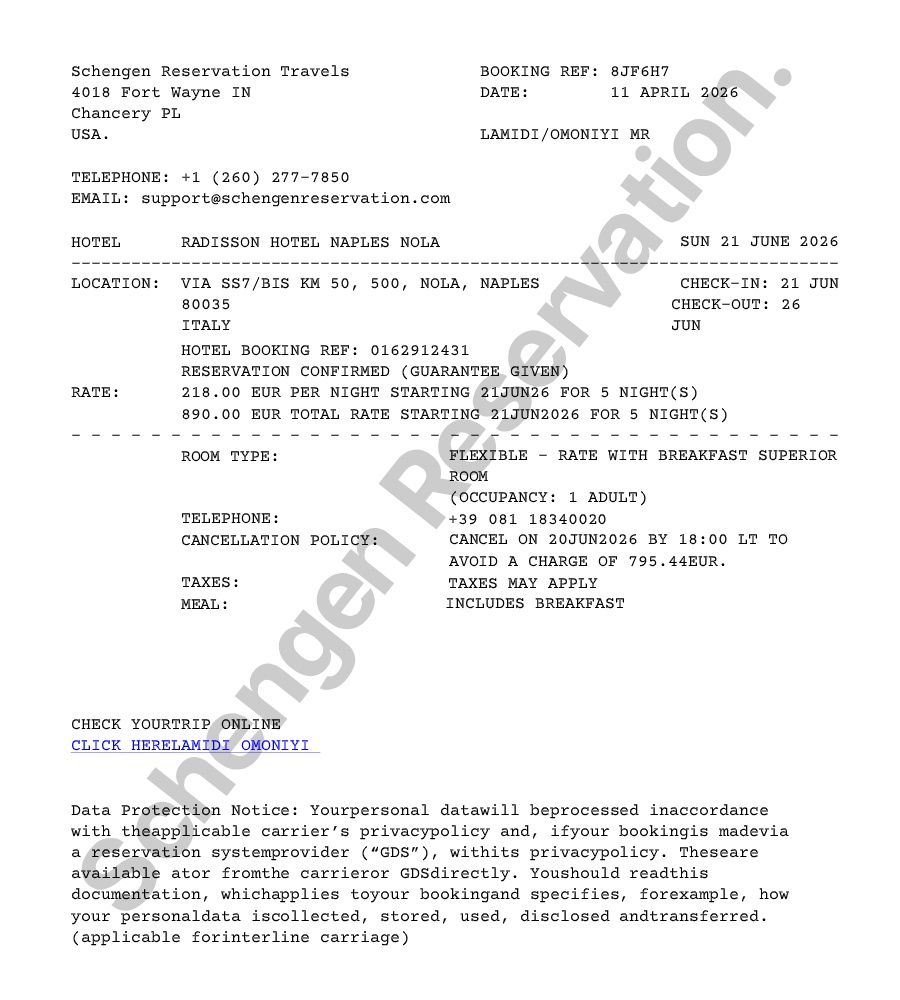
A proper accommodation document usually presents:
- the traveler’s name,
- the city or property details,
- check-in and check-out dates,
- the duration of stay,
- and booking-related information where applicable.
That is why people also search for related terms like verifiable hotel reservation, hotel itinerary for visa, hotel ticket for Schengen visa, and hotel confirmation. They are all looking for a stay document that can support the accommodation side of the file in a clearer and more credible way.
Why applicants prefer reservation-based hotel support?
The main reason is caution.
A visa application is often assembled before the final decision is issued. In that stage, many travelers prefer not to commit to fully paid accommodation too early, especially if dates may still change or if the outcome is not yet known. A structured hotel booking for visa gives them a more measured way to show intended stay while preserving flexibility.
This does not mean the document should feel weak. In fact, the opposite is true. Because you are not yet making the final travel purchase, the stay record should look even more structured, more readable, and more intentionally presented. It should answer the questions a reviewer would naturally have:
- Where will you stay?
- Do the dates make sense?
- Does the accommodation align with the rest of the trip?
- Is the stay pattern realistic?
A well-prepared proof of accommodation answers those questions more effectively than a vague hotel record. It supports the Schengen Visa file while helping you avoid premature financial pressure.
Why hotel booking matters so much in visa preparation?
The transport side of the trip tells only half the story. Your arrival and departure dates may be clear, but a visa file still needs to show what happens between those points. That is where accommodation becomes essential.
A stronger hotel reservation helps the application show:
- where you intend to stay,
- how long you will stay there,
- whether your lodging aligns with the trip duration,
- and whether your travel plan feels internally consistent.
This is especially important in Schengen travel, where the trip often needs to look well organized from beginning to end. If your flight arrives on one date but your hotel booking confirmation dates do not start until much later, your file may feel disjointed. If your route suggests a multi-city journey but your stay record only reflects one static hotel, the application may feel incomplete. When hotel dates align naturally with the rest of the file, the overall presentation becomes more coherent.
That is why a stronger hotel booking for Schengen visa is not merely an extra attachment. It is part of the logic of the trip.
What makes a stronger dummy hotel booking than a weak one?
A weak accommodation record often has one or more of these issues:
- the stay dates are unclear,
- the city sequence does not match the route,
- the tentative hotel booking feels too thin,
- or the presentation does not look easy to review.
A stronger record is different. It should feel ordered. It should show the stay details in a way that makes immediate sense. It should help the file read more naturally rather than forcing the reviewer to guess what the travel pattern is supposed to be.
A stronger hotel itinerary for visa usually has:
- a clear stay structure,
- check-in and check-out logic,
- destination alignment,
- a readable format,
- and booking information that feels dependable.
When those elements come together, the hotel document stops looking like a minor supporting paper and starts functioning as a meaningful part of the file.
How to Book a dummy hotel through Schengen Reservation
If you want to book a hotel document through Schengen Reservation., the process is straightforward, but accuracy matters. A stronger result depends not only on the service itself, but also on how clearly you provide your travel details.
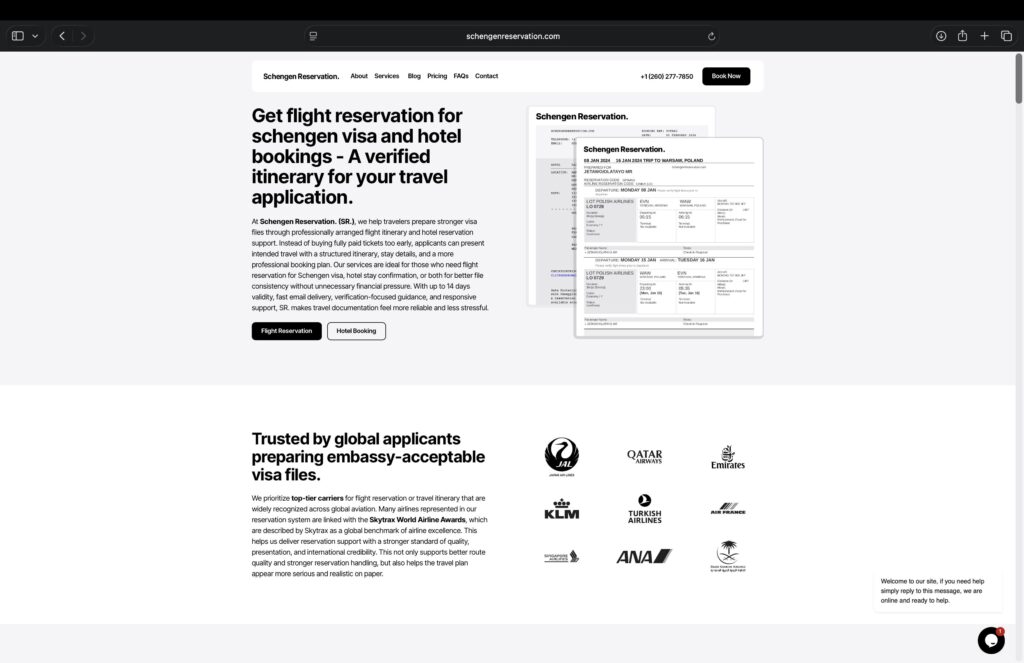
Step 1: Open the hotel-booking page
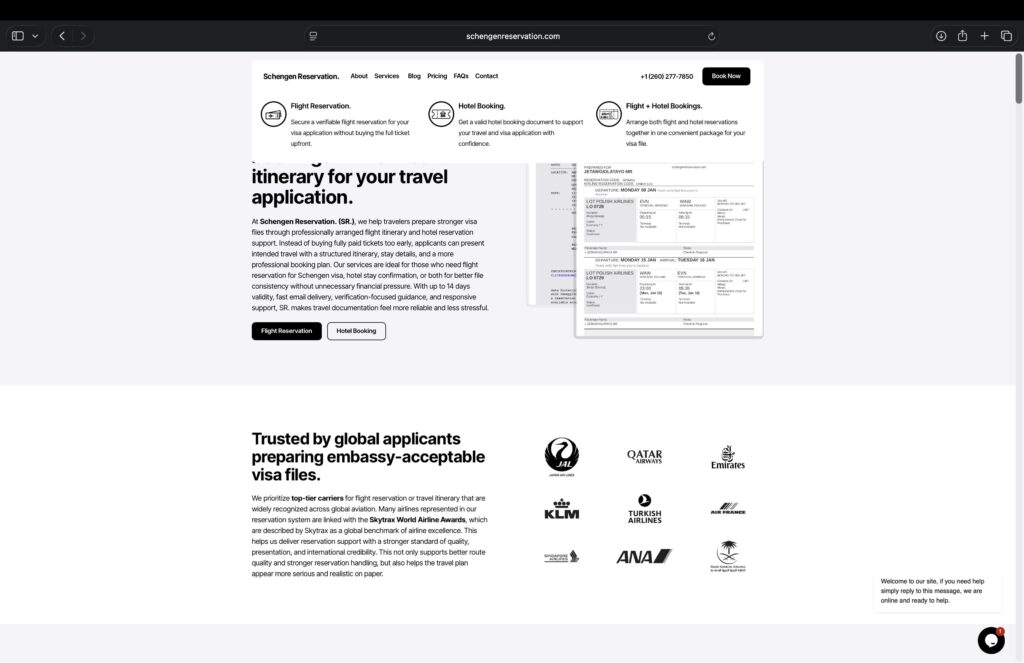
Begin from the Hotel Booking service page on the Schengen Reservation website. This is the correct place to request accommodation support rather than trying to adapt a flight page or a combo request.
Step 2: Enter traveler information exactly as on passport
Use the traveler’s details exactly as shown on the passport. This is one of the most important parts of the process. If the name is entered casually or differently, the final document can lose clarity and may need correction later.
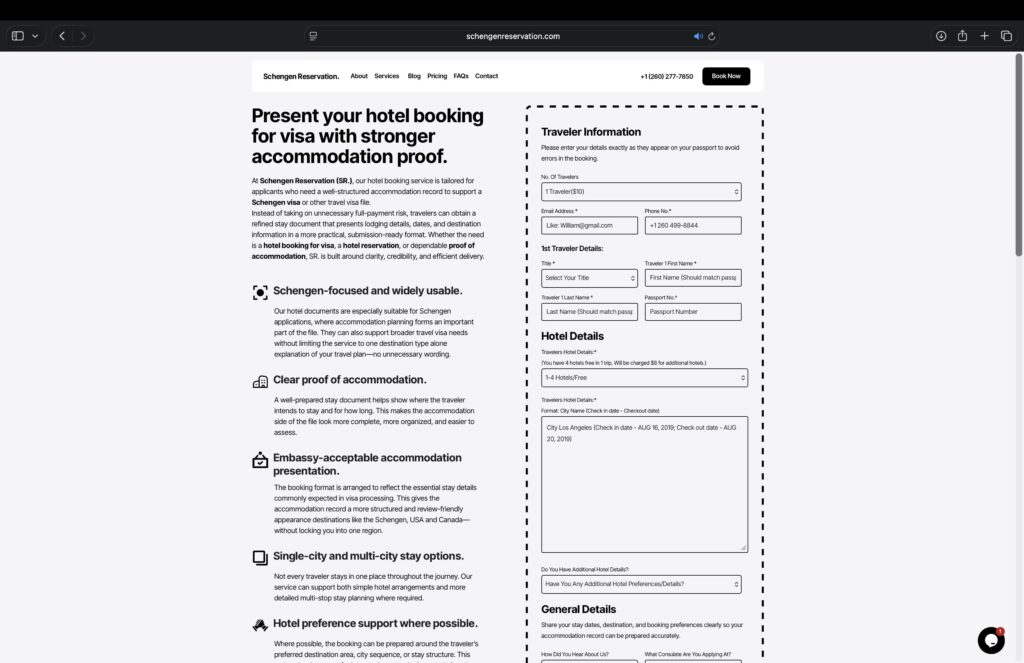
Step 3: Choose the number of travelers
Select the correct number of people staying under the booking. This makes the accommodation record more accurate for solo travelers, couples, families, or groups.
Step 4: Add hotel details in city-and-date format
Enter the destination city, check-in date, and check-out date carefully. If your trip involves more than one city, include the stay pattern properly rather than forcing everything into one unrealistic hotel entry.
Step 5: Add hotel preferences where needed
If you have preferred city areas, a certain stay sequence, or specific hotel-side expectations, mention those where possible. A more tailored booking often feels more relevant to the actual journey.
Step 6: Complete the general details section
Add the consulate where you are applying and indicate how quickly you need the order. This helps shape the urgency of the request.
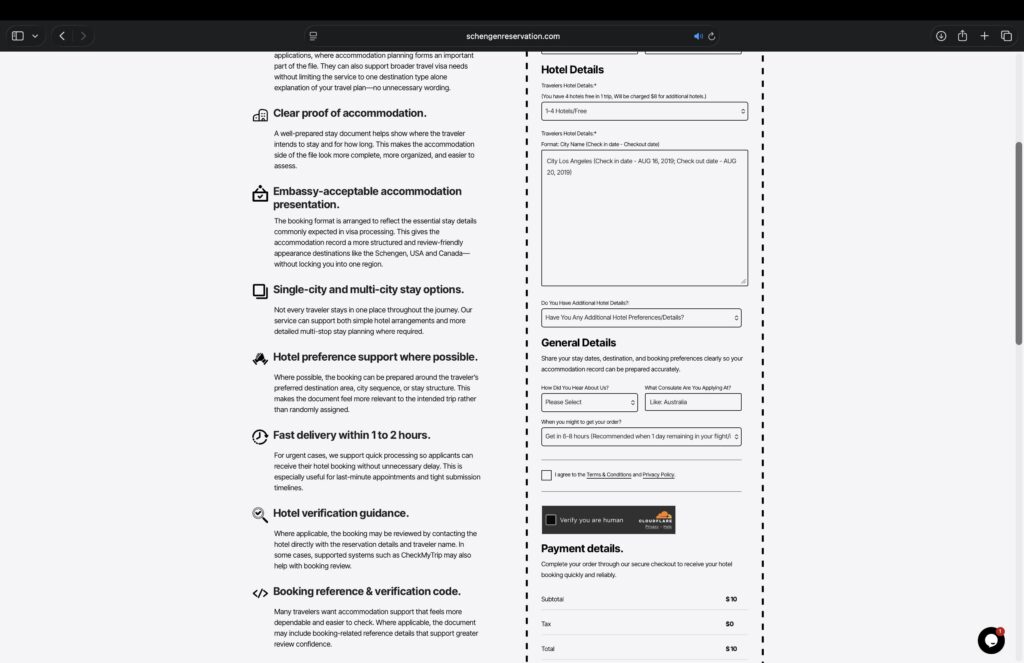
Step 7: Review your details before payment
Before checkout, go over your traveler name, city details, and stay dates one more time. Small mistakes on the accommodation side can affect the coherence of the whole file.
Step 8: Proceed through secure checkout
The checkout process is SSL-encrypted, which helps make payment activity more secure and more dependable for the customer.
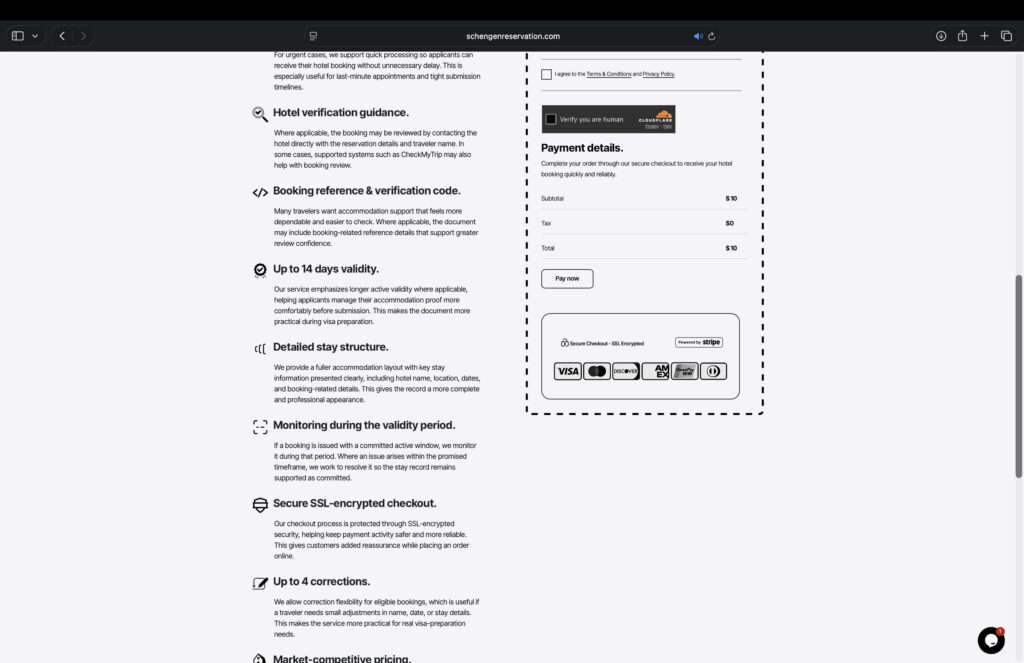
Step 9: Watch for delivery by email
Once the order is placed, the booking is delivered by email. If the confirmation message does not appear promptly, you should also check your spam or junk folder.
The process is simple, but it works best when the details are already clear before you begin. A stronger order is not just a faster order. It is a more accurate one.
How to book hotel urgently without weakening the file?
Urgency is common in visa preparation. Travelers often realize late in the process that accommodation proof is still missing. In such cases, speed matters, but speed should not replace structure.
If you need a hotel document urgently, prepare these points first:
- your name exactly as on passport,
- your destination city or cities,
- your check-in and check-out dates,
- the number of travelers,
- your consulate or visa center,
- and whether the stay is single-city or multi-city.
This matters because the strongest urgent booking is not the one typed in a panic. It is the one placed quickly after the stay logic has been decided. If your city sequence is unclear, if your dates do not match your route, or if you are still changing the stay plan while placing the order, urgency becomes harder to fulfill cleanly.
A disciplined urgent request is far more useful than a rushed one.
Fast delivery and why it matters
One of the biggest concerns applicants have is timing. If the appointment is close, if the file is almost complete, or if the verifiable accommodation side is the last missing piece, quick turnaround becomes highly valuable.
That is why Schengen Reservation. places strong emphasis on urgent support and fast delivery by email. Where applicable, delivery may be handled quickly, and the overall process is designed to reduce unnecessary delay. This matters because accommodation proof often becomes urgent at the exact moment a traveler realizes the rest of the file is already ready.
Fast delivery is especially valuable when:
- your submission date is close,
- the visa interview has been scheduled,
- the rest of the file is already complete,
- or the accommodation document is the missing item.
A strong hotel booking for visa is therefore not only about structure. It is also about timing.
How to verify your hotel booking?
Verification is one of the most important parts of this topic, and it should be understood in practical terms. You can usually review a hotel booking in one of two ways:
Direct hotel confirmation
You can contact the hotel directly using the phone number or details shown on the booking record and confirm the reservation using the traveler’s name and the booking information. This is the most straightforward approach because it connects directly with the accommodation side itself.
CheckMyTrip or supported platform
Where applicable, the booking may also be reviewed through CheckMyTrip or a comparable platform connected with supported reservation systems. This can provide an added layer of reassurance for travelers who want another way to review the booking.
Verification matters because a stronger proof of accommodation should not feel abstract. It should feel grounded enough that the traveler understands how the record can be reviewed. That makes the booking easier to trust and more useful within the file.

Why dummy hotel validity matters so much?
Applicants often focus heavily on delivery speed, but validity can be just as important. A hotel record that arrives quickly but loses usefulness too soon still creates pressure. A hotel record that remains active for a more comfortable period gives you time to finish the rest of your application without panic.
That is why up to 14 days validity is such a strong benefit. A longer active window helps you:
- review the accommodation details carefully,
- align the stay with your route,
- complete the rest of your file,
- and submit with more confidence.
A hotel reservation that remains useful for longer is more practical, especially if your flight itinerary, insurance, or other supporting papers are still being finalized. In real visa preparation, time is rarely consumed by one document alone. It is consumed by coordination. That is exactly why lasting validity matters.
Monitoring during the validity period
Another valuable feature is active monitoring during the committed validity period. If a hotel booking is issued with a stated active window, support should not stop the moment the file reaches your inbox. A stronger service continues to pay attention to the booking during that committed period.
That means if an issue appears within the promised timeframe, steps can be taken to address it and keep the accommodation record supported. This matters because some travelers do not actually use the document on the same day they receive it. They may still be coordinating other parts of the file. A monitored booking is therefore a more dependable booking.
This point is especially useful because many applicants think of validity as a passive feature. In reality, validity becomes much stronger when it is paired with active oversight.
Why multi-city hotel support can improve the application
Many visa trips are not limited to one city. A traveler may arrive in Paris, continue to Amsterdam, and later move on to Barcelona. If the accommodation side of the file does not reflect that movement, the journey can feel unrealistic.
A better hotel itinerary for visa should therefore support the actual stay pattern where needed. Multi-city stay support helps the file read more naturally because it mirrors the route rather than simplifying it into something less accurate. If your trip is layered, your accommodation record should be layered too.
This is especially useful for:
- tourism across multiple Schengen destinations,
- family or friend visits combined with city stays,
- event-based travel followed by leisure travel,
- or any itinerary where one static hotel would not reflect the actual journey.
A more realistic stay pattern often strengthens the file simply because it feels more authentic.
Group travelers and accommodation support
Another useful angle is group travel. Not every visa file is for one solo traveler. Many applications involve couples, families, or small groups traveling together. A stronger hotel reservation or room accommodation service should therefore support more than one individual profile.
That is why group-traveler functionality and potential multi-traveler handling matter. When a hotel record is prepared for several travelers in one coordinated way, the application often feels more orderly than if several fragmented stay records are attached without consistent structure.
This is also where group discount logic and market-competitive pricing become meaningful advantages. A service that supports multi-traveler booking more smoothly is naturally more useful for real travel situations.
Competitive hotel pricing and why it matters
Price always matters, but in this space the best value is not always the cheapest raw number. The real question is whether the hotel reservation support gives you:
- a structured record,
- practical validity,
- email delivery,
- verification guidance,
- urgent support when needed,
- and a format that feels more suitable for submission.
That is why market-competitive pricing is valuable when it is paired with service quality. A weak document at a low price can still cost you in stress, confusion, and correction time. A stronger booking at a practical rate often saves you much more by helping the file feel cleaner and easier to assemble.
Why hotel alignment with flights matters
Even though this article focuses on hotel booking for Schengen visa, accommodation should not be thought of separately from travel movement. A better file usually shows that flight dates and stay dates work together. If they do not, the application can feel uneven.
For example:
- if your flight arrives on 12 June but the hotel begins on 14 June, the file has a gap,
- if the route suggests Rome but the hotel shows only Milan, the stay pattern may look incomplete,
- if the trip is multi-city but the lodging side is static, the file can feel less convincing.
That is why accommodation alignment matters so much. A stronger proof of accommodation does not merely exist on its own. It works naturally with the rest of the travel plan.

Common mistakes to avoid
Many weak hotel orders fail not because the service is wrong, but because the traveler information is inconsistent. The most common mistakes are simple:
- entering the traveler’s name differently from the passport
- choosing city dates that do not match the route
- forgetting that the trip includes more than one city
- leaving the stay structure vague
- waiting until the last possible moment to think through lodging details
A stronger accommodation record begins with stronger clarity from the applicant. The more realistic your own stay plan is before ordering, the more useful the final document becomes.
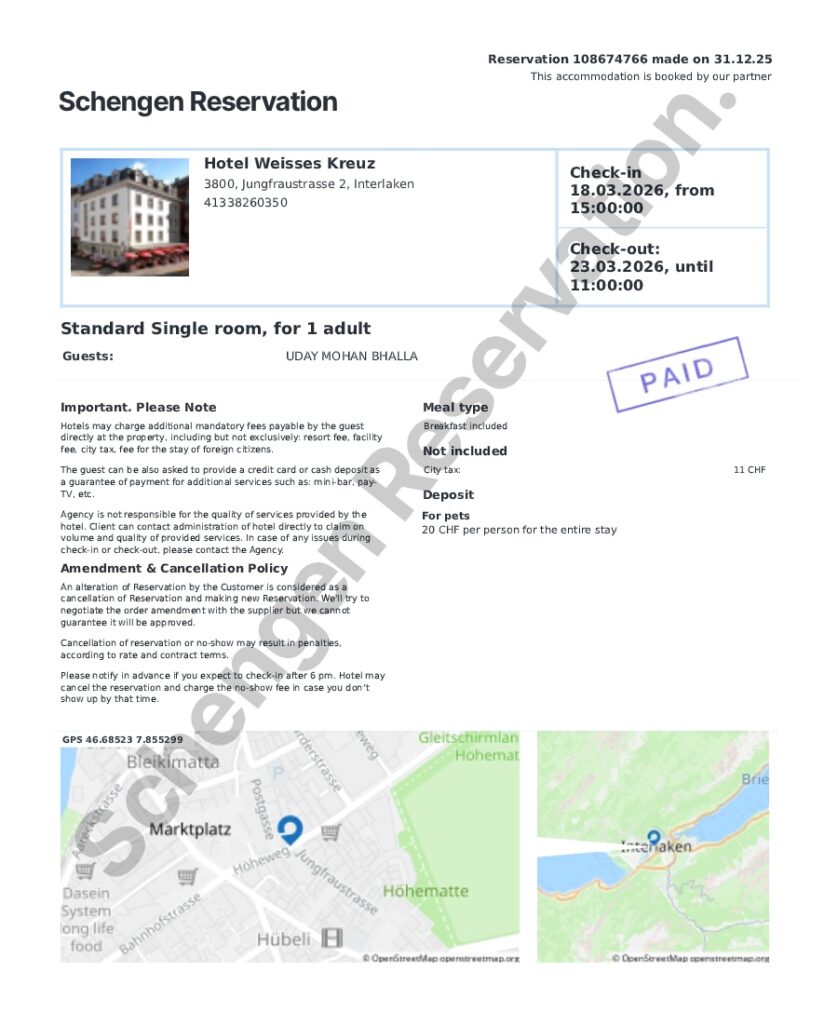
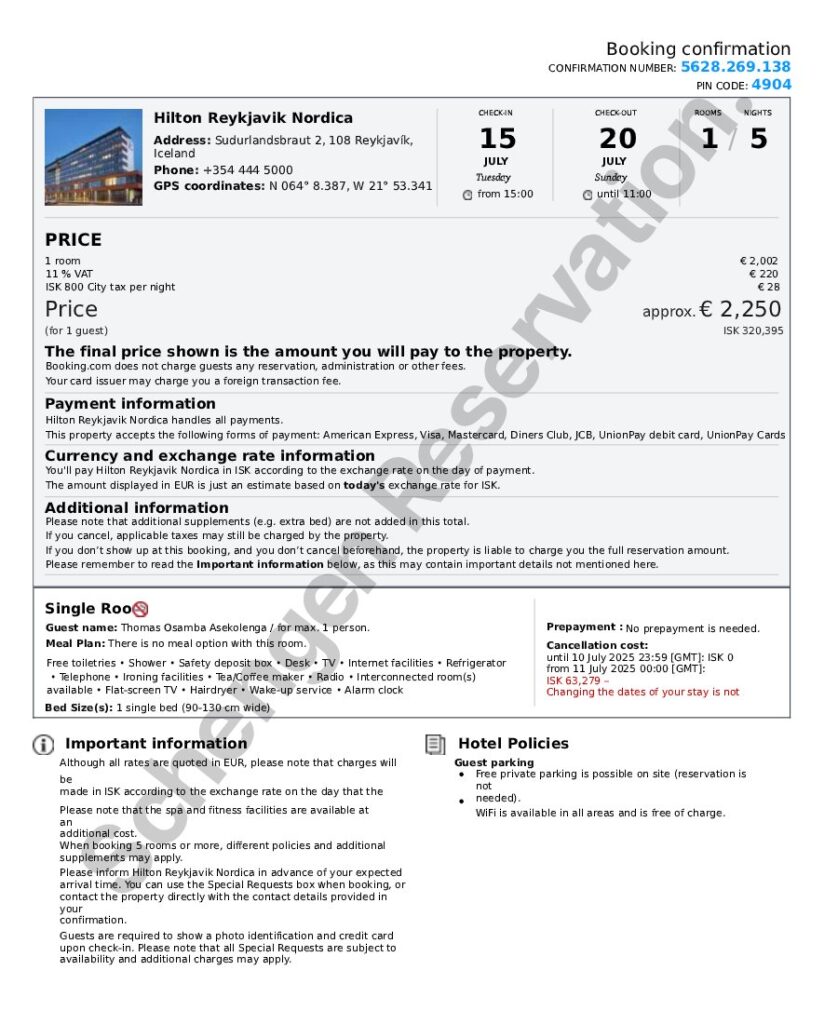
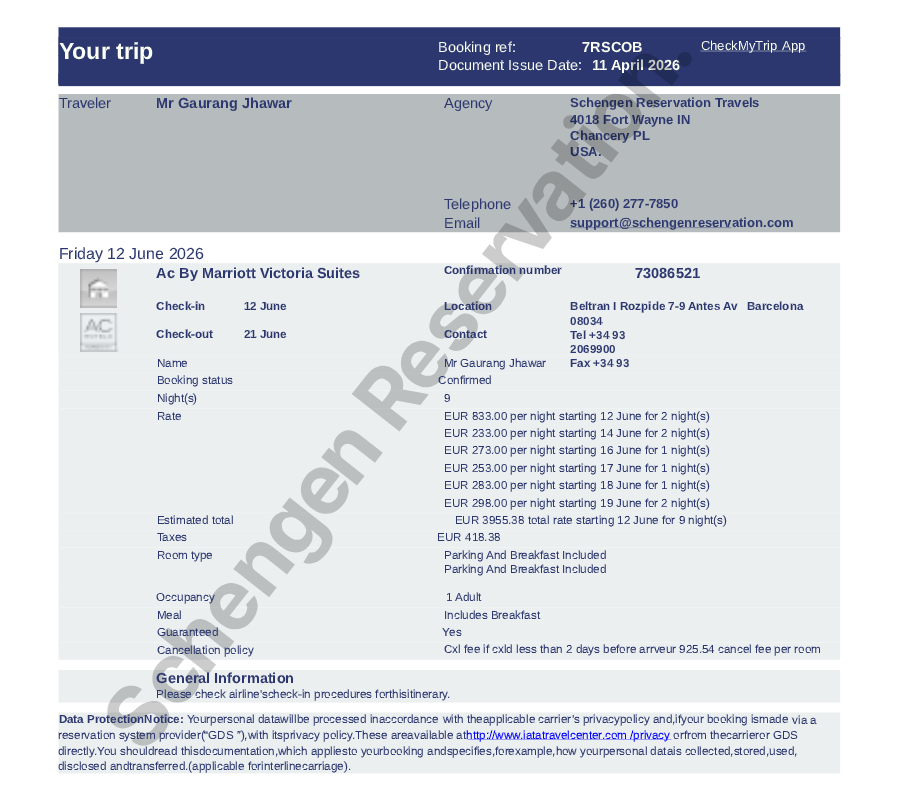
Dummy hotel for Schengen visa Samples:
Frequently Asked Questions
What is a dummy hotel for Schengen visa?
A dummy hotel for Schengen visa is the everyday search term people use for a reservation-based accommodation document prepared for visa purposes. In professional use, it is usually a hotel booking for visa or proof of accommodation.
Is hotel booking the same as proof of accommodation?
In many visa cases, yes. A hotel booking is one of the most common forms of proof of accommodation because it shows where you plan to stay and for how long.
Why is hotel booking important for a Schengen visa?
Because it supports the accommodation side of the application and helps show that the stay portion of the trip has also been planned clearly.
How do I book a dummy hotel urgently?
Go to the hotel-booking page, enter the traveler details exactly as on passport, add the stay details in city-and-date format, complete the general information, choose the timing, and proceed through payment.
Can I order only hotel booking without flight reservation?
Yes. A standalone hotel booking can be ordered if the accommodation side is what you need.
Can I include more than one hotel?
Yes. If your trip includes several cities or more than one stay, the accommodation pattern can be structured accordingly.
How can I verify my booking?
You can usually verify the booking by contacting the hotel directly using the booking details and traveler name, or by checking through CheckMyTrip where applicable.
How long can the hotel booking remain useful?
Where applicable, the service emphasizes up to 14 days validity, which gives applicants more flexibility before submission.
Is urgent delivery available?
Yes. Fast email delivery is part of the practical value of this service, especially when the application timeline is tight.
Why not just pay the hotel in full now?
Because many applicants prefer to avoid unnecessary full-payment commitments before the visa decision is known. A reservation-based stay record can support the file while preserving flexibility.
Can the booking be monitored during the validity period?
Yes. Active monitoring during the committed validity period adds reassurance and helps keep the booking supported if an issue arises.
Does hotel booking have to match my flight dates?
As closely as possible, yes. A stronger file usually shows that travel and accommodation dates align naturally.
Final word
A dummy hotel for Schengen visa is not a casual extra. It is one of the clearest ways to show that your stay arrangements have been considered properly before submission. When prepared well, it helps your application feel more complete, more organized, and more persuasive as a whole.
That is why the real goal is not merely to obtain any hotel document. The better goal is to secure a stay record that offers practical validity, clear date structure, usable verification pathways, thoughtful formatting, and stronger alignment with the rest of your travel plan. When those elements come together, the accommodation side of the visa file stops feeling like a weak supporting page and begins to function as what it should be: a meaningful part of a stronger and more credible application.