
Applying for a Schengen visa from Morocco is not simply a matter of collecting a passport, a bank statement and a hotel confirmation. A successful application must present a credible journey supported by documents that agree with one another from beginning to end.
The consular authority needs to understand why you are travelling, where you will stay, how the trip will be financed and why you are expected to return to Morocco before the authorized stay expires. An application becomes substantially stronger when its dates, finances, professional circumstances, reservations and written explanations collectively tell the same story.
This guide explains how Moroccan citizens and legal residents can prepare a Schengen visa application for tourism, business, family visits and other permitted short stays. It also identifies the appropriate application channel for each Schengen country and highlights the practical weaknesses that commonly undermine otherwise genuine files.
No travel company, application centre or document can guarantee that a visa will be issued. The final decision belongs exclusively to the competent consulate. The purpose of an approval-focused application is therefore not to manufacture certainty, but to remove avoidable doubt.
What Moroccan Applicants Should Know Before Applying
The Schengen area currently consists of 29 European countries applying a common short-stay visa framework. A standard Schengen visa generally permits visits of no more than 90 days within any rolling 180-day period, although the visa sticker may authorize a shorter stay. Visits exceeding 90 days are governed mainly by the national immigration rules of the destination country.
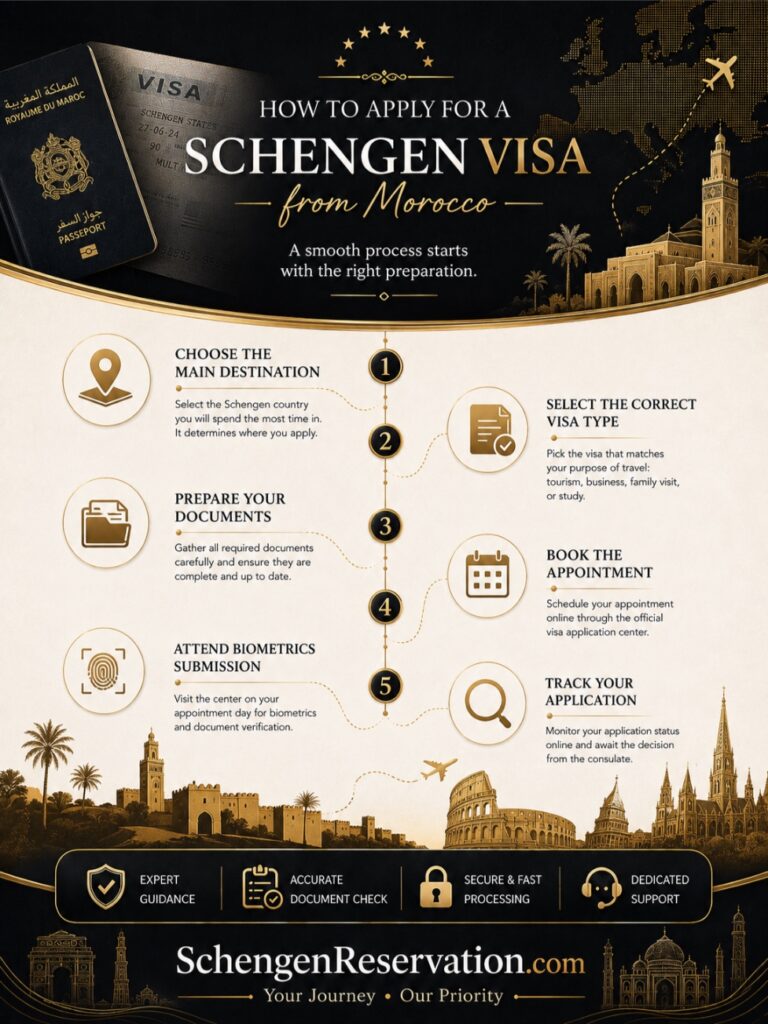
For most applicants, the process involves:
- Identifying the Schengen country responsible for the application
- Selecting the correct visa category
- Completing the official application form
- Booking an appointment with the designated embassy or service provider
- Preparing purpose-specific supporting documents
- Attending in person when biometrics are required
- Paying the visa fee and any authorized service charge
- Waiting for the competent consular authority to decide the case
Visa application centres such as VFS Global, TLScontact and BLS International may receive files, collect biometrics and return passports. They do not decide whether a visa should be granted. Paying for an optional premium lounge, courier facility, assisted form service or earlier appointment does not purchase preferential treatment from the embassy.
Select the Correct Schengen Country Before Booking an Appointment
One of the most consequential decisions in the application is identifying which country has jurisdiction over the proposed journey.
Apply to the Country of Your Main Destination
Submit the application to the country where you intend to spend the greatest number of nights.
For example, an itinerary containing:
- Four nights in Spain
- Two nights in France
- Two nights in Belgium
would normally make Spain the main destination.
Apply According to the Principal Purpose
The purpose of the visit can take precedence where one country is clearly central to the journey.
Suppose an applicant plans to attend a three-day professional conference in Germany and then spend four days sightseeing in the Netherlands. Germany may remain the appropriate destination because the professional event is the principal reason for travelling.
Use the First-Entry Rule Only When Stays Are Equal
When the applicant will spend the same number of nights in two or more Schengen countries and no destination has a stronger purpose, the application is generally lodged with the country of first entry.
If the traveller plans:
- Three nights in Italy
- Three nights in Austria
- Entry through Italy
Italy would ordinarily be the responsible country.
The official EU guidance requires applicants to apply through the consulate of the main destination. Applications should not be redirected to a country merely because its appointments appear easier to obtain.
Why “Visa Shopping” Can Damage an Application
A nominal itinerary created only to obtain an appointment from a supposedly easier country can cause serious inconsistencies.
Warning signs include:
- Applying through one country while most hotel nights are elsewhere
- Showing a brief stay in the issuing country but a much longer stay in another
- Presenting reservations that do not support the declared route
- Cancelling the principal destination immediately after obtaining the visa
- Giving an explanation at the border that differs from the application
The correct approach is to build the application around the genuine journey, not to redesign the journey around internet rumors about an “easy embassy.”
Schengen Visa Types from Morocco
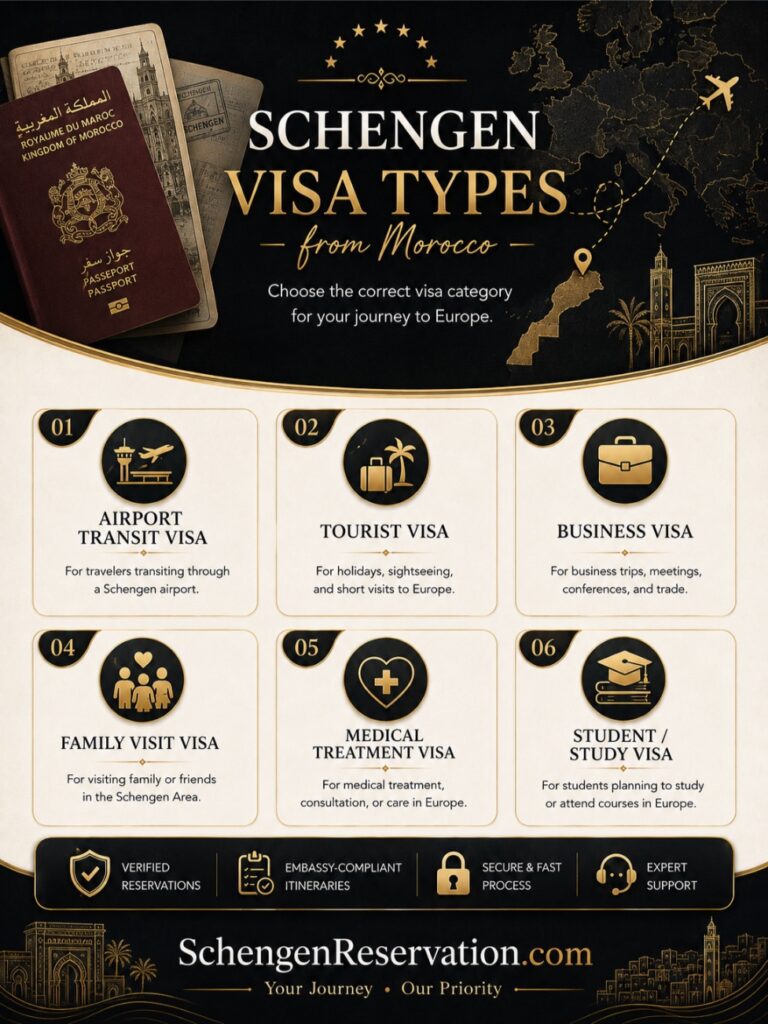
Selecting the correct category is essential because each visa serves a different legal and practical purpose.
Type A: Airport Transit Visa
A Type A visa permits transit through the international area of a Schengen airport while travelling to a destination outside the Schengen area.
It does not ordinarily allow the traveller to:
- Leave the international transit zone
- Enter the Schengen territory
- Stay overnight outside the airport
- Travel onward by train, bus or domestic flight requiring formal entry
An airport transit visa may be relevant where a traveller changes aircraft at a Schengen airport but continues to a non-Schengen destination. Requirements can depend on nationality, route, airport configuration, residence permits and visas held for other countries.
A traveller should not assume that every connection is an airside transit. Collecting checked luggage, changing airports or transferring between terminals that require border control may instead require a regular short-stay visa.
Type C: Short-Stay Schengen Visa
The Type C visa is the category used by most Moroccan applicants travelling temporarily for:
- Tourism
- Visiting relatives or friends
- Business meetings
- Conferences and trade fairs
- Short professional training
- Cultural activities
- Sporting events
- Medical treatment
- Educational visits of limited duration
- Other authorized stays not exceeding the permitted short-stay limit
A Type C visa may be issued for:
Single Entry
The traveller may enter the Schengen area once. Leaving the area normally exhausts the entry permission even if unused days remain.
Double Entry
The holder may enter twice during the validity period, provided the total authorised stay is not exceeded.
Multiple Entry
The holder may enter and leave multiple times while the visa remains valid. The traveller must still comply with the authorised duration and the 90-days-in-180-days rule.
A multiple-entry request should have a rational basis, such as recurring professional duties, repeated family visits or a demonstrated history of lawful travel. Asking for a five-year visa without a genuine recurring need does not oblige the consulate to issue one.
Type D: National Long-Stay Visa
A Type D visa is issued under the national law of a particular country for a stay generally exceeding 90 days.
It may be required for:
- University education
- Long-term employment
- Family reunification
- Research
- Extended professional assignments
- Certain residence programmes
A national visa is not simply a longer tourist visa. Its eligibility conditions, fees, forms and supporting documents depend on the destination country. Applicants planning to relocate, work permanently or study for an academic year should consult the national immigration instructions rather than relying on a short-stay Schengen checklist.
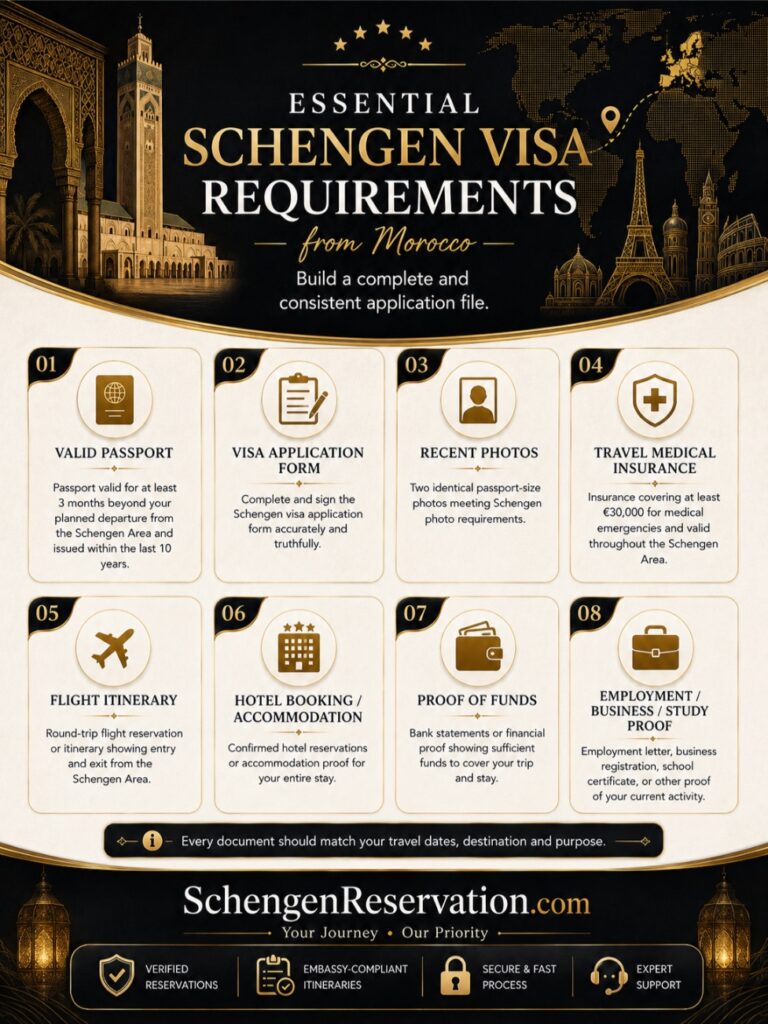
Ultimate Schengen Visa Requirements from Morocco
The exact checklist depends on the destination, applicant profile and purpose of travel. Nevertheless, most short-stay files from Morocco are built around the following core requirements.
- A Valid Passport
The passport should normally:
- Have been issued within the previous 10 years
- Remain valid for at least three months beyond the intended departure from the Schengen area
- Contain at least two blank visa pages
- Be undamaged and fully legible
- Match the applicant’s identity information on every supporting document
Submit copies of the identity page, previous Schengen visas and relevant entry or exit stamps where requested.
An applicant using a recently issued passport may also be asked to provide an old passport so that previous travel history can be assessed.
- Completed and Signed Visa Application Form
The form must be completed accurately and consistently.
Particular attention should be given to:
- Full name and surname
- Previous surnames
- Passport number
- National identity details
- Employment or educational status
- Intended arrival and departure dates
- Main destination
- Number of requested entries
- Accommodation details
- Person or organization financing the trip
- Previous fingerprints and visas
The harmonized application form is provided without charge. Information entered in the form should correspond with the passport, cover letter, reservations, invitation and financial evidence.
- Recent Biometric Photographs
Applicants normally provide recent photographs that meet the destination’s prescribed dimensions and biometric standards.
The photographs should be:
- Recent
- Clear and sharply focused
- Taken against the required plain background
- Free from heavy editing or digital alteration
- Consistent with the applicant’s present appearance
Do not rely on a photograph merely because it was accepted for an unrelated ID card. Visa photograph specifications can differ.
- Proof of Legal Residence in Morocco
A Moroccan citizen will generally provide a copy of the national identity card where required.
A non-Moroccan national applying from Morocco should normally establish lawful residence through a valid Moroccan residence card or comparable authorisation. A visitor temporarily present in Morocco may not automatically be entitled to apply there unless the consulate accepts an exceptional justification.
- Travel Medical Insurance
The policy should normally:
- Cover the complete intended travel period
- Be valid throughout the Schengen area
- Provide at least €30,000 of coverage
- Include emergency medical treatment
- Include hospitalization and repatriation where required
- Clearly identify the insured applicant
- Show the geographical and temporal validity
The insurance certificate must cover the actual travel dates. Where a policy uses ambiguous wording, attach the complete schedule or conditions showing that Schengen-wide coverage is included.
- Flight Itinerary or Transport Evidence
The file should demonstrate how the applicant intends to enter, move within and leave the Schengen area.
Depending on the route, this may include:
- Round-trip flight itinerary
- Multi-city flight reservation
- Ferry booking
- Rail reservation
- Bus booking
- Vehicle documents
- Driving licence
- Cross-border transport plan
The itinerary should show coherent dates, passenger names, departure airports and destinations.
A consulate may request a reservation rather than a fully paid non-refundable ticket before a decision has been made. Applicants must follow the exact wording of the destination’s checklist and should not misrepresent an itinerary as a purchased ticket.
- Proof of Accommodation
Accommodation evidence must account for the entire stay.
It may consist of:
- Hotel reservations
- Serviced-apartment bookings
- Tour accommodation confirmations
- An invitation from a private host
- Proof of ownership or tenancy where the applicant has access to a residence
- A combination of hotels and private accommodation
Every night should be identifiable. Unexplained gaps between cities can make the journey appear incomplete.
A hotel itinerary should correspond with:
- Flight dates
- Cities named in the cover letter
- Daily travel plan
- Main destination
- Number of travellers
- Length of stay
For private visits, the host may need to provide an official accommodation declaration, identity document, residence permit, proof of address or municipality-validated sponsorship form, depending on the destination.
- Evidence of Sufficient Financial Means
A large closing balance alone does not establish financial credibility. Consular authorities may examine how the money was accumulated, whether the account is actively used and whether the proposed expenditure is proportionate to the applicant’s regular income.
A strong financial file may include:
- Personal bank statements for the period requested by the checklist
- Bank-stamped statements where required
- Salary slips
- Employment income
- Business income
- Tax declarations
- Pension statements
- Scholarship confirmation
- Savings evidence
- Sponsorship documents
- Proof of prepaid transport or accommodation
The official EU framework expects applicants to establish their means of subsistence, accommodation, purpose of stay and intention to return.
The Source-of-Funds Test
Before submitting the file, ask four questions:
- Is the money traceable?
The statements should show where the funds came from. - Is the money stable?
A consistent balance is usually easier to explain than a large last-minute deposit. - Is the budget realistic?
Trip expenses should be proportionate to the applicant’s income and obligations. - Is the financier correctly identified?
Where another person is paying, the file should clearly establish that person’s identity, financial capacity and relationship with the applicant.
Explaining Recent Large Deposits
A recent deposit is not automatically disqualifying, but unexplained funds can raise questions.
Possible legitimate explanations include:
- Salary arrears
- Sale of an asset
- Matured savings
- Business proceeds
- Family transfer
- Rental income
- Bonus or commission
- Reimbursement
Support the explanation with evidence such as a sale agreement, payslip, transfer receipt, invoice, contract or written sponsorship declaration.
Never borrow money temporarily simply to inflate the statement. A balance that disappears immediately after submission can be difficult to defend if additional evidence is requested.
- Proof of Employment, Business, Study or Retirement
The applicant’s circumstances in Morocco help the consulate evaluate both financial capacity and the likelihood of timely return.
Employees
An employee may need:
- Employment certificate
- Position and joining date
- Monthly salary
- Approved leave letter
- Recent payslips
- CNSS records where applicable
- Work contract
- Employer contact details
- Bank statements showing salary credits
The leave period should correspond with the proposed journey. A letter allowing seven days of leave cannot convincingly support a three-week holiday without explanation.
Business Owners and Self-Employed Applicants
A business owner may provide:
- Commercial registration
- ICE documentation
- Professional tax or licence evidence
- Articles or company formation documents
- Corporate bank statements
- Personal bank statements
- Tax declarations
- Recent invoices
- Client contracts
- Proof of active trading
- Ownership or management evidence
The file should distinguish company funds from personal funds. An applicant should not claim that the company will finance the trip without demonstrating authority to use its money for that purpose.
Students
A student may need:
- Current enrollment certificate
- Student card
- Attendance record where relevant
- Academic calendar
- Leave or holiday confirmation
- Sponsorship declaration
- Sponsor’s employment and financial documents
- Proof of relationship with the sponsor
The intended travel dates should not conflict with mandatory classes or examinations unless the institution has approved the absence.
Retired Applicants
A retired traveller may provide:
- Retirement or pension certificate
- Pension statements
- Personal bank records
- Property or rental-income evidence
- Family and social ties in Morocco
- Sponsorship evidence where applicable
Unemployed Applicants
Unemployment does not create an automatic refusal. It does, however, make the explanation of finance and return incentives particularly important.
The file may include:
- Sponsor’s undertaking
- Sponsor’s income and bank statements
- Proof of relationship
- Evidence of personal savings
- Family responsibilities
- Property or tenancy evidence
- Ongoing studies, training or professional commitments
- A truthful explanation of present circumstances
Avoid inventing employment. False certificates can damage the current application and future visa credibility.
- Evidence of the Purpose of Travel
The documentation should be specific to the declared reason for travelling.
Tourism
A tourism file may include:
- Day-by-day or city-by-city itinerary
- Transport reservations
- Hotel bookings
- Attraction or activity plans
- Cover letter
- Evidence of approved leave
- Realistic travel budget
A good itinerary does not need to schedule every hour. It should show that the route is feasible and genuinely understood by the applicant.
Visiting Family or Friends
A private-visit file may require:
- Invitation letter
- Host’s passport or identity card
- Host’s residence permit
- Proof of address
- Evidence of the relationship
- Official sponsorship or accommodation form
- Host’s financial evidence where the host is paying
- Civil-status documents
An invitation alone does not replace the applicant’s responsibility to explain personal circumstances in Morocco.
Business Travel
A business file may include:
- Invitation from the European company
- Letter from the Moroccan employer
- Meeting programme
- Conference registration
- Commercial correspondence
- Proof of an existing business relationship
- Explanation of who will pay
- Evidence that the applicant will return to continued employment or business duties
The inviting and sending organisations should describe the same event, dates and financial arrangement.
Medical Treatment
A medical application may require:
- Medical report from Morocco
- Acceptance letter from the European clinic
- Treatment plan
- Estimated cost
- Proof of payment or financing
- Accommodation arrangements
- Details of an accompanying person
- Evidence of the applicant’s intended return or continued care
Cultural, Sporting or Educational Visit
Relevant evidence can include:
- Official invitation
- Event schedule
- Registration
- Membership confirmation
- Sending organisation’s letter
- Competition or training details
- Funding arrangements
- Proof of return to the school, club or institution
- Proof of Intention to Return to Morocco
A Schengen visa application is evaluated as a temporary-travel request. The applicant should therefore demonstrate credible reasons for returning.
Potential evidence includes:
- Permanent or continuing employment
- Approved limited leave
- Business ownership
- Active commercial contracts
- Current university enrollment
- Scheduled examinations
- Dependent children or family responsibilities
- Property ownership
- Residential tenancy
- Pension commitments
- Ongoing medical care
- Previous lawful international travel
- A dated professional obligation after the trip
No single document proves return intention in every case. The consulate assesses the overall circumstances.
A property title can support a file, but it does not compensate for unexplained finances or an implausible journey. Similarly, a stable job is helpful, but contradictory statements can still weaken the application.
- Cover Letter for the Schengen Visa Application
A concise cover letter can connect documents that would otherwise appear as isolated pieces of evidence.
It should explain:
- The purpose of the trip
- Destination countries and dates
- Why the chosen consulate is responsible
- Who is financing the journey
- Employment, business or educational circumstances
- Accommodation and transport arrangements
- Previous travel history where relevant
- Any unusual transaction, itinerary detail or personal circumstance
- Commitment to leave before the permitted stay expires
The letter should not be an emotional appeal, a copied online template or a long autobiography. Its value lies in making the file easier to understand.
- Civil-Status and Family Documents
Depending on the application, the consulate may request:
- Birth certificate
- Marriage certificate
- Family record
- Divorce judgment
- Death certificate
- Proof of parental authority
- Relationship documents
- Certified translation
- Legalisation or apostille where applicable
Names and dates must be consistent. Where transliteration produces different spellings, explain the variation and submit evidence connecting the records.
Requirements for Minors Applying from Morocco
A minor’s application may require:
- Separate visa application form
- Passport
- Birth certificate
- Parents’ identity documents
- Parents’ passports
- School enrollment certificate
- Travel medical insurance
- Accommodation and transport evidence
- Financial sponsorship documents
- Written parental consent
- Authorization from a non-travelling parent
- Custody decision where applicable
- Death certificate if one parent is deceased
The exact consent format can vary according to the destination and family circumstances. Both parents may need to attend or provide authenticated authorisation.
A minor’s file should clearly identify:
- Who will accompany the child
- Who will finance the journey
- Where the child will stay
- Whether both parents consent
- When the child is expected to return to school
The Five-Pillar Approval Framework
The strongest applications tend to perform well in five interconnected areas.
Pillar One: A Credible Purpose
The trip should make sense for the applicant’s circumstances.
A short annual holiday for a salaried employee may be straightforward. A long, expensive trip immediately after beginning a low-paid job may require a more detailed explanation.
Pillar Two: Verifiable Financial Capacity
The applicant or sponsor should be able to afford the journey without relying on unexplained temporary funds.
Pillar Three: Documentary Consistency
Every important date and statement should agree across:
- Application form
- Cover letter
- Flight itinerary
- Hotels
- Insurance
- Invitation
- Leave approval
- Event registration
- Bank evidence
Pillar Four: Strong Return Context
The file should show why the visit is temporary and what the applicant will return to in Morocco.
Pillar Five: Document Integrity
Documents should be genuine, current, complete and verifiable. A modest but authentic file is considerably safer than an impressive file containing altered evidence.
The Schengen Application Process from Morocco
Step 1: Define the Genuine Travel Plan
Decide:
- Why you are travelling
- Which countries you will visit
- How many nights you will spend in each country
- Who will pay
- Where you will stay
- How you will travel between destinations
Do not book an appointment before knowing which country is competent.
Step 2: Confirm the Responsible Embassy or Provider
Application arrangements in Morocco vary by country. Some states use VFS Global, some use TLScontact or BLS International, and others accept files through their embassies.
Representation arrangements also exist. For example, an embassy acting for another Schengen country may receive and decide short-stay applications on its behalf.
Always verify the current provider and consular district before paying or booking.
Step 3: Obtain the Official Checklist
Use the checklist for:
- The destination country
- The correct travel purpose
- The applicant’s place of residence
- The relevant application centre
- The applicant’s age and professional category
Do not combine random checklists from several blogs. A tourism checklist for France cannot automatically be treated as the official checklist for a business application to Poland.
Step 4: Create a Document Timeline
Prepare time-sensitive documents in the correct order.
For example:
- Obtain employer leave approval
- Finalise the itinerary
- Arrange accommodation
- Arrange transport evidence
- Purchase compliant insurance
- Obtain recent bank statements
- Complete the form
- Prepare the cover letter
- Perform a final consistency audit
Documents requested within a particular age limit should not be obtained too early.
Step 5: Book the Appointment Through the Authorised Channel
Use only the embassy or its officially designated service provider.
Be cautious of unofficial agents claiming to:
- Control embassy decisions
- Sell guaranteed appointments
- Provide guaranteed approvals
- Remove a refusal record
- Influence consular staff
- Obtain visas without required biometrics
An authorised service provider may charge a published service fee in addition to the visa fee. The EU confirms that an additional service-centre charge may apply where an external provider receives applications for the consulate.
Step 6: Complete the Application Form
Enter final, verified information rather than estimated details.
Check:
- Passport number character by character
- Dates
- City names
- Host contact details
- Hotel addresses
- Employer information
- Previous visa history
- Requested entries
- Person paying for the trip
Step 7: Attend the Appointment
Applicants should arrive with:
- Appointment confirmation
- Passport
- Complete document file
- Photographs
- Payment method permitted by the centre
- Copies required by the checklist
- Any consent documents for minors
Fingerprints and a facial image may be collected. Exemptions exist for certain categories, but applicants should not assume that previous biometrics remove the need to attend unless the provider confirms this.
The applicant may also be asked brief questions about:
- Purpose of travel
- Dates
- Destination
- Employment
- Financing
- Host
- Previous travel
- Intention to return
Answer honestly and consistently.
Step 8: Pay the Applicable Fees
The standard short-stay Schengen visa fee is presently:
- €90 for adults
- €45 for children aged six to under 12
- No standard visa fee for children under six
Exemptions may apply to specific applicant categories. An external provider’s service charge, courier charge or optional service cost is separate from the consular fee. Fees are generally non-refundable even when the application is refused.
The amount collected in Moroccan dirhams can change with the consular exchange rate. Check the live fee page shortly before the appointment.
Step 9: Track the Application
Tracking normally confirms administrative movement, such as:
- Submitted to the consulate
- Under processing
- Returned to the application centre
- Ready for collection
- Dispatched by courier
A tracking message generally does not disclose the decision before the passport or formal notification is returned.
Step 10: Check the Visa Sticker Carefully
After approval, verify:
- Name and passport number
- Valid-from date
- Valid-until date
- Number of entries
- Authorised length of stay
- Territorial validity
- Any remarks
Report a printing error immediately.
A visa permits travel to the border but does not remove the traveller’s obligation to satisfy entry conditions. Carry supporting documents such as accommodation, return transport, insurance and evidence of funds.
When Should You Apply?
A Schengen visa application can normally be lodged up to six months before the intended journey and should generally be submitted no later than 15 days before departure. The standard decision period is often 15 calendar days, but additional scrutiny can extend processing in individual cases.
Applying at the last permissible moment is risky because:
- Appointment slots may be unavailable
- The consulate may request additional documents
- Public holidays can interrupt processing
- The application may require consultation
- The passport may not be returned before departure
A practical target is often several weeks before travel, particularly during summer, Eid periods, school holidays and major European events.
Schengen Visa Application Channels in Morocco
Morocco does not have one universal centre for all Schengen destinations. Application channels broadly fall into four groups:
VFS Global
VFS Global currently handles applications in Morocco for several destinations, including Austria, Croatia, Denmark, Finland, Italy, Malta, the Netherlands, Sweden and Switzerland. Some of these states also represent other Schengen members.
TLScontact
TLScontact is used for destinations including France, Germany, Belgium and Luxembourg, subject to the relevant consular district and official application procedure.
BLS International
BLS International receives applications for Spain and Portugal in Morocco through designated centres and consular jurisdictions.
Direct Embassy or Consular Submission
Some states use direct embassy procedures or their own reservation systems. These arrangements can change, so applicants should verify the live consular instructions before travelling to Rabat or another city.
Where to Apply for Every Schengen Country from Morocco
The following directory provides a starting point for identifying the correct submission route. Representation agreements and service-provider arrangements can change; the live embassy or provider instructions must always take precedence.
Applying for an Austrian Schengen Visa from Morocco
Austria receives Schengen visa applications through VFS Global in Morocco.
Applicants should create a file based on the Austrian checklist for tourism, private visits, business or another applicable purpose. Austria also represents Slovakia for short-stay visa processing in Morocco.
Austria Visa Application Centres in Morocco:
Casablanca: VFS Global Visa Application Centre, Angle Boulevard Abdelmoumen and Boulevard Anwal, Capital Tower, Entrance C, MG 8, Casablanca, Morocco.
Rabat: VFS Global Visa Application Centre, 09 Rue Al Koufa, near Bab Rouah, Rabat 10000, Morocco.
Tangier: VFS Global Visa Application Centre, Tasnim Plaza, corner of Avenue Abdellah Guennoun and Rue Abi Jarir Tabari, Tangier, Morocco.
Applying for a Belgian Schengen Visa from Morocco
Belgian applications are submitted through the official TLScontact network serving the relevant Belgian consular jurisdiction in Morocco. The form is filled on visa on web and then appointment is booked through TLScontact.
Belgium also handles short-stay applications for Luxembourg under the applicable representation arrangement. Applicants should complete the official preliminary procedure before booking with TLScontact.
Belgium Visa Application Centres in Morocco:
Casablanca: TLScontact Belgium Visa Application Centre, 3 Boulevard Ghandi, Casablanca, Morocco.
Rabat: TLScontact Belgium Visa Application Centre, Millennium Business Center, Avenue Mehdi Ben Barka, Souissi, Rabat, Morocco.
Applying for a Bulgarian Schengen Visa from Morocco
Bulgaria is now included in the common Schengen short-stay framework. Applicants in Morocco should follow the current instructions of the Bulgarian Embassy in Rabat and confirm whether the relevant category is submitted directly or through a designated intake arrangement.
Because procedures can be revised, do not rely on pre-Schengen Bulgarian visa instructions or outdated appointment links.
Bulgaria Visa Application Centre in Morocco:
Rabat: Embassy of the Republic of Bulgaria, 4 Avenue Ahmed El Yazidi, formerly Avenue Meknes, Rabat 10000, Morocco.
Applying for a Croatian Schengen Visa from Morocco
Croatia uses VFS Global for visa application intake in Morocco.
Applicants should select the correct purpose and centre through the official Croatian VFS portal. Hotel nights, internal transportation and the principal destination should establish that Croatia is genuinely responsible for the application.
Croatia Visa Application Centre in Morocco:
Rabat: VFS Global Croatia Visa Application Centre, 09 Rue Al Koufa, near Bab Rouah, Rabat, Morocco.
Applying for a Czech Schengen Visa from Morocco
The Czech Republic Embassy in Rabat operates its own appointment and submission procedure for Schengen visa applications.
Applicants should consult the current embassy instructions for the relevant category and use the authorised reservation system rather than purchasing an appointment from an intermediary.
Czech Republic Visa Application Centre in Morocco:
Rabat: Embassy of the Czech Republic, 4.5 km Avenue Mohammed VI, 10 Rue Ait Melloul, Villa Merzaa, Souissi, Rabat 10000, Morocco.
Applying for a Danish Schengen Visa from Morocco
Denmark receives applications through VFS Global in Morocco.
The applicant must complete the relevant Danish process and prepare documents according to the travel purpose before attending the VFS appointment. Denmark also represents Norway for Schengen visa applications in Morocco.
Denmark Visa Application Centres in Morocco:
Casablanca: VFS Global Denmark Visa Application Centre, Capital Center No. 213, corner of Boulevard Abdelmoumen and Boulevard Anoual, Entrance C, Office No. 1, 1st Floor, Casablanca, Morocco.
Rabat: VFS Global Denmark Visa Application Centre, 09 Rue Al Koufa, next to Bab Rouah, Rabat 10000, Morocco.
Tangier: VFS Global Denmark Visa Application Centre, Tasnim Plaza, corner of Avenue Abdellah Guennoun and Rue Abi Jarir Tabari, Tangier, Morocco.
Applying for an Estonian Schengen Visa from Morocco
France represents Estonia for short-stay Schengen visa processing in Morocco.
An applicant whose genuine main destination is Estonia should therefore use the designated French representation route and select Estonia as the destination where instructed. The itinerary must still establish Estonia as the principal destination rather than France.
France Visa Application Centres in Morocco:
Agadir: TLScontact France Visa Application Centre, Les Galeries Talborjt, Boulevard Mohamed Cheikh Saadi, Block H, Units D27–D28, Agadir 80000, Morocco.
Casablanca: TLScontact France Visa Application Centre, 3 Boulevard Ghandi, Casablanca, Morocco.
Fez: TLScontact France Visa Application Centre, Résidence Menara, 10 Avenue Allal Ben Abdellah, Fez, Morocco.
Marrakech: TLScontact France Visa Application Centre, Résidence Henri 13, Rue Ibn El Cadi, Gueliz, Marrakech, Morocco.
Oujda: TLScontact France Visa Application Centre, Lotissement Benkachour, Boulevard Hassan II, Lot No. 2, Route Sidi Yahya, Oujda, Morocco.
Rabat: TLScontact France Visa Application Centre, Millennium Business Center, Avenue Mehdi Ben Barka, Souissi, Rabat, Morocco.
Tangier: TLScontact France Visa Application Centre, Résidence Adam 1, corner of Rue Kortoba and Rue El Ouchak, Tangier, Morocco.
Applying for a Finnish Schengen Visa from Morocco
Finland accepts applications through VFS Global in Rabat.
The Finnish mission’s current instructions cover applicants legally residing in Morocco and, under its stated arrangements, certain applicants from Mauritania. Always check the location and residence criteria before booking.
Finland Visa Application Centre in Morocco:
Rabat: VFS Global Finland Visa Application Centre, Joint Visa Application Centre, 09 Rue Al Koufa, next to Bab Rouah, Rabat 10000, Morocco.
Applying for a French Schengen Visa from Morocco
France uses a two-stage process. Applicants generally begin through the official France-Visas system and then follow the instructions for appointment and submission through TLScontact in Morocco.
France has TLScontact operations in several Moroccan cities. The correct centre can depend on the applicant’s place of residence and the French consular district.
France Visa Application Centres in Morocco:
Agadir: TLScontact France Visa Application Centre, Les Galeries Talborjt, Boulevard Mohamed Cheikh Saadi, Block H, Units D27–D28, Agadir 80000, Morocco.
Casablanca: TLScontact France Visa Application Centre, 3 Boulevard Ghandi, Casablanca, Morocco.
Fez: TLScontact France Visa Application Centre, Résidence Menara, 10 Avenue Allal Ben Abdellah, Fez, Morocco.
Marrakech: TLScontact France Visa Application Centre, Résidence Henri 13, Rue Ibn El Cadi, Gueliz, Marrakech, Morocco.
Oujda: TLScontact France Visa Application Centre, Lotissement Benkachour, Boulevard Hassan II, Lot No. 2, Route Sidi Yahya, Oujda, Morocco.
Rabat: TLScontact France Visa Application Centre, Millennium Business Center, Avenue Mehdi Ben Barka, Souissi, Rabat, Morocco.
Tangier: TLScontact France Visa Application Centre, Résidence Adam 1, corner of Rue Kortoba and Rue El Ouchak, Tangier, Morocco.
Applying for a German Schengen Visa from Morocco
German short-stay visa applications are received through TLScontact under the instructions of the German diplomatic mission in Morocco.
Applicants should complete the official process, choose the appropriate category and use the designated Rabat submission arrangement. Germany also represents Latvia for short-stay applications in Morocco.
Germany Visa Application Centre in Morocco:
Rabat: TLScontact Germany Visa Application Centre, Millennium Business Center, Avenue Mehdi Ben Barka, Souissi, Rabat, Morocco.
Applying for a Greek Schengen Visa from Morocco
Applicants whose main destination is Greece should follow the current visa and appointment instructions published by the Greek Embassy in Rabat.
The embassy’s live information should be checked before preparing the file because the submission mechanism, appointment procedure and document requirements may be updated.
Greece Visa Application Centre in Morocco:
Rabat: Consular Office of the Embassy of the Hellenic Republic, 18 Rue Aït Hdidou, Souissi, Rabat, Morocco.
Applying for a Hungarian Schengen Visa from Morocco
Hungarian Schengen applications are handled under the instructions of the Embassy of Hungary in Rabat.
Applicants should verify the embassy’s current appointment procedure, permitted categories and document-order requirements. Hungary also represents Slovenia for short-stay visa applications in Morocco.
Hungary Visa Application Centre in Morocco:
Rabat: Consular Office of the Embassy of Hungary, 17 Zankat Ait Melloul, Route des Zaërs, Souissi, P.O. Box 5026, Rabat 10000, Morocco. Hungary also represents Slovenia for short-stay Schengen visa applications submitted in Morocco.
Applying for an Icelandic Schengen Visa from Morocco
Sweden represents Iceland for Schengen visa processing in Morocco.
Applicants whose genuine main destination is Iceland should use the designated Swedish VFS Global route and ensure that Iceland—not Sweden—is supported as the principal destination by the accommodation and travel plan.
Sweden Visa Application Centre in Morocco:
Rabat: VFS Global Sweden Visa Application Centre, Rue Al Koufa, next to Bab Rouah, Rabat, Morocco.
Applying for an Italian Schengen Visa from Morocco
Italy receives applications through VFS Global in Morocco.
Applicants should choose the centre and checklist applicable to their place of residence and travel purpose. A multi-country Mediterranean itinerary should demonstrate that Italy is the principal destination when the application is submitted through the Italian route.
Italy Visa Application Centres in Morocco:
Beni Mellal: VFS Global Italy Visa Application Centre, 43 Dyar El Amal, Avenue Casablanca, Beni Mellal, Morocco.
Casablanca: VFS Global Italy Visa Application Centre, 130, corner of Boulevard Rachidi and Boulevard Hassan I, Casablanca, Morocco.
Marrakech: VFS Global Italy Visa Application Centre, Zohour Targa, Lotissement Targa, Menara, Marrakech, Morocco.
Rabat: VFS Global Italy Visa Application Centre, 23 Avenue Tariq Ibn Ziyad, Rabat
Applying for a Latvian Schengen Visa from Morocco
Germany represents Latvia for short-stay Schengen visa applications in Morocco.
Applicants should follow the German representation instructions while preparing a journey centred on Latvia. Reservations should not inaccurately suggest that Germany is the main destination merely because it receives the application.
Germany Visa Application Centre in Morocco:
Rabat: TLScontact Germany Visa Application Centre, Millennium Business Center, Avenue Mehdi Ben Barka, Souissi, Rabat, Morocco.
Applying for a Liechtenstein Schengen Visa from Morocco
Liechtenstein’s short-stay visa interests are generally handled through Switzerland.
Applicants travelling principally to Liechtenstein should follow the Swiss VFS Global application route available in Morocco and verify the correct destination selection before booking. The itinerary should show accommodation in Liechtenstein or a credible nearby arrangement where appropriate.
Switzerland Visa Application Centre in Morocco:
Rabat: VFS Global Switzerland Visa Application Centre, Rue Al Koufa, next to Bab Rwah, Rabat, Morocco.
Applying for a Lithuanian Schengen Visa from Morocco
Lithuania does not maintain a resident visa-issuing embassy in Morocco. Its honorary consular presence should not be treated as a Schengen visa application office.
Applicants should consult Lithuania’s official consular directory to identify the currently authorised representing Schengen state before booking. Representation can change, and an honorary consulate cannot be assumed to receive or decide visa applications.
Applying for a Luxembourg Schengen Visa from Morocco
Belgium represents Luxembourg for short-stay visa processing in Morocco.
Applicants should use the Belgian TLScontact route designated for Luxembourg and present an itinerary establishing Luxembourg as the true main destination.
Belgium Visa Application Centres in Morocco:
Casablanca: TLScontact Belgium Visa Application Centre, 3 Boulevard Ghandi, Casablanca, Morocco.
Rabat: TLScontact Belgium Visa Application Centre, Millennium Business Center, Avenue Mehdi Ben Barka, Souissi, Rabat, Morocco.
Applying for a Maltese Schengen Visa from Morocco
Malta receives applications through VFS Global in Morocco, with official centre information listing locations including Casablanca, Rabat and Tangier.
Applicants must use the centre and checklist applicable to their jurisdiction and purpose.
Malta Visa Application Centres in Morocco:
Casablanca: VFS Global Malta Visa Application Centre, Capital Center No. 213, corner of Boulevard Abdelmoumen and Boulevard Anoual, Entrance C, Office No. 1, 1st Floor, Casablanca, Morocco.
Rabat: VFS Global Malta Visa Application Centre, Rue Al Koufa, next to Bab Rouah, Rabat, Morocco.
Tangier: VFS Global Malta Visa Application Centre, Tasnim Plaza, corner of Avenue Abdellah Guennoun and Rue Abi Jarir Tabari, Tangier, Morocco.
Applying for a Dutch Schengen Visa from Morocco
The Netherlands receives Schengen visa applications through VFS Global in Morocco.
Applicants should follow the Dutch government’s online instructions and use the corresponding VFS route. Those combining the Netherlands with Belgium, France or Germany should calculate nights carefully to establish the actual main destination.
Netherlands Visa Application Centres in Morocco:
Rabat: VFS Global Netherlands Visa Application Centre, 9 Rue Al Koufa, Hassan, near Bab Rouah, Rabat, Morocco.
Tangier: VFS Global Netherlands Visa Application Centre, Tasnim Plaza, corner of Avenue Abdellah Guennoun and Rue Abi Jarir Tabari, Tangier, Morocco.
Applying for a Norwegian Schengen Visa from Morocco
Denmark represents Norway for Schengen visa applications in Morocco.
Applicants whose main destination is Norway should submit through the Danish VFS arrangement specified for Norwegian cases. The travel plan should remain centred on Norway.
Denmark Visa Application Centres in Morocco:
Casablanca: VFS Global Denmark Visa Application Centre, Capital Center No. 213, corner of Boulevard Abdelmoumen and Boulevard Anoual, Entrance C, Office No. 1, 1st Floor, Casablanca, Morocco.
Rabat: VFS Global Denmark Visa Application Centre, 09 Rue Al Koufa, next to Bab Rouah, Rabat 10000, Morocco.
Tangier: VFS Global Denmark Visa Application Centre, Tasnim Plaza, corner of Avenue Abdellah Guennoun and Rue Abi Jarir Tabari, Tangier, Morocco.
Applying for a Polish Schengen Visa from Morocco
Poland accepts applications through the Embassy of Poland in Rabat according to its direct consular procedure.
Applicants should use the official appointment system and check the embassy’s current category-specific requirements before attending. Schengen visa applications must be submitted in person at the Polish Embassy in Rabat after securing an appointment through the official e-Konsulat system.
Poland Visa Application Centre in Morocco:
Rabat: Consular Section of the Embassy of the Republic of Poland, 23 Avenue Oqbah, P.O. Box 425, Rabat 10090, Morocco.
Applying for a Portuguese Schengen Visa from Morocco
Portugal uses BLS International for Schengen visa intake in Morocco, with submission arrangements in Rabat and Casablanca.
The appropriate centre can depend on residence and consular jurisdiction. Applicants should begin with the official Portuguese or BLS instructions rather than an unauthorized appointment seller.
Portugal Visa Application Centres in Morocco:
Casablanca: BLS International Portugal Visa Application Centre, Anoual Capital Center, No. 15, corner of Boulevard Abdelmoumen and Boulevard Anoual, Entrance B, Office 203, 3rd Floor, Casablanca, Morocco.
Rabat: BLS International Portugal Visa Application Centre, 50 Place Abou Bakr Essedik, 1st Floor, Agdal, Rabat, Morocco.
Applying for a Romanian Schengen Visa from Morocco
Romania is part of the common Schengen framework. Applicants should begin through Romania’s official electronic visa system and follow the instructions of the Romanian Embassy in Rabat for appointment and physical submission.
Older guidance describing Romania as entirely outside Schengen should not be used for a current short-stay application.
Romania Visa Application Centre in Morocco:
Rabat: Consular Section of the Embassy of Romania, 10 Rue d’Ouezzane, Rabat, Morocco.
Applying for a Slovak Schengen Visa from Morocco
Austria represents Slovakia for short-stay visa applications in Morocco.
Applicants should use the designated Austrian VFS Global route and select Slovakia where instructed. Their accommodation and itinerary must show Slovakia as the main destination.
Austria Visa Application Centres in Morocco:
Casablanca: VFS Global Visa Application Centre, Angle Boulevard Abdelmoumen and Boulevard Anwal, Capital Tower, Entrance C, MG 8, Casablanca, Morocco.
Rabat: VFS Global Visa Application Centre, 09 Rue Al Koufa, near Bab Rouah, Rabat 10000, Morocco.
Tangier: VFS Global Visa Application Centre, Tasnim Plaza, corner of Avenue Abdellah Guennoun and Rue Abi Jarir Tabari, Tangier, Morocco.
Applying for a Slovenian Schengen Visa from Morocco
Hungary represents Slovenia for short-stay visa processing in Morocco.
Applicants should follow the representation instructions issued by the Hungarian Embassy in Rabat while preparing a Slovenia-centered file.
Hungary Visa Application Centre in Morocco:
Rabat: Consular Office of the Embassy of Hungary, 17 Zankat Ait Melloul, Route des Zaërs, Souissi, P.O. Box 5026, Rabat 10000, Morocco. Hungary also represents Slovenia for short-stay Schengen visa applications submitted in Morocco.
Applying for a Spanish Schengen Visa from Morocco
Spain receives visa applications through BLS International in Morocco.
Spain has several consular jurisdictions and application centres, so applicants should use the centre corresponding to their place of residence. Booking in another city does not necessarily transfer jurisdiction.
Spain Visa Application Centres in Morocco:
Agadir: BLS International Spain Visa Application Centre, Subdivision No. 33 B2C, SIS Building 12, 2nd Floor, Office B6, Sonaba Founty, Agadir, Morocco.
Casablanca: BLS International Spain Visa Application Centre, 6 Boulevard Anoual, Mezzanine Floor, Apartment 2, Casablanca, Morocco.
Nador: BLS International Spain Visa Application Centre, El Kadiriya 2, Al Matar District, Lot Essaada, Nador, Morocco.
Rabat: BLS International Spain Visa Application Centre, Building 26, Rue Jbel Oukaimeden, 3rd Floor, Agdal, Rabat, Morocco.
Tangier: BLS International Spain Visa Application Centre, Rue Ibn Zaydoun, Immeuble La Giralda 2, Tangier, Morocco.
Tetouan: BLS International Spain Visa Application Centre, 12 Avenue Allal El Fassi, Ground Floor, Tetouan, Morocco.
Applying for a Swedish Schengen Visa from Morocco
Sweden receives Schengen visa applications through VFS Global in Morocco.
Applicants should follow the Swedish checklist for their purpose and verify the current centre information. Sweden also represents Iceland for short-stay applications.
Sweden Visa Application Centre in Morocco:
Rabat: VFS Global Sweden Visa Application Centre, Rue Al Koufa, next to Bab Rouah, Rabat, Morocco.
Applying for a Swiss Schengen Visa from Morocco
Switzerland receives applications through VFS Global in Morocco.
Applicants travelling through Switzerland to France, Italy, Germany, Austria or Liechtenstein should calculate the main destination accurately. Entering through a Swiss airport does not by itself make Switzerland responsible.
Switzerland Visa Application Centre in Morocco:
Rabat: VFS Global Switzerland Visa Application Centre, Rue Al Koufa, next to Bab Rwah, Rabat, Morocco.
Common Reasons Schengen Visa Applications from Morocco Are Refused
The Purpose of Travel Is Unclear
A generic statement such as “I want to visit Europe” may not adequately explain:
- Why those cities were chosen
- Why the trip is taking place on those dates
- What the traveller intends to do
- Why the proposed duration is necessary
The solution is not to produce an exaggerated itinerary. It is to provide a logical and proportionate plan.
Financial Evidence Is Unconvincing
Problems can include:
- Sudden unexplained deposits
- Dormant bank accounts
- Statements that do not show salary credits
- A budget exceeding realistic resources
- Sponsor documents without proof of relationship
- Business funds presented as personal savings
- Missing bank pages
- Inconsistent balances
The Consulate Is Not Competent
Applying to the wrong country can result in non-acceptance, delay or substantive doubt.
The Reservations Contradict One Another
Examples include:
- Insurance beginning after the flight
- Hotel checkout before the return flight
- A cover letter naming France while hotels are in Spain
- An invitation covering different dates
- Multiple travellers listed inconsistently
- A flight route that omits the declared main destination
Return Intention Is Insufficiently Established
This concern can arise where:
- Employment is recent or undocumented
- Leave is not approved
- Business activity is unverified
- Studies do not appear active
- The applicant has few explained commitments in Morocco
- The proposed stay is unusually long
- The trip cost is disproportionate
- Previous overstays or immigration breaches are not addressed
The File Contains False or Manipulated Evidence
False employment certificates, edited statements, fictitious invitations and fabricated reservations can have consequences extending beyond one refusal.
Consulates may verify documents with:
- Employers
- Banks
- Hosts
- Hotels
- Event organizers
- Civil registries
- Other immigration authorities
A Previous Refusal Is Ignored
A previous refusal does not automatically prevent approval. Reapplying with the same file and no material improvement, however, may reproduce the same outcome.
A new application should address the stated concern with evidence rather than simply changing the cover letter.
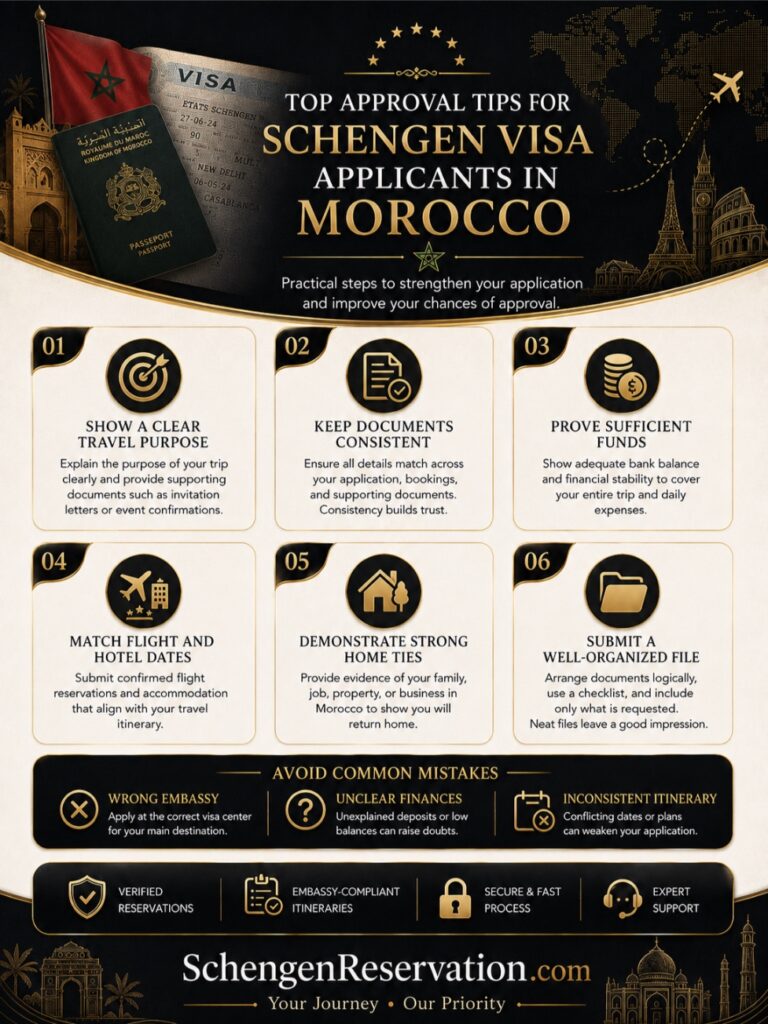
The 48-Hour Final Application Audit
Complete this review two days before the appointment.
Identity Audit
- Is the passport number correct everywhere?
- Are names spelled consistently?
- Are civil-status details accurate?
- Are translations linked to the correct originals?
Date Audit
- Do flights, hotels, insurance and leave dates agree?
- Does every night have accommodation?
- Do event dates fall within the journey?
- Is the passport valid for the required period?
Destination Audit
- Is the selected country genuinely competent?
- Does it contain the most nights?
- Is it central to the main purpose?
- Is the first-entry rule being used correctly?
Finance Audit
- Is the trip affordable?
- Are large deposits documented?
- Is the sponsor clearly identified?
- Do stated income and bank activity agree?
- Are statements complete and recent?
Return-Ties Audit
- Is employment, business or study evidence current?
- Is approved leave included?
- Are obligations after the trip documented?
- Is the intended return date credible?
Purpose Audit
- Does the invitation match the cover letter?
- Is the itinerary feasible?
- Are meetings, activities or family relationships supported?
- Has any unusual circumstance been explained?
Presentation Audit
- Are documents arranged in the checklist order?
- Are photocopies readable?
- Are originals available where required?
- Are unnecessary and contradictory pages removed?
- Is the file easy for an officer to review?
How Schengen Reservation Can Support a Morocco-Based Application
Flight and accommodation documentation often creates difficulty for applicants who do not want to commit substantial money before receiving a decision.
Schengen Reservation can assist travellers who need a structured flight itinerary for visa submission, proof of accommodation or a combined flight-and-hotel reservation package based on their intended route.
A properly organised reservation can help present:
- Intended entry and exit dates
- Main destination
- Passenger information
- One-way, round-trip or multi-city routing
- Cities of stay
- Accommodation dates
- Alignment between transport and lodging
The reservation must still reflect the applicant’s genuine plans. It does not replace:
- Financial evidence
- Travel insurance
- Employment documents
- An invitation
- A cover letter
- Proof of return
- The destination’s official checklist
Schengen Reservation is a private travel-documentation service and does not represent an embassy, consulate, VFS Global, TLScontact, BLS International or any government. A reservation can strengthen the organization of a file, but it cannot guarantee the visa decision.
Frequently Asked Questions
Do Moroccan citizens need a visa for the Schengen area?
Moroccan passport holders generally require a visa for ordinary short visits to the Schengen area unless they qualify under a specific exemption or hold another travel document or status that changes the requirement.
Which Schengen country is easiest for Moroccans?
There is no universally easiest Schengen country. Each application is assessed according to jurisdiction, purpose, finances, travel history and return circumstances.
The appropriate country is the genuine main destination—not the country with the most favourable reputation on social media.
How much bank balance is required?
There is no single balance that guarantees approval across every country and trip.
Required resources depend on:
- Destination
- Number of days
- Accommodation arrangement
- Prepaid expenses
- Number of travellers
- Whether the applicant or host is paying
- Destination-specific daily subsistence rules
The balance should be sufficient, traceable and proportionate to the applicant’s income.
Can another person sponsor my trip?
Yes, where permitted by the destination’s rules. A sponsor may need to provide:
- Signed sponsorship declaration
- Passport or identity document
- Proof of residence
- Employment or business evidence
- Bank statements
- Proof of relationship
- Explanation of the reason for sponsorship
Sponsorship does not remove the need to explain the applicant’s own circumstances and intention to return.
Should I buy a fully paid flight ticket before approval?
Follow the wording of the official checklist. Where it asks for a reservation or itinerary, purchasing a restrictive non-refundable ticket may create unnecessary financial exposure.
A reservation must be genuine, consistent and appropriate for submission. It must not be presented as a paid e-ticket when it is not one.
Can I apply without a travel history?
Yes. Previous travel can support credibility, but it is not a universal legal requirement for a first application.
A first-time traveller should focus on:
- A modest and logical trip
- Clear finances
- Reliable employment or study evidence
- Strong return context
- Complete and consistent documentation
Can an unemployed person obtain a Schengen visa?
Yes, but the file should explain financing and the applicant’s reasons for returning.
A sponsor’s financial capacity, family relationship, personal circumstances and ongoing commitments should be documented clearly.
Can I apply from a city outside my consular jurisdiction?
Not always. Spain, France, Portugal and other destinations may allocate applicants according to residence or consular district.
An available appointment in another city does not necessarily mean that the centre is authorised to accept the file.
How long does Schengen visa processing take in Morocco?
The standard legal decision period is commonly 15 calendar days for an admissible application, but individual cases can take longer when additional examination, consultation or documents are required.
Applicants should also allow time for appointment availability and passport transportation.
Can I keep my passport during processing?
This depends on the embassy and provider. Some routes may offer a passport-retention or temporary-withdrawal arrangement under specific conditions, while others require the passport to remain with the application.
Check before submission if another journey is planned.
Does a valid visa guarantee entry?
No. Border authorities may ask the traveller to demonstrate:
- Purpose of visit
- Accommodation
- Return or onward travel
- Sufficient funds
- Insurance
- Compliance with the visa conditions
Since 10 April 2026, the EU Entry/Exit System has been fully operational for relevant short-stay border crossings, digitally recording entry, exit and refusal information alongside traveller data.
Can I change my hotels after the visa is issued?
Reasonable changes can occur, but the revised journey should remain compatible with the country that issued the visa and the declared main destination.
A complete change that removes the issuing country can raise questions about whether the original application was genuine.
What should I do after a refusal?
Read the refusal notice carefully and identify the stated grounds.
Then decide whether to:
- Appeal within the permitted deadline
- Submit a materially improved application
- Postpone the journey
- Correct the destination or purpose
- Provide missing financial or return evidence
Do not immediately resubmit an identical file.
Final Approval-Focused Checklist
Before submitting a Schengen visa application from Morocco, confirm that:
- The correct country has been selected
- The correct visa type has been chosen
- The passport meets validity rules
- The form is complete and signed
- Photographs meet current specifications
- Legal residence in Morocco is established
- Insurance covers the whole journey
- Transport and accommodation dates agree
- The main destination is evident
- Every night is accounted for
- The financial plan is realistic
- Large transactions are explained
- Employment, business or study evidence is current
- The travel purpose is documented
- Return ties are credible
- Sponsor evidence is complete where applicable
- Civil-status records are consistent
- Minor consent documents are included
- Previous refusals are addressed truthfully
- Documents are genuine and verifiable
- The file follows the official checklist order
Conclusion
A well-prepared Schengen visa application from Morocco is not defined by the number of pages it contains. Its strength comes from clarity, authenticity and internal agreement.
The consulate should be able to follow a simple, credible sequence:
- This is who the applicant is.
- This is why the applicant is travelling.
- This is the country responsible for the application.
- This is where the applicant will stay.
- This is how the trip will be financed.
- This is why the applicant will return to Morocco.
Applicants who choose the proper submission route, use authentic reservations, explain their finances and align every document with the same genuine journey give the consular authority a coherent file to assess.
That is the practical meaning of an approval-ready application: not a promise of success, but a carefully evidenced request with no unnecessary contradictions, omissions or manufactured claims.