

Choosing where to apply for a Schengen visa is no longer a small procedural detail. For many travelers, it has become one of the most strategic parts of the process. Applicants increasingly want to know which Schengen countries look more approval-friendly, which destinations seem to process stronger volumes of successful applications, and which states may offer a more realistic route for first-time or cautious travelers in 2026. That interest is not based on guesswork alone. Official Schengen visa statistics do show that some destination countries consistently record lower refusal rates than others.
At the same time, no Schengen state can guarantee a visa. The Schengen area operates under a common short-stay visa framework, and every application is still judged on the quality of the file presented: travel purpose, finances, route structure, proof of accommodation, and the overall logic of the journey. A country can be statistically favorable, yet a weak file can still fail there. A country can also be statistically less forgiving, yet a highly organized file can still succeed. The point of this article is therefore not to oversimplify the process. It is to read the official numbers intelligently and to place them inside a practical travel context.
This guide uses the latest official destination-country Schengen short-stay visa statistics available in 2026, which are the 2024 figures published by the European Commission in 2025. According to the Commission, EU and Schengen-associated countries received more than 11.7 million short-stay visa applications in 2024, issued more than 9.7 million visas, and recorded a worldwide refusal rate of 14.8%. The same official summary notes that the biggest origin markets were China, Turkey, India, Morocco, and Russia, which helps explain where application pressure is highest.
What follows is a full formal ranking of the top 12 Schengen countries that appear more approval-friendly heading into 2026, together with a practical explanation of what each destination offers from a travel-planning perspective. This is followed by a second data section on the 12 origin countries that apply the most, showing where those applicants were most heavily accepted, then a detailed explanation of how travelers can strengthen their own files through smarter planning, stronger travel documentation, and more coherent visa preparation. The goal is not only to identify the easiest countries statistically, but also to understand which ones make the most sense in real-world application strategy.
What “easy” and “fast” really mean in Schengen visa terms
In serious visa analysis, the word easy should never be confused with automatic. A destination country with a lower refusal rate is not offering guaranteed approval. What it is offering, at least in statistical terms, is a more favorable approval environment. That distinction matters because many travelers misunderstand rankings like this one. A lower refusal rate does not remove the need for proper documentation; it simply means that the broader approval climate is more encouraging than in a country with a significantly higher refusal share.
The word fast also needs precision. Under the Schengen Visa Code, admissible short-stay applications are generally decided within 15 calendar days, and that period may be extended often up to 45 calendar days in cases where additional scrutiny or further documentation is needed. There is therefore no official Schengen list of countries that lawfully promise “instant approval.” In practice, when travelers talk about fast approval, they usually mean a destination where the case can move more smoothly because the file is clear, the category is appropriate, and the application does not trigger avoidable doubts.
That means the smartest use of Schengen approval statistics is not to hunt for shortcuts. It is to make better decisions. If two countries could both fit your trip, statistics can help you decide which destination seems more approval-friendly. If only one country genuinely matches your route, then the solution is not to manipulate the destination. It is to improve the file. Rankings are useful. They are not magical.
Why the latest official data matters in 2026
As of 2026, the latest destination-country figures published by the European Commission are the 2024 short-stay visa statistics released in 2025. The Commission’s visa statistics page also notes that Bulgaria and Romania started issuing Schengen visas as of 31 March 2024, which is important when reading newer data for those countries. Their presence in the current ranking is therefore both statistically and procedurally significant.
Top 12 Schengen countries with the strongest approval climate
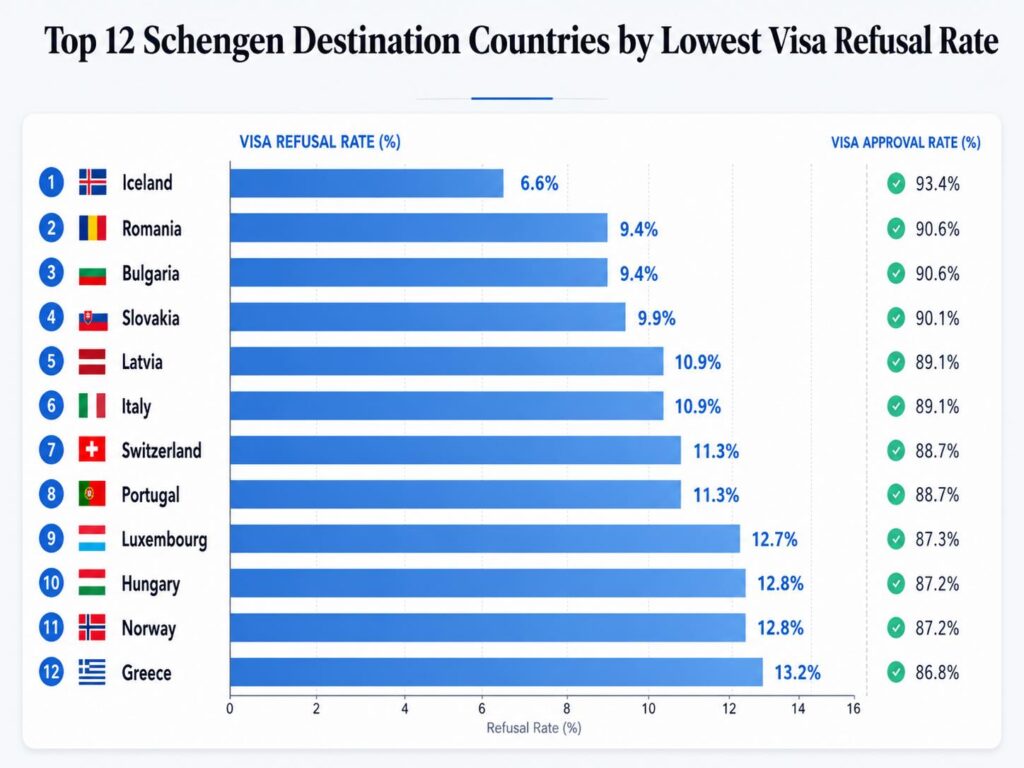
The table below is based on the European Commission’s official 2024 destination-country Schengen visa statistics. The approximate approval rate is calculated by subtracting the official refusal or “not issued” rate from 100%. This provides a practical destination-level ranking for travelers planning in 2026.
| Rank | Schengen country | Applications | Refusal rate | Approx. approval rate |
| 1 | Iceland | 35,413 | 6.6% | 93.4% |
| 2 | Romania | 35,359 | 9.4% | 90.6% |
| 3 | Bulgaria | 122,229 | 9.4% | 90.6% |
| 4 | Slovakia | 14,215 | 9.9% | 90.1% |
| 5 | Latvia | 17,654 | 10.9% | 89.1% |
| 6 | Italy | 1,233,316 | 10.9% | 89.1% |
| 7 | Switzerland | 636,077 | 11.3% | 88.7% |
| 8 | Portugal | 206,420 | 11.3% | 88.7% |
| 9 | Luxembourg | 13,007 | 12.7% | 87.3% |
| 10 | Hungary | 251,364 | 12.8% | 87.2% |
| 11 | Norway | 149,988 | 12.8% | 87.2% |
| 12 | Greece | 710,024 | 13.2% | 86.8% |
Reference: European Commission, Short-stay visas issued by Schengen countries (2024 destination-country statistics, published in 2025).
This ranking reveals an important split. Some countries near the top are small-volume leaders, while others combine high approval rates with far heavier application traffic. For many travelers, that second category is especially important because it reflects a friendlier approval environment at a scale closer to real-world demand. Countries like Italy, Switzerland, Portugal, Hungary, and Greece therefore deserve more weight in practical planning than a ranking alone might suggest.
Top 12 origin countries that apply the most – and where they were most often approved
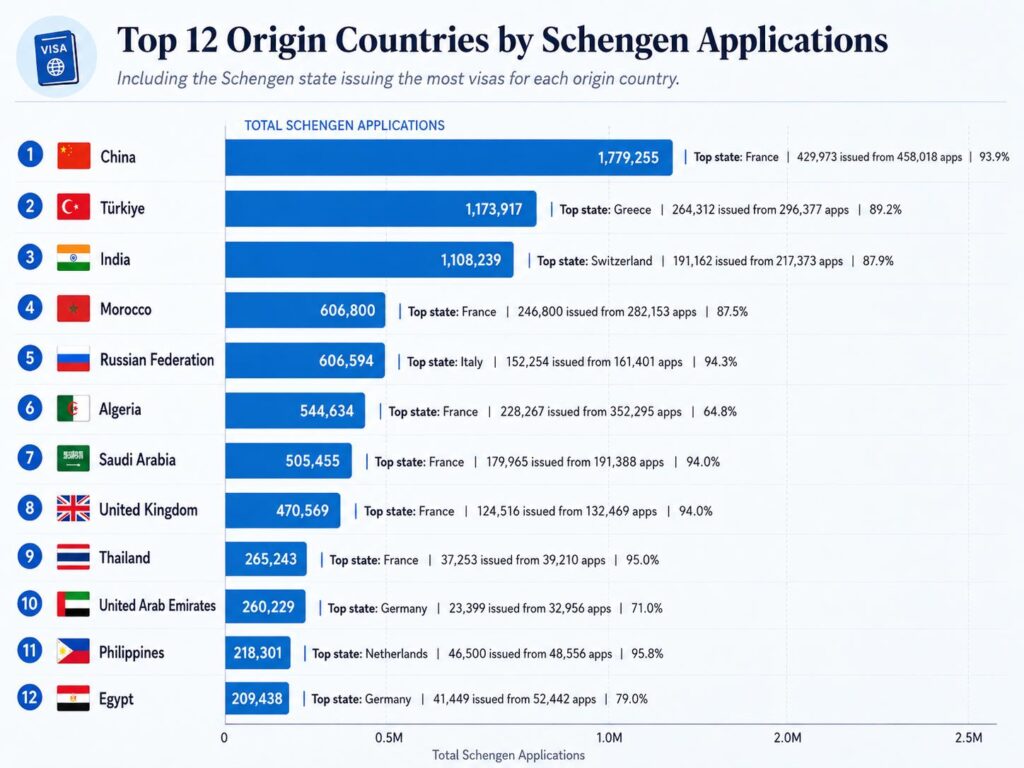
Looking only at approval-friendly Schengen destinations tells only half the story. To make this ranking more useful for actual applicants, it is equally important to examine the major origin markets that submit the highest number of Schengen visa applications and then identify the Schengen states that issued the largest number of visas to those applicants. This creates a more practical picture of demand and acceptance together. Instead of showing only which Schengen country has a favorable refusal rate overall, the list below also helps explain where applicants from high-volume countries such as China, Turkey, India, Morocco, and Russia were most frequently granted visas. In other words, it connects the strongest applicant markets with the destination states that processed and approved the highest number of their applications, making the broader ranking more relevant for readers who want to understand not just where approval rates are strong, but which Schengen routes appear to work most successfully for the world’s busiest visa-origin countries.
| Origin country / market | Total Schengen applications (2024) | Schengen state with most visas issued | Applications to that state | Visas issued by that state | Approx. approval rate for that state pair |
| China | 1,779,255 | France | 458,018 | 429,973 | 93.9% |
| Türkiye | 1,173,917 | Greece | 296,377 | 264,312 | 89.2% |
| India | 1,108,239 | Switzerland | 217,373 | 191,162 | 87.9% |
| Morocco | 606,800 | France | 282,153 | 246,800 | 87.5% |
| Russian Federation | 606,594 | Italy | 161,401 | 152,254 | 94.3% |
| Algeria | 544,634 | France | 352,295 | 228,267 | 64.8% |
| Saudi Arabia | 505,455 | France | 191,388 | 179,965 | 94.0% |
| United Kingdom | 470,569 | France | 132,469 | 124,516 | 94.0% |
| Thailand | 265,243 | France | 39,210 | 37,253 | 95.0% |
| United Arab Emirates | 260,229 | Germany | 32,956 | 23,399 | 71.0% |
| Philippines | 218,301 | Netherlands | 48,556 | 46,500 | 95.8% |
| Egypt | 209,438 | Germany | 52,442 | 41,449 | 79.0% |
Reference: European Commission short-stay visa statistics page and downloadable 2024 consulates dataset linked there; top-origin-market context also summarized in the Commission’s 2025 news update.
This table is particularly useful because it explains clearly: not only who applies the most, but also which destination country those applicants were most successfully accepted through in the largest numbers. For example, applicants in China were approved most heavily through France, applicants in India through Switzerland, applicants in Russia through Italy, applicants in Turkey through Greece, and applicants in the Philippines through the Netherlands. That does not mean those are the only valid routes for those origin markets. It means that, in the official 2024 data, those destination-country pairings were the largest issuing channels.
Country Profiles: The Top 12 Schengen States with Favorable Approval Rates
1) Iceland
Iceland ranks first in this list with 35,413 applications, a 6.6% refusal rate, and an approximate 93.4% approval rate. This gives it the strongest approval profile among the top 12 Schengen countries.
From a travel perspective, Iceland is also easy to present in a visa file because the trip usually has a very clear structure. Most short itineraries naturally revolve around Reykjavík, the Golden Circle, waterfalls, geothermal attractions, and nature-based experiences. That makes the destination easier to explain and the travel plan easier to organize. Iceland should not be chosen only because of its high approval rate, but when it is the genuine main destination, it offers one of the best combinations of strong statistics and clear travel logic.
2) Romania
Romania holds second place with 35,359 applications, a 9.4% refusal rate, and an approximate 90.6% approval rate. Statistically, it is one of the most approval-friendly Schengen destinations in the current ranking.
Romania is also easier to justify than many applicants expect. A well-structured route can include Bucharest, Brașov, Sibiu, and Sighișoara, combining city travel, history, and culture in a way that feels natural rather than overcomplicated. This makes Romania a strong choice for travelers who want a destination that is both distinctive and manageable. Its tourism profile supports a file that feels coherent and well planned.
3) Bulgaria
Bulgaria also records a 9.4% refusal rate and an approximate 90.6% approval rate, but with a larger application volume of 122,229. That gives its approval strength more practical weight than some lower-volume destinations.
What makes Bulgaria especially useful is its range. A traveler can build a file around Sofia, Plovdiv, mountain resorts, spa travel, seaside destinations, or cultural routes. This flexibility is helpful because the destination can support different travel purposes without making the itinerary feel weak or confused. Bulgaria therefore stands out as both statistically strong and practically versatile.
4) Slovakia
Slovakia appears fourth with 14,215 applications, a 9.9% refusal rate, and an approximate 90.1% approval rate. Its numbers are very strong, even though the total number of applications is lower than in many larger Schengen states.
One of Slovakia’s main advantages is simplicity. A short-stay route built around Bratislava and nearby cultural or historical attractions can look highly organized without needing to be elaborate. Slovakia suits travelers who prefer compact itineraries, city breaks, and lower-profile destinations. That makes it one of the easiest countries in this ranking to present in a calm and proportionate way.
5) Latvia
Latvia ranks fifth with 17,654 applications, a 10.9% refusal rate, and an approximate 89.1% approval rate. Although it is a smaller-volume destination, its approval profile remains clearly favorable.
From a travel point of view, Latvia works especially well because Riga provides a strong and elegant anchor for a short trip. The destination can also include places such as Jūrmala, Kuldīga, and Gauja National Park, which add variety without making the route feel crowded. Latvia is therefore a strong option for applicants who want a refined, culturally rich destination with a clear itinerary structure.
6) Italy
Italy is one of the most important countries in the ranking because it combines strong approval numbers with very high demand. It received 1,233,316 applications, recorded a 10.9% refusal rate, and achieved an approximate 89.1% approval rate.
This is what makes Italy especially persuasive. It is not only statistically strong — it is also one of the easiest countries to explain in a visa file. Routes built around Rome, Florence, Venice, Milan, Naples, or the Amalfi Coast are naturally understandable and highly believable. For first-time applicants in particular, Italy is one of the strongest choices because it combines high application volume, a strong approval environment, and a very clear tourism identity.
7) Switzerland
Switzerland ranks seventh with 636,077 applications, an 11.3% refusal rate, and an approximate 88.7% approval rate. These are very strong figures, especially given the country’s large volume of applications.
Switzerland also benefits from a naturally structured travel identity. An itinerary built around Zurich, Lucerne, Interlaken, lakes, alpine towns, or scenic train routes often looks precise and easy to follow. That said, Switzerland usually requires a realistic financial profile because it is widely seen as a premium destination. When the budget and itinerary match the destination properly, Switzerland becomes one of the most elegant and approval-friendly Schengen options in 2026.
8) Portugal
Portugal also shows an approximate 88.7% approval rate, with 206,420 applications and an 11.3% refusal rate. This places it among the strongest mid-to-large volume destinations in the ranking.
Portugal is especially attractive because it supports simple and convincing tourism files. A trip centered on Lisbon, Porto, coastal routes, or a relaxed city-and-culture stay is easy to justify and easy to organize. The destination does not usually require an overcomplicated travel story. That makes Portugal one of the most naturally coherent Schengen choices for applicants who want both statistical strength and practical simplicity.
9) Luxembourg
Luxembourg ranks ninth with 13,007 applications, a 12.7% refusal rate, and an approximate 87.3% approval rate. Even though the application volume is smaller, its refusal profile remains very strong by Schengen standards.
Luxembourg works particularly well for short, focused itineraries. A route built around Luxembourg City can feel compact, polished, and highly readable, especially for business travel, private visits, or short cultural stays. This is one of the reasons Luxembourg performs well in approval terms: the destination often supports a concise and easily understandable travel plan.
10) Hungary
Hungary records 251,364 applications, a 12.8% refusal rate, and an approximate 87.2% approval rate. That makes it one of the stronger mid-volume performers in the current ranking.
The country’s main practical advantage is how naturally a tourism file can be built around Budapest. The city offers architecture, history, thermal baths, food, and cultural appeal in a way that is immediately recognizable. Hungary is therefore one of the easiest destinations in this list to explain clearly. It may not always be the first country applicants think of, but it is one of the most usable in real visa planning.
11) Norway
Norway also shows an approximate 87.2% approval rate, with 149,988 applications and a 12.8% refusal rate. Its numbers place it among the stronger Schengen destinations, even if it is more specific in travel style than some others in the list.
Norway is best suited to travelers whose itinerary genuinely revolves around fjords, scenic routes, Tromsø, northern lights, or other nature-led travel. It is not a generic destination, and that can actually be an advantage. When the route, budget, and purpose all align with Norway’s landscape-focused identity, the application can feel very convincing. For the right traveler, Norway is both statistically strong and narratively clear.
12) Greece
Greece completes the top 12 with 710,024 applications, a 13.2% refusal rate, and an approximate 86.8% approval rate. Although it stands twelfth rather than sixth, it remains one of the strongest high-volume destinations in the Schengen area.
Greece is also one of the easiest countries to explain from a tourism perspective. A route centered on Athens, Santorini, Mykonos, Crete, or Thessaloniki is highly familiar and naturally appealing. This matters because the easier a destination is to imagine, the easier it is to present clearly in a visa file. Greece therefore remains one of the most practical approval-friendly countries in 2026, especially for applicants planning a straightforward tourism trip.

Which countries feel strongest in real life, not just on paper?
The rankings alone do not answer the whole question. Some destinations are statistically elite but itinerary-sensitive – Iceland, Slovakia, Latvia, Luxembourg, and, in many cases, Romania. These countries are extremely attractive in the data, but they work best when the itinerary genuinely belongs there.
Others are statistically strong and broadly practical – especially Italy, Switzerland, Portugal, Hungary, Greece, and Bulgaria. These countries combine favorable refusal profiles with travel experiences that are easy to justify, easy to organize, and easy to explain in an application. For many ordinary travelers, this second group is more useful than the pure ranking leaders.
That is why the smartest visa question is not simply, “Which country is easiest?” It is, “Which country is statistically favorable and genuinely fits the trip I intend to take?” A country becomes more useful when both answers point in the same direction.
What the numbers do not show – and why that still matters
Approval statistics are valuable, but they do not tell the entire visa story. They do not reveal whether your itinerary is realistic, whether your accommodation dates align with your route, whether your budget matches the destination, or whether your travel purpose is expressed with sufficient clarity. Those are all questions that live inside the file itself.
This is one reason many applicants become confused by refusal outcomes. They may have chosen a country with good approval numbers, but the file itself still looked uncertain. The purpose of travel was weakly explained. The route looked vague. The stay details did not align with the trip. The financial evidence did not support the scale of the visit. When that happens, the country’s statistics stop being helpful because the application never reaches the point of feeling completely credible.
A stronger strategy is to use country rankings as a filter, not as a fantasy. If two destinations both fit the same travel purpose, the numbers may help you choose the more approval-friendly route. But if only one country truly makes sense for the trip, no ranking should tempt you into building an artificial application around the wrong destination.
How Schengen Reservation can fit into that process
This is where Schengen Reservation can fit into the process in a natural and practical way. Many applicants do not struggle most with the visa form itself. They struggle with the travel architecture of the file – the part that shows how the trip is expected to happen in real terms.
If the route side of the application still feels uncertain, a clear flight itinerary for visa can help show intended movement more coherently. If the accommodation side is missing or fragmented, a hotel booking for visa or broader proof of accommodation support can help the stay plan make sense. If both elements still need coordination, using one source to align the route and the accommodation can make the full file easier to read. The point is not to turn reservation support into the whole application. It is to make the application more intelligible. A good file reads like one journey, not a pile of disconnected documents.
Tips on How to Increase Your Chances of Getting a Visa
Let the destination match the actual trip
Do not choose a country purely because it ranked well if the real route, duration, or purpose clearly point somewhere else. A file is stronger when the main destination makes immediate sense.
Build an itinerary that reads clearly
A Schengen application should not feel vague. Entry point, exit point, dates, and general movement should support one another without confusion. A clean route is one of the easiest ways to make the application feel more serious.
Keep accommodation aligned with the route
If your hotel dates do not support your travel dates, the file starts to weaken quietly. This is why proof of accommodation matters far more than many applicants initially assume.
Treat travel-support documents as part of the application logic
A good flight itinerary helps show intended movement. A good hotel booking helps show where the traveler will stay. Together, they make the route and stay pattern easier to trust.
Use reservation support intelligently where needed
If the travel side of the application still feels incomplete, Schengen Reservation can be used for a flight itinerary, a hotel booking, or both together. The goal is not to add papers for their own sake. It is to help the file read more coherently.
Keep finances proportionate to the destination
A trip to Switzerland or Norway should usually be supported by finances that realistically match those destinations. The more polished the trip sounds, the more important it becomes for the budget to support it.
Apply with enough time in hand
Even when travelers search for “fast” approval, the legal rhythm still matters. Admissible applications are generally decided within 15 calendar days, but some cases take longer. Time is not a luxury in visa preparation; it is part of the structure.
Read your own file before submission
Know your dates, your route, your accommodation, and your purpose of travel without hesitation. One of the easiest ways to weaken a decent file is to sound unfamiliar with your own plans.
FAQs
Which Schengen country has the highest approval rate in the latest official data?
Based on the latest official destination-country figures available in 2026, Iceland has the strongest approval profile, with an approximate approval rate of 93.4% in the 2024 data published by the European Commission in 2025.
Which country is the best practical choice for first-time applicants?
For many first-time travelers, Italy is one of the strongest practical choices because it combines excellent approval statistics with a very large application volume and a naturally coherent tourism itinerary. Portugal, Greece, and Hungary are also strong practical options.
Does a lower refusal rate guarantee approval?
No. A lower refusal rate creates a more favorable approval environment, but the final outcome still depends on the strength and coherence of the individual application.
Are smaller Schengen countries always easier than larger ones?
Not necessarily. Smaller countries like Latvia or Luxembourg may rank very strongly on paper, but larger destinations such as Italy, Switzerland, and Portugal may be more practical because their travel logic is easier for many applicants to justify and their approval profiles remain strong at scale.
What really makes a Schengen application stronger?
A clear purpose of travel, a believable budget, a readable itinerary, aligned accommodation, and a sensible return logic are usually the foundations of a stronger visa file.
Do flight itineraries and hotel bookings really matter?
Yes. They help the file read more clearly. A flight itinerary shows intended movement, while a hotel booking or other accommodation proof shows where the traveler plans to stay. Together, they improve the application’s internal logic.
Can Schengen Reservation help with this kind of preparation?
Yes. If the route or stay side of the application still needs structure, Schengen Reservation can be used for a flight itinerary, a hotel booking, or both together in one coordinated format.
What does “fast approval” really mean in Schengen practice?
In practical terms, it usually means the application moved smoothly through the ordinary legal timeline without triggering extra scrutiny. Under the Schengen rules, admissible applications are generally decided within 15 calendar days, though some cases may take longer.
Conclusion
The search for the easiest Schengen countries to get visa approval in 2026 is a reasonable starting point for visa planning. The latest official numbers clearly show that some destinations are statistically more approval-friendly than others, with Iceland, Romania, Bulgaria, Slovakia, Latvia, Italy, Switzerland, Portugal, Luxembourg, Hungary, Norway, and Greece standing out in the current ranking.
But the most useful conclusion is not to chase a percentage blindly. It is to choose the destination that genuinely fits the real trip and then present that trip in the clearest possible way. A favorable approval environment helps, but it only works in your favor when the itinerary, accommodation, financial story, and travel purpose all move in the same direction.
In the end, the easiest Schengen visa country is not simply the one with the lowest refusal rate. It is the one where your actual journey and the approval climate meet naturally — and where your application is strong enough to make that journey believable.